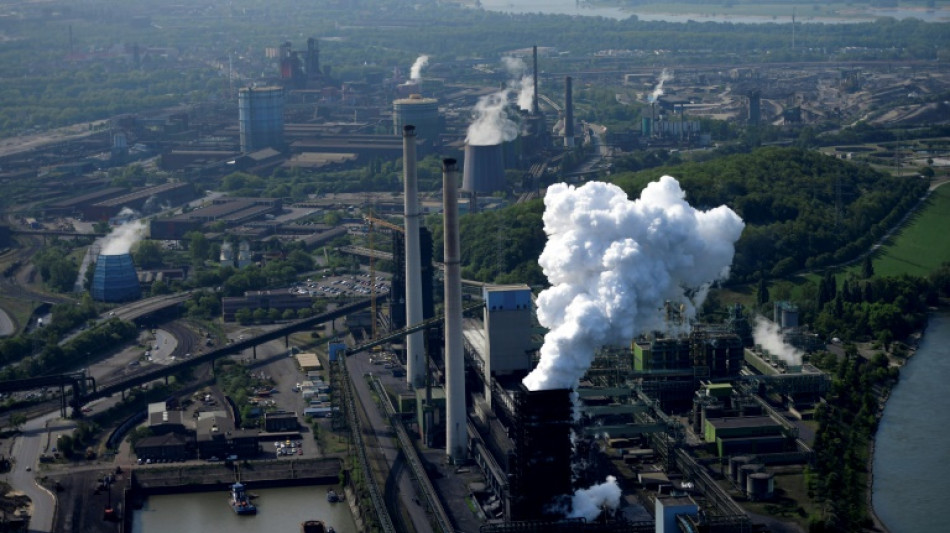
Germany factory output falls to lowest since pandemic in 2020 / Photo: Ina FASSBENDER - AFP

 Venezuela govt, opposition wrap up round of post-Maduro talks

 Five things to know about Zambia as it goes to the polls

 Nakashima holds off Jodar to book first ATP Masters final in Montreal

 Trump 'low-key' bets on economic pressure against Iran

 Pitch invaders take selfies with Fernandes during Man Utd friendly

 No-stress Sabalenka won't fret over lackluster 2026 results

 Hometown hero Hudson-Smith basks in Euro glory

 PSG down Aston Villa to retain UEFA Super Cup

 Trump's spokesperson Karoline Leavitt to step down

 'Imposing ignorance': US climate science under siege

 As millions gazed in awe, a swathe of Spain plunged into darkness

 Xavi named first foreign Netherlands coach since 1978

 NBA triple-double king Westbrook to retire after 18 seasons

 'Trying to bury the science': US climate research under siege

 Eurovision to bar countries at war from hosting

 Italian teenager Curtis breaks 50m backstroke world record at Europeans

 New mum Sjostrom wins 50m butterfly for 18th European gold
 Solar eclipse darkens Arctic Russia on course for Spain

 Russian economy rebounds in second quarter despite Ukrainian strikes

 NBA's Los Angeles Lakers to be sold for $12.5 bn: ESPN

 Trump sued over sale of access to Truth Social posts

 Europe looks to the skies as solar eclipse cast its shadow
 At least 44 drown after ferry overturns on Zimbabwe's Lake Kariba

 Grieving Argentine icon Messi unsure about playing on 'much longer'

 Nigeria kidnap victims escape 'hellfire' captivity beaten, malnourished

German industrial production slumped in June to its lowest level since the pandemic in 2020, data showed Thursday, underlining the fragility of Europe's top economy even before US President Donald Trump's new tariffs kicked in.
Factory output fell 1.9 percent month-on-month, federal statistics agency Destatis said, steeper than a drop of 0.5 percent forecast by analysts polled by financial data firm FactSet.
There were particularly heavy falls in the machinery and pharmaceutical sectors, helping to drag overall output down to levels last seen in May 2020 during the coronavirus pandemic.
Destatis also made a major revision to May industrial production data, saying the indicator fell 0.1 percent. It had previously reported a healthy rise of 1.2 percent.
ING bank analyst Carsten Brzeski said the dire data could prompt a downward revision to an already poor initial estimate showing that the economy shrank slightly in the second quarter.
"This is bad news," he said. "At face value, industry remains stuck in a very long bottoming out."
- Political setback -
Fixing the eurozone's traditional export powerhouse has been a key priority for Germany's conservative Chancellor Friedrich Merz, with the economy battered in recent years by high energy costs and fierce Chinese competition.
Plans to spend hundreds of billions of euros on infrastructure upgrades and rearmament -- combined with a series of brighter data releases since the start of the year -- had raised hopes that the worst might be over for Europe's export champion.
German business morale rose to its highest level in July after seven straight increases, while think tanks including the respected DIW institute have revised growth forecasts up for 2025 and 2026.
But hard data on business activity has been mixed, raising fears that the improved mood was down to unfounded optimism.
Some experts say better data early in the year was the temporary effect of US "front-loading" as American customers rushed to get orders in before Trump's tariffs took effect.
"Optimism still seems to be based on a big portion of wishful thinking and is not at all matched by current data," Brzeski said.
"For now, what looked like a cyclical rebound in the making has only been US front-loading."
Pointing to increased investment and an uptick in retail sales, however, Berenberg analyst Holger Schmieding said there were signs of green shoots for the German economy.
"The situation at home seems to be stabilising," he said. "German consumers are opening their wallets at least cautiously."
- Tariff troubles -
A new baseline US levy of 15 percent on EU exports took effect Thursday, up from 10 percent in effect since April, stiffening the tariff faced by Germany's exporters even while leaving many of them mired in uncertainty.
Export data released Thursday showed that German exports in June to the United States -- the country's biggest trading partner -- fell 2.1 percent, even as they rose 0.8 percent worldwide.
And data released Wednesday showed that industrial orders -- closely watched as an indicator of future business activity -- fell 1.0 percent month-on-month in June, after dropping 0.8 percent in May.
The United States is also carrying out investigations into sectors including pharmaceuticals and semiconductor equipment, heightening worries about worse to come.
"The tariffs are a big burden for German companies," the head of the German chambers of commerce, Helena Melnikov, told AFP. "Don't forget that tariffs were usually between zero and about two percent at the most beforehand."
"It could even come out worse for a variety of sectors because negotiations are ongoing," she added. "It is a real setback and makes it harder to do business in Germany."
S.Caetano--PC