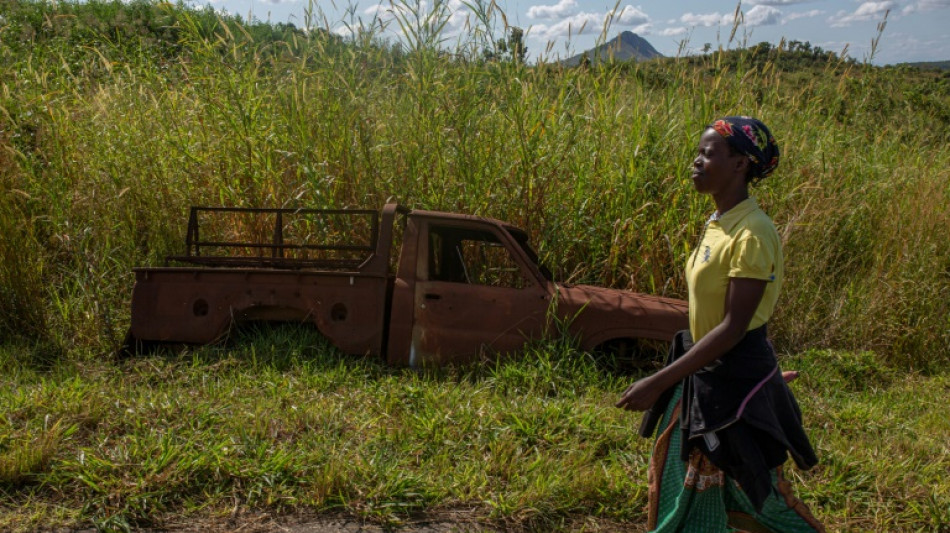
Mozambique still haunted by civil war as new conflict rages / Photo: Alfredo Zuniga - AFP

 Former Peru minister last-minute contender for UN labour agency helm

 Messi legacy will 'live forever', says Beckham

 'Literally tasting the smoke': Malaysians suffer as haze worsens

 Kyiv's defences, 'hybrid' threat from Moscow headline EU talks
 Oil extends gains, stocks mostly down as Trump issues fresh Iran warning

 ThinkMarkets Expands Weekend Trading Offering, Launches Weekend League Competition

 Tibet activists accuse China of downplaying floods
 Afghanistan war victims left 'without justice', UN says

 Iran president offers US olive branch before Putin meeting

 China-Nepal flood toll tops 1,000 as tunnel rescue offers last hope

 Japan to relax overtime regulation under workaholic PM

 Thwarted Niger mutiny exposes junta's Russia dependence

 Illegal mining ravages S.Africa's economic hub
 Nepal's wall of missing offers last hope after Himalayan flood

 US to press G20 on light-touch AI regulation

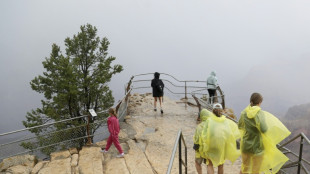
 2 die in Grand Canyon flash flood, only 1 person unaccounted for

 US Army Secretary Driscoll submits resignation: White House
 Oil extends gains, stocks drop as Trump issues fresh Iran warning

 Tsitsipas says Kyrgios's positive cocaine test 'kind of expected'

 In Japan's mountains, a different way to manage bears

 Middle East war a boon for UAE defence giant with global ambitions

 Former gang member found guilty of murdering Tupac Shakur
 Top-seeded Zverev opens US Open campaign
 US regulator, 22 states accuse Amazon of 'manipulating' ad auctions: lawsuit

 TRON Founder Justin Sun Shares Outlook on Bitcoin, Stablecoins and Global Finance at Bitcoin Asia 2026

As Mozambique battles a brutal Islamist insurgency, the legacy of a decades-long civil war still haunts the African nation where many former rebels refuse to disarm.
"It's hard to live alone, with nothing, living without family nearby," said Aurelio Capece Mudiua, who demobilised in 2020 after nearly four decades hiding around the Gorongosa mountains.
"Some of us had children, and they (the fighters) died here without getting to see them," he said. "I want to tell the others, who are still in the mountains, come join us."
This area of central Mozambique was a bastion of RENAMO, the rebel movement that battled the government for decades.
Burned-out carcasses of pickups, already overgrown with tall grass, still dot the landscape, vestiges of another time.
Most of the current violence is about 1,000 kilometres (621 miles) to the north. When the Islamists took up arms in 2017, RENAMO was still at war with the government, led by the rival FRELIMO party.
Most of the RENAMO rebels are now too old to take up arms, with an average age of 55. But they face an uncertain future in one of the poorest countries in the world.
When Mozambique won independence in 1975, after a decade of fighting colonial master Portugal, the country was plunged into a civil war that served as a Cold War proxy battle.
The United States, apartheid South Africa, and white-ruled Rhodesia supported RENAMO, while the Soviets backed FRELIMO.
The war claimed a million lives, decimated the economy and left the nation littered with landmines.
- We 'want peace' -
After a 1992 peace deal, RENAMO turned into a political party but never won a national election. In 2013, they took up arms again, until a new deal was signed in 2019.
"There's no one in RENAMO who doesn't want peace," said Antonio Muchanga, one of the party's lawmakers.
Nearly two-thirds of RENAMO fighters have surrendered their weapons since 2020, and 11 of the movement's 16 bases have been closed, according to official statistics.
But on the ground, observers say Mozambique suffers from problems experienced in many other post-war countries.
"The fighters have mostly turned in old hunting weapons," said one humanitarian worker, who spoke on condition of anonymity.
Everyone who demobilised received about $2,000 to help them start a new life. Like most of the ex-fighters, Aurelio spent his payout quickly and yearns to receive a pension.
Under the peace deal, RENAMO fighters should receive the same pensions as their FRELIMO counterparts. But many are still waiting for them, which they see as a sign of the government's bad faith.
"If the government gave me money, I would do my best to help my family, build a house, many things," Aurelio said.
"But the government still hasn't given us money. The payout is finished and we are now waiting at home, with nothing."
Disarmament "can't work if people are only given money", said Zenaida Machado, a researcher for Human Rights Watch. "They also need to be given the tools to reintegrate into their communities and to become self-sufficient."
The real problem is simply financial, said Mirko Manzoni, the UN representative in Mozambique credited with crafting the latest peace deal.
"Mozambique's government has a limited budget, with enormous needs. On top of that is a constant burden, the financing of the combatants' pensions," he said.
A new law is in the works to finance and harmonise the pensions.
"The discussions have taken two and a half years. The first ones who demobilised have already used up their packages a year ago already," Manzoni said.
He hopes the law will be approved before the end of the year.
"The combatants have to understand that not only do they have rights, but they also have a duty to share in the suffering of the rest of the population. Most Mozambicans have no pension," Manzoni said.
Civilians are the forgotten victims of the war. Both sides committed horrific violence, but the peace deals offered a general amnesty, and the victims have practically no hope for justice.
"Both sides fought for a cause they believed to be just," Manzoni said. "The best justice is development, within a system where people feel included."
F.Cardoso--PC