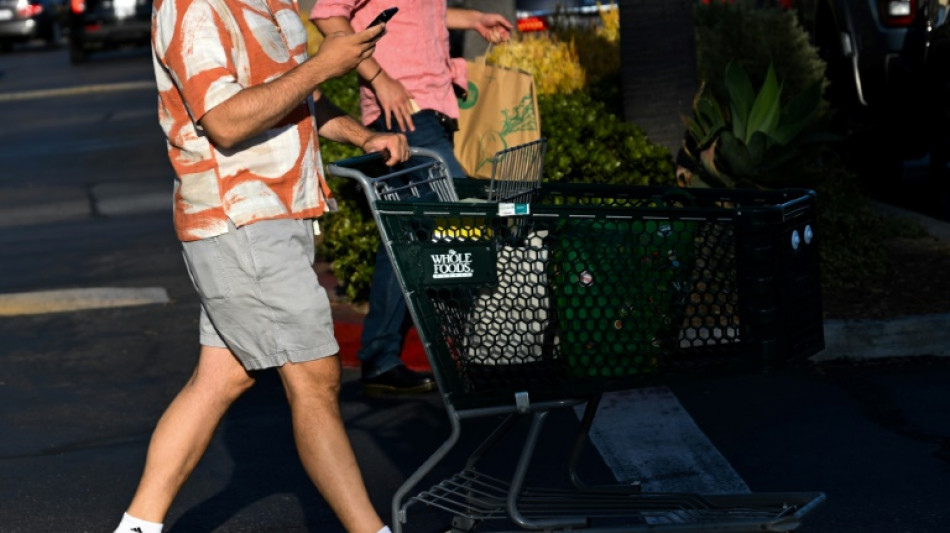
US consumer inflation holds steady but tariff worries persist / Photo: Patrick T. Fallon - AFP/File

 Best Pet Advent Calendars for Christmas 2026: Dog Treats and Cat Toys

 Grattan Institute Releases Blueprint to Target Specialists Over Excessive Fees

 Arizona Science Center Hosts Girls in STEM Astro Adventures for Students

 New Turkish Cafe, Japanese BBQ, and Korean Restaurants Open Across East Bay

 Knowle Move Four Points Clear at Top After Histon Victory

 Physicians Urge Arizona to Ban Medical Gag Clauses and Enable Private Lawsuits

 New Campaign Highlights Knowledge Gaps on Carbon Monoxide Safety Among Americans

Consumer inflation in the United States held steady in July, data showed Tuesday, but underlying price increases picked up as President Donald Trump's sweeping tariffs ripple through the world's biggest economy.
The consumer price index (CPI) rose 2.7 percent from a year ago in July, the same rate as in June, said the Department of Labor.
But, excluding the volatile food and energy segments, "core" CPI accelerated to 0.3 percent on a month-on-month basis last month, up from a 0.2-percent rise before, the CPI report said.
From a year ago, underlying inflation rose 3.1 percent, picking up pace too.
Analysts are closely watching CPI amid increasing fears over the reliability of economic data from the Trump administration, which fired the head of the Bureau of Labor Statistics recently after a jobs report showed significantly lower hiring numbers.
They are also watching closely for weakening amid Trump's trade war, as he tries to reshape the global economy.
He has ordered a 10-percent tariff on goods from almost all trading partners. For dozens of economies including Japan, South Korea and the European Union, this level rose to various higher rates last Thursday.
Sectors that have been targeted individually -- or are under investigation by officials -- have been spared from these countrywide levies so far. But Trump has been progressively imposing steep duties on different sectors.
The headline CPI figure was a touch lower than the 2.8-percent rate expected in a median forecast of analysts surveyed by Dow Jones Newswires and The Wall Street Journal.
But experts have warned that a cooler figure could also point to a slowing economy.
Some say that even a slight acceleration in inflation would not deter the Federal Reserve from cutting interest rates soon to boost the economy.
But policymakers are trying to balance between supporting the economy and keeping cost increases under control. They are monitoring for signs that goods prices in particular have risen due to tariffs.
While businesses have stocked up in anticipation of Trump's tariff hikes this year and may not have raised consumer costs directly, economists warn that companies will not be able to do so indefinitely as narrower margins bite.
While the indexes for energy and gasoline dropped in the month, shelter costs rose in July.
Indexes that rose over the month included medical care, airline fares and household furnishings, the Labor Department report showed.
"With activity growth below potential and job growth below its breakeven pace, the case for (rate) cuts has become much clearer," Goldman Sachs analysts said in a recent note.
V.F.Barreira--PC

