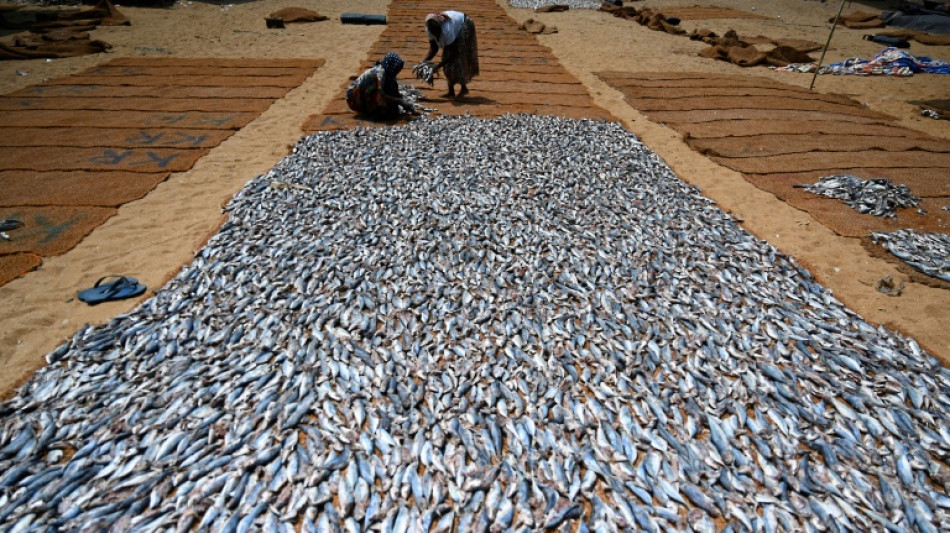
Aquaculture drives aquatic food yields to new high / Photo: Ishara S. KODIKARA - AFP/File

 Trump envoys arrive in Kyiv for first Ukraine visit

 Indonesia's main airport suspends operations after volcanic eruption

 US aircraft carrier departs Thailand after port call

 Haze emergency grips Malaysian Borneo town

 Messi creates both Miami goals in 2-2 draw with Atlanta

 Rybakina books US Open fourth-round berth, inches closer to No. 1

 Sobering reality: Curbs on alcohol in northeast Syria cause discontent

 Wobbly Osaka 'shocked' to battle past Mertens and reach last 16

 Indian Oscar-nominated filmmaker turns camera on his cancer

 Argentina 'let off hook' by Australia as Kiss's winning run ends

 Argentina threatens to sanction oil projects around Falklands

 Gauff into round four at US Open after straight-set win

 Bordeaux hammer Racing in Top 14 start as Bielle-Biarrey extends deal

 Zheng, Potapova pull off upsets to reach US Open last 16

 Swiatek into US Open fourth round in tight two-setter

 Werro wins in Brussels, as Russell and Dos Santos shine

 Kolbe breaks jaw and shoulder injury sidelines Savea

 US military strikes oil tankers as Iran vows tougher reprisals

 Zheng rallies to stun Keys, Anisimova out in US Open third round

 Bayern held to draw by stubborn Schalke

 Lens lose again ahead of Champions League date

 Olympic champion Zheng storms home to reach US Open last 16

 Big-spending Spurs must make better attacking decisions, says De Zerbi

 South Africa dominate New Zealand in second half to lead series

 Kiefer Sutherland still in action, but ibuprofen lending helping hand

The amount of fish, shellfish and algae caught in the wild and farmed in aquaculture hit a record 214 million tonnes in 2020, the Food and Agriculture Organization said Wednesday.
Driven by a sustained surge in aquaculture, the new record is good news for a world facing price hikes and food shortages due to the war in Ukraine, disrupted supply chains, and inflation.
"The growth of fisheries and aquaculture is vital in our efforts to end global hunger and malnutrition," said FAO director Qu Dongyu.
But overfished oceans, climate change and pollution -- if left unaddressed -- could threaten that potential, the UN agency warned in its 2022 state of the world fisheries report.
"Aquaculture growth has often occurred at the expense of the environment," it said.
"Sustainable aquaculture development remains critical to supply the growing demand for aquatic food."
Production of aquatic animals in 2020 -- totalling 178 million tonnes -- was evenly divided between fisheries and aquaculture.
The remaining 36 million tonnes was algae production.
Yields of fish, shrimp and other shellfish destined for human consumption is more than 60 percent higher than during the 1990s, far outpacing population growth, according to the report, released during the UN Ocean Conference in Lisbon.
On average, people worldwide consume over 20 kilos (44 pounds) of aquatic foods per year today, more than double the amount 50 years ago.
Globally, 17 percent of the protein consumed by humans comes from aquatic sources. In many Asian and African countries, that figure rises to more than 50 percent, according to the report.
Wild and farmed food from the seas and inland waters are also a critical source of essential omega-3 fatty acids and micronutrients, recent research has shown.
"Aquatic foods are increasingly recognised for their key role in food security and nutrition," Qu said.
Nearly 90 percent of aquatic animal production is for human consumption, with the rest destined for non-food uses such as fishmeal and fish oil.
Asian countries were the source of 70 percent of the world's fisheries and aquaculture of aquatic animals in 2020.
China remaining by far the top fisheries producer, followed by Indonesia, Peru, Russia, the United States and Vietnam.
So-called capture fisheries in the wild -- which have stagnated since the mid-1990s -- dropped by four percent in 2020 compared to the average of the previous three years.
Part of the drop can be attributed to disruptions caused by the Covid pandemic, but long-term decline is due to overfishing.
"The FAO estimates that 34 percent of caught fish come from overfished stocks," University of British Columbia economist and fisheries expert Rashid Sumaila told AFP.
"But they are very conservative," he added. "Independent studies put that figure at 50 percent."
E.Borba--PC