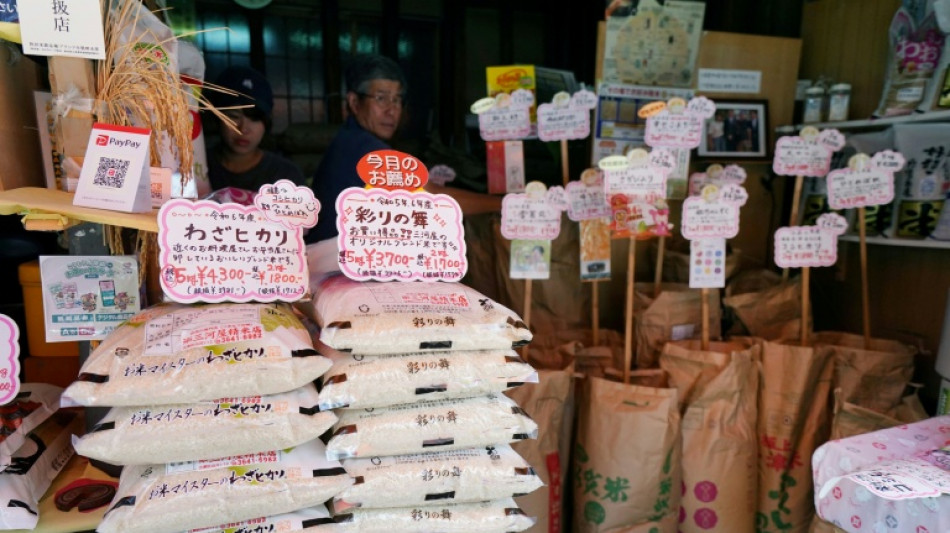
Rice prices up 91 pct year-on-year in Japan / Photo: Kazuhiro NOGI - AFP

 Best Pet Advent Calendars for Christmas 2026: Dog Treats and Cat Toys

 Grattan Institute Releases Blueprint to Target Specialists Over Excessive Fees

 Arizona Science Center Hosts Girls in STEM Astro Adventures for Students

 New Turkish Cafe, Japanese BBQ, and Korean Restaurants Open Across East Bay

 Knowle Move Four Points Clear at Top After Histon Victory

 Physicians Urge Arizona to Ban Medical Gag Clauses and Enable Private Lawsuits

 New Campaign Highlights Knowledge Gaps on Carbon Monoxide Safety Among Americans

Rice prices in Japan soared 90.7 percent in July year-on-year, official data showed Friday, but the rate of increase slowed from previous months offering some relief for Prime Minister Shigeru Ishiba.
Ishiba's future is uncertain after his coalition lost its majority in both chambers in elections this year, as voters angry about rising prices deserted his long-dominant Liberal Democratic Party.
Rice prices have skyrocketed in recent months because of supply problems linked to a very hot summer in 2023 and panic-buying after a "megaquake" warning last year, amongst other factors.
Overall, Japan's core inflation eased to 3.1 percent from 3.3 percent in June.
But it remains above the Bank of Japan's two-percent target, cementing expectations that it will hike interest rates this year.
The reading, which excludes fresh food prices, was slightly above market expectations of 3.0 percent.
Stripping out energy too, consumer prices rose 3.4 percent -- the same as in June.
The BoJ last hiked interest rates in January but has been reluctant to tighten monetary policy further.
It sees above-target inflation as caused by temporary factors -- including the price of rice.
This month US Treasury Secretary Scott Bessent added to pressure on the BoJ to hike, saying the central bank was "behind the curve" on inflation.
"Although inflation is likely to cool a bit further in the months ahead, it shouldn't prevent the Bank of Japan from resuming its tightening cycle in October," Abhijit Surya at Capital Economics said Friday.
- Rice reserves -
In June the price of rice was 100.2 percent higher than a year earlier. In May the rate was 101.7 percent.
Ishiba has appointed a new farm minister and his government has released emergency stocks in an effort to bring prices down.
Earlier this month it announced a change in its decades-old policy of encouraging farmers to grow crops other than rice.
US President Donald Trump also wants Japan to import more American rice.
Last week, data showed that Japan's economy grew at an annualised pace of 1.0 percent in the second quarter.
The reading suggested the economy was suffering less than feared from US tariffs.
But other data released Wednesday showed exports to the United States plunging 10.1 percent in July, with cars down 28.4 percent.
Trump initially imposed across-the-board tariffs of 10 percent on Japan, as well as levies of 27.5 percent on cars.
Japan's automobile industry, which includes giants such as Toyota and Honda, accounts for around eight percent of the country's jobs.
Japan last month secured a trade deal that cut threatened 25 percent "reciprocal" tariffs to 15 percent.
The rate on Japanese cars was also cut to 15 percent, although this has yet to take effect.
A.Magalhes--PC

