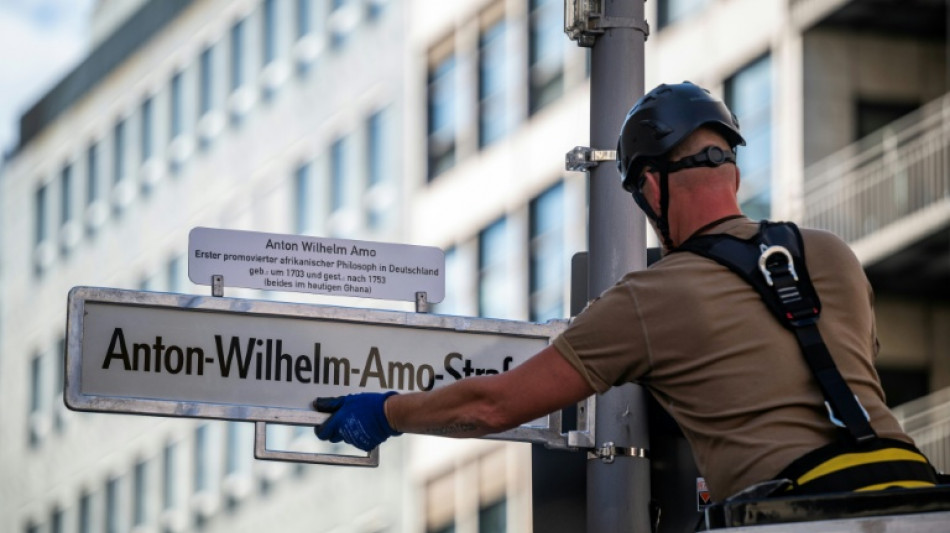
Berlin's 'Moors' Street' renamed after years of controversy / Photo: John MACDOUGALL - AFP

 Best Pet Advent Calendars for Christmas 2026: Dog Treats and Cat Toys

 Grattan Institute Releases Blueprint to Target Specialists Over Excessive Fees

 Arizona Science Center Hosts Girls in STEM Astro Adventures for Students

 New Turkish Cafe, Japanese BBQ, and Korean Restaurants Open Across East Bay

 Knowle Move Four Points Clear at Top After Histon Victory

 Physicians Urge Arizona to Ban Medical Gag Clauses and Enable Private Lawsuits

 New Campaign Highlights Knowledge Gaps on Carbon Monoxide Safety Among Americans

A central Berlin street is being officially renamed on Saturday for an 18th-century African philosopher after years of debate over its current name, Mohrenstrasse ("Moors' Street"), viewed as outdated and offensive.
The local council of the central Mitte district first announced in 2020 that it wanted to change the name of the street to Anton Wilhelm Amo Street, after the first black philosopher known to have taught at a German university.
The Mohrenstrasse metro station will also take the new name on Saturday, a date chosen to coincide with the International Day for the Remembrance of the Slave Trade.
"It's a great success for civil society, which has been pushing for a name change for more than 30 years," said Tahir Della, from the group Decolonize Berlin, which is organising celebrations to mark the name change.
"It makes clear why the former name is so problematic for many black people in Germany," he said.
The origins of the current name are unclear.
It dates back to the early 18th century, the height of the Atlantic slave trade, and some have suggested it may refer to former slaves who settled there.
Another theory is that it refers to a visiting African diplomatic delegation.
Whatever its precise origins, Della said the name is a "racist description for black people".
However, local residents mounted legal challenges against the council to try to stop the renaming.
A last-minute court decision on Friday briefly threatened to derail the process, even after workers had already begun switching the street signs.
However, a higher court overturned the decision hours later, allowing the renaming to go ahead.
Born around 1700 in what is today Ghana, Anton Wilhelm Amo is believed to have been sold into slavery as a child and then brought to Europe.
He later had the opportunity to receive an education which took him to the prestigious universities of Wittenberg, Halle and Jena, becoming an important figure in Germany's Enlightenment period.
Decolonize Berlin says the new name honours a symbol of "resistance, self-affirmation and knowledge in the African diaspora".
Della said he hopes the renaming will serve as an "impetus for further discussions on public spaces", pointing to debates on other street names in Berlin honouring figures from Germany's colonial past.
pyv-raph/jsk/jhb
A.Magalhes--PC

