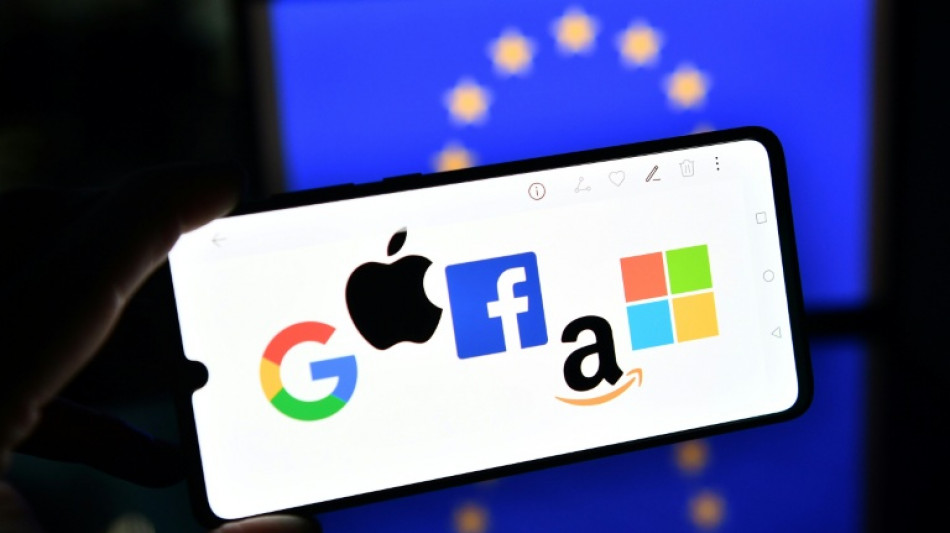
EU claims 'sovereign right' to regulate tech after Trump threat / Photo: JUSTIN TALLIS - AFP/File

 Best Pet Advent Calendars for Christmas 2026: Dog Treats and Cat Toys

 Grattan Institute Releases Blueprint to Target Specialists Over Excessive Fees

 Arizona Science Center Hosts Girls in STEM Astro Adventures for Students

 New Turkish Cafe, Japanese BBQ, and Korean Restaurants Open Across East Bay

 Knowle Move Four Points Clear at Top After Histon Victory

 Physicians Urge Arizona to Ban Medical Gag Clauses and Enable Private Lawsuits

 New Campaign Highlights Knowledge Gaps on Carbon Monoxide Safety Among Americans

The European Commission Tuesday asserted the "sovereign right" to regulate the activities of tech giants within the bloc and rejected claims by President Donald Trump that its rules unfairly harm US firms.
Brussels has adopted a powerful legal arsenal aimed at reining in tech giants, particularly through the Digital Markets Act (DMA) covering competition and Digital Services Act (DSA) on content moderation.
Without explicitly naming the EU, Trump threatened on Monday to impose fresh tariffs on countries with regulations that sought to "harm" American technology, just days after both sides released details of a hard-fought transatlantic trade deal.
"It is the sovereign right of the EU and its member states to regulate economic activities on our territory," European Commission chief spokesperson Paula Pinho told reporters in response.
The EU has already slapped heavy fines on US behemoths including Meta and Apple under its new digital rules, which have faced months of pushback from Trump's administration.
EU tech spokesman Thomas Regnier said the bloc could "firmly rebut" the idea pushed by Trump that its rules targeted US companies.
"The DSA does not look at the colour of a company, at the jurisdiction of a company," Regnier said -- noting that the last three enforcement decisions under the law had been against China's AliExpress and TikTok, and Chinese-founded Temu.
Aimed at protecting consumers from disinformation and hate speech as well as counterfeit or dangerous goods, the DSA obliges platforms to swiftly remove illegal content or make it inaccessible.
Among its provisions, the law instructs platforms to suspend users who frequently share illegal content such as hate speech -- something framed as "censorship" by detractors from Meta CEO Mark Zuckerberg to the US State Department.
"The claims that the DSA is a censorship tool are completely wrong and completely unfounded," Regnier said.
"We're not asking platforms to remove content. We're asking them to enforce their own terms and conditions."
- 'Speculative' -
Trump's latest threat comes after the United States and the EU finally released details of the trade deal struck between the US leader and European Commission President Ursula von der Leyen in July to end a months-long transatlantic standoff.
A joint statement issued last Thursday confirmed that the deal imposes a 15-percent US levy on most EU exports, including cars, pharmaceuticals, semiconductors and lumber, but negotiations are not over and some moving parts remain.
The bloc's trade chief Maros Sefcovic insisted last week that Brussels successfully kept digital issues "out of the trade negotiations" with Washington -- and that the bloc's "regulatory autonomy" was not up for debate.
The commission's Pinho stood by those comments, saying Trump's latest threat would not derail work on implementing the agreement.
"We have a clear framework on which we are working," she said, adding: "any other measures which fall out of the scope of this framework agreement at this stage are merely speculative."
A.Silveira--PC

