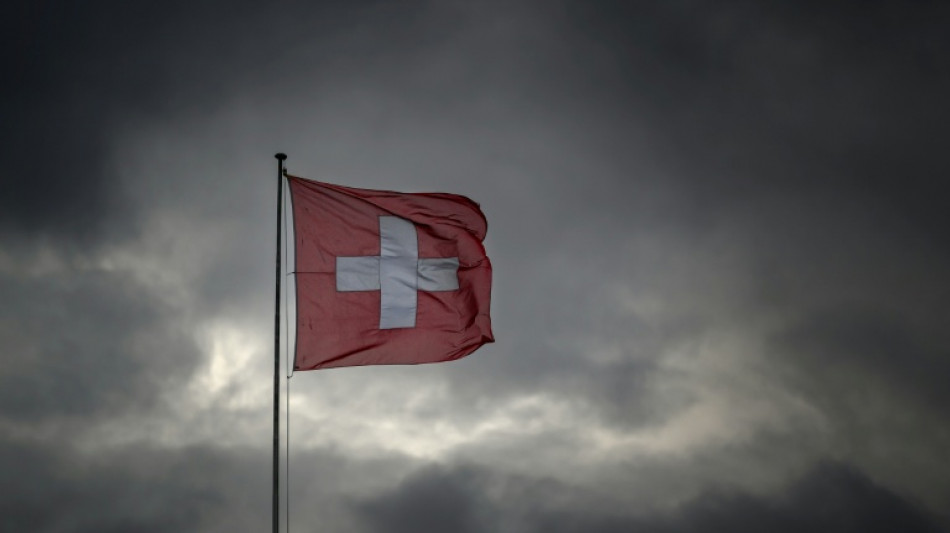
Swiss economy set to slow due to US tariffs / Photo: Fabrice COFFRINI - AFP/File

 Best Pet Advent Calendars for Christmas 2026: Dog Treats and Cat Toys

 Grattan Institute Releases Blueprint to Target Specialists Over Excessive Fees

 Arizona Science Center Hosts Girls in STEM Astro Adventures for Students

 New Turkish Cafe, Japanese BBQ, and Korean Restaurants Open Across East Bay

 Knowle Move Four Points Clear at Top After Histon Victory

 Physicians Urge Arizona to Ban Medical Gag Clauses and Enable Private Lawsuits

 New Campaign Highlights Knowledge Gaps on Carbon Monoxide Safety Among Americans

The Swiss economy will likely grow more slowly than previously expected next year due to the massive import tariffs imposed by US President Donald Trump, the economy ministry said Thursday.
Trump blindsided Switzerland when he announced that incoming Swiss goods would be hit with a huge 39-percent tariff on August 1, one the highest new levies he imposed on dozens of countries.
The Swiss economy ministry's State Secretariat for Economic Affairs (SECO) said it was now looking at weaker growth.
"An updated economic scenario from SECO shows that, as a result of higher US import tariffs, the Swiss economy is likely to grow more slowly than previously expected, particularly in 2026," it said in a statement.
In its June forecast, the Swiss government's expert group on business cycles projected significantly below-average growth for the Swiss economy: 1.3 percent this year and 1.2 percent next year.
"With the introduction of higher US tariffs on imports from Switzerland at the beginning of August, the outlook has worsened further," SECO said.
In its updated economic scenario, SECO is eyeing growth of 1.2 percent this year and 0.8 percent next year.
"A severe recession is not currently expected. However, the economic impact could be significant for certain sectors and companies," it said.
The next full economic forecast update is scheduled for October 16.
The 39-percent tariff rate was up from a 10 percent "baseline" levy that Trump launched in April on US imports of goods from around the world.
The new, higher tariff rate jeopardises entire sectors of the export-heavy Swiss economy, notably watchmaking and industrial machinery, but also chocolate and cheese.
Swiss businesses worry that competitors in other wealthy economies will have an edge, with the European Union and Japan having negotiated a 15-percent tariff and Britain securing a rate of 10 percent.
Bern has argued that the United States enjoys a significant services trade surplus and that most US industrial goods enter Switzerland tariff-free.
In the second quarter of 2025, Switzerland's gross domestic product, adjusted for sporting events, increased by 0.1 percent, following growth of 0.7 percent in the first quarter.
Switzerland hosted the UEFA Women's Euro 2025 football championships in July, with total attendances topping 600,000 across the 31 matches.
"After the above-average growth seen in the previous quarter, the anticipated correction has now occurred," SECO said.
J.Oliveira--PC

