Hope and hate: how migrant influx has changed Germany / Photo: Odd ANDERSEN - AFP

 New mum Sjostrom wins 50m butterfly for 18th European gold
 Solar eclipse darkens Arctic Russia on course for Spain
 Russian economy rebounds in second quarter despite Ukrainian strikes

 NBA's Los Angeles Lakers to be sold for $12.5 bn: ESPN
 Trump sued over sale of access to Truth Social posts

 Europe looks to the skies as solar eclipse cast its shadow
 At least 44 drown after ferry overturns on Zimbabwe's Lake Kariba

 Grieving Argentine icon Messi unsure about playing on 'much longer'

 Nigeria kidnap victims escape 'hellfire' captivity beaten, malnourished
 Google unveils finder tag, new AI smartphone features
 US equities gain as inflation report eases fear of rate rise
 Colombia declares three days mourning for quake victims

 44 lives lost after ferry capsizes on Zimbabwe's Lake Kariba

 WallStreetPR Releases Report on China’s Gold Purchases and African Mining Investment

 Former Chinese premier Zhu Rongji dies aged 97
 Markets steady awaiting US inflation data

 WHO says Trump vaccine shake-up goes against evidence

 Eclipse chasers flock to Spain for 'breathtaking' experience

 'To make the civilians leave': Russia pummels Ukraine's petrol stations

 Japan brushes off Australian PM's melon drama

 Rod Stewart cancels tour dates after heart surgery

 How Britain's mapmakers track climate change

 Australian delivery drivers win 'world-leading' pay rise

 Meta meets its own 'tobacco' moment in court
 Art or medicine? Japan's cosmetic tattoo artists in limbo
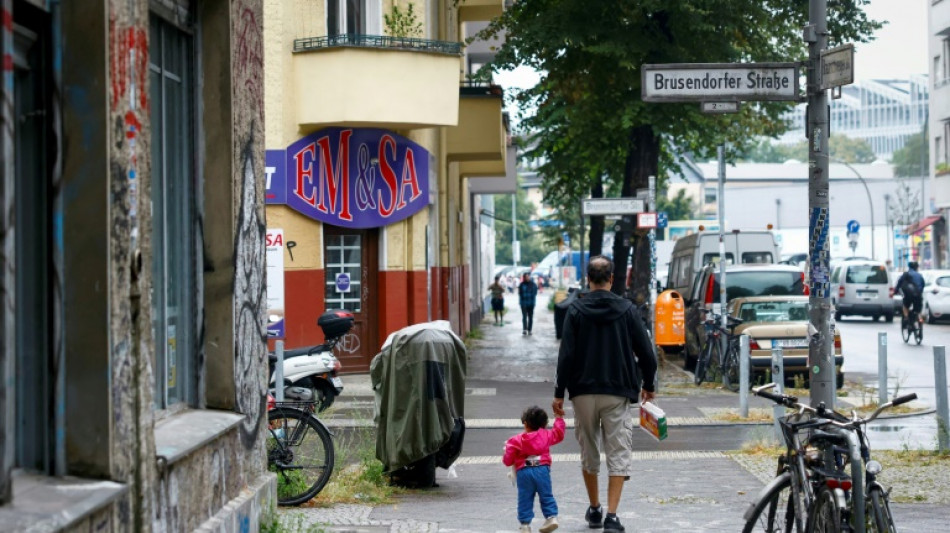
Men sit outside shisha bars and women in hijabs push strollers past Middle Eastern restaurants and pastry shops in Berlin's Sonnenallee, a wide avenue which has become a symbol of how much Germany has changed in the last decade.
Many came during the huge migrant influx of 2015, when a million people arrived in a matter of months -- mostly from Syria, Afghanistan and Iraq.
For barber Moustafa Mohmmad, 26, who fled the ruins of Syria's Aleppo, it is a home from home, "a kind of Arab street" where he can find sweets from Damascus and Aleppo-style barbecue.
To others it is a byword for integration gone wrong and disorienting change that has divided the country and helped make the far-right Alternative for Germany (AfD) the second biggest party.
"We can do this," Angela Merkel famously declared on August 31, 2015 as columns of desperate people walked through the Balkans towards Germany.
Civil wars were raging in Syria and Afghanistan, driving the largest wave of refugees since World War II, with the Mediterranean Sea becoming a mass grave.
Four days later the then chancellor took the fateful decision to keep the Austria border open, eventually letting in more than one million asylum seekers.
German volunteers greeted trainloads of new arrivals with water and teddy bears, an outpouring of compassion that was too good to last.
Merkel later wrote that "no phrase has been thrown back at me with quite such virulence" as "wir schaffen das" (We can do this). "No phrase has been so polarising."
- Immigration crackdown -
Ten years on, many bitterly complain that services, from childcare to housing, have been stretched to breaking point.
Others point to the many migrant success stories, the joys of a more cosmopolitan country, and newcomers plugging gaps in the ageing labour market.
But the country's current leader, Friedrich Merz, is not convinced and has lost little time undoing Merkel's legacy since coming to power in May.
His coalition government has cracked down hard with stricter border controls, tougher residency and citizenship rules and even deported migrants to Taliban-ruled Afghanistan.
Merz insists that strong measures are needed to halt the rise of the AfD and soothe fears inflamed by stabbings and car-ramming attacks blamed on migrants.
In one especially horrific incident this year in the southern city of Aschaffenburg, a mentally ill Afghan is accused of attacking nursery school children with a knife, killing a two-year-old boy and a German man who tried to protect the toddlers.
Asked recently about Merkel's declaration, Merz said Germany had "clearly not" managed "to do it". "We must control immigration. And we must ensure that those who come to us are well integrated."
- 'I feel part of community' -
Even to virulent critics of immigration, Syrian restaurateur Malakeh Jazmati, 38, ticks most integration boxes.
She came to Berlin in 2015 and quickly started a catering business with her husband. Two years later she was serving food to Merkel.
In 2018 she opened the Malakeh restaurant, among the most beloved of Berlin's new Syrian eateries.
"The German people are open to trying something new," she said, preparing batata harra, a potato appetiser scattered with pomegranate seeds.
Jazmati said her life in Germany is "full of challenges... but also full of happiness.
"It's not easy to live outside your homeland."
While her two German-born sons, aged two and nine, speak German and Arabic, her own attempts to learn the language have been thwarted by her workload and the fact that English is so widely spoken in Berlin.
But Jazmati believes integration also means feeling "part of the community. I have German friends. I pay my taxes. I try to speak German. And I also try a lot of German food," she said with a smile.
- Finding work -
Germany is now home to more than 25 million people with a "migration background", meaning either they or their parents were born abroad -- some 30 percent of the population. That includes more than a million with Syrian roots.
Arabic words like "yalla" (hurry up) and "habibi" (my love) have entered the vocabulary, particularly among the young.
"Talahon" too, though it is less flattering, a term for thuggish young men sporting designer tracksuits and gold chains.
Middle East culture from rap to theatre is also thriving, with some artists relishing the liberties of cosmopolitan Berlin.
Syrian belly dancer The Darvish whipped up the crowd in a gold-tasselled skirt and a red fez at a recent show in the Kreuzberg area.
The dancer -- a figure in the capital's LGBTQ community -- came in the 2015 wave, identifies as non-binary, and wants to connect "Arab and queer culture".
For most Syrians work is more humdrum, with the majority working low-paid jobs in the service, construction and health sectors.
Bonita Grupp has hired almost 70 migrants in her Trigema textile factory in the southern town of Burladingen, offering them housing, German lessons and training.
"Germans simply don't apply for these positions anymore," she said.
Hard at work on his sewing machine, Habash Mustafa, 29, learned to tailor in Aleppo. He arrived in 2015 after crossing the Aegean Sea by boat and the Balkans on foot. He got his German citizenship a few months ago.
- Resentment over benefits -
Europe's biggest economy will need migrants more than ever in the years to come, with the German Economic Institute predicting a shortfall of around 768,000 skilled workers in the next two years.
Foreigners already account for 15 percent of healthcare professionals, according to the DKG hospital federation, with the largest number coming from Syria.
When right-wing politicians called for Syrians to go home when Bashar al-Assad's regime fell in December, the alarmed healthcare sector warned it couldn't do without its 5,000 or so Syrian doctors.
At one hospital in Quedlinburg in the central Harz mountains, 37 of the 100 doctors are migrants.
"Without our foreign colleagues, we would no longer be able to function," said Matthias Voth, director of the Harzklinikum Dorothea Christiane Erxleben.
Nearly two thirds of refugees who came in the 2015 wave had jobs by 2022, according to the latest data from the Institute for Employment Research (IAB).
But many migrants have yet to find work. They are four times more likely to be jobless than the rest of the population, with an unemployment rate of 28 percent last year.
Around 44 percent receive social benefits, according to the Federal Employment Agency -- a key vector fuelling resentment.
Much of the load falls on local councils that are already stretched. Salzgitter, a steel town south of Hanover that has seen better days, has taken in 10,000 migrants in a decade -- a tenth of its population. Its mayor Frank Klingebiel complained to Merkel, his party leader, that the pressure on public services "could not go on like this".
Most migrants were "women with children entitled to places in nurseries, schools and language courses", he told AFP.
In 2019, Salzgitter got 50 million euros that it used for two schools and three new nurseries, but Klingebiel said this was a "drop in the ocean".
The town now has four primary schools where more than 70 percent of pupils are migrants. Many do not speak German, which poses "exorbitant challenges", the mayor said.
- Desire to succeed -
Hamburg's Kurt Koerber Gymnasium was also "caught off guard by the suddenness" of the refugee wave, said headteacher Christian Lenz.
The secondary school serves an area where 85 percent of the population are from immigrant backgrounds, and has two "international preparation" classes for new arrivals which Lenz argues ensures a smoother transition.
Simon Groscurth, headteacher of Berlin's Refik Veseli School, said many migrant children have a "strong desire to perform well", keen to please parents who have sacrificed so much to be there.
Having arrived with no German at all, Syrian student Hala, 16, now even speaks it with her cousins and has "started to forget Arabic a little".
The country's 2,500 mosques -- long dominated Turks -- have also become more diverse, said Syrian imam Anas Abu Laban. In his little mosque in the northeastern town of Parchim, koranic classes are in both German and Arabic as young people born there tend to "understand German better".
- Overcrowded shelters -
Most 2015 arrivals have long moved out of emergency accommodation, but many camps remain, filled by later migrants, including from Ukraine.
Some 1,300 people live inside hangars in Berlin's disused Nazi-era Tempelhof airport.
Each prefabricated unit contains four beds, tables and lockers, all packed into 12 square metres (130 square feet).
Tempers can flare in the crowded space.
Faruk Polat, 34, a Kurd from Turkey, who has been there since early 2023, said many residents "do not understand each other" because they speak different languages.
He is desperate to leave. "I spend almost every day on the internet looking for a flat or a room," he told AFP, his face sweaty from the poor ventilation.
Even when their asylum application is granted there is often nowhere to go, said centre director Robert Ziegler.
"Everyone knows that the housing market is very tight which means these people have to stay here longer," he said.
- AfD backlash -
To the AfD -- and the fifth of voters who supported it in February's elections -- Berlin's streets, crowded migrant shelters and multiethnic classrooms are proof the country is doomed. The party now calls for the "remigration" of millions of foreigners.
2015 turbo-charged its rise, particularly after the shock at 1,200 women who reported being sexually assaulted that New Year's Eve in Cologne and other cities by men described as being mostly of Arab or North African origin, according to a final criminal police report cited in German media.
Even worse was to come. At the height of the Islamic State group, a Tunisian man drove a truck through a Berlin Christmas market the following year, killing 13 people and wounding dozens more.
This February's election was dominated by a bitter debate on migration amid a spate of knife and car-ramming attacks in which all the arrested suspects were asylum seekers.
The AfD is especially strong in the ex-communist east, where it won its first regional election last year in Thuringia, which has the second lowest GDP per capita of any German state.
On a recent market day in Arnstadt near the state capital Erfurt, pensioner Monika Wassermann, 66, said she felt there were "too many foreigners".
"Many are hated because they get everything they need, while the Germans have to work hard for it," she said.
Ronny Hupf, 42, working a meat and sausage stall, said he was against migration because of the "violent crimes committed by migrants".
"I've seen other traders being attacked at the market," he said.
- 'Crime wave' -
German police data shows that violent crime has risen by a fifth over the past decade, but experts argue about the causes.
Last year 35.4 percent of criminal suspects were foreign nationals, according to the BKA criminal police office, rising to nearly 42 percent when you count crimes such as illegally entering the country.
Syrians top the list by nationality.
However, the idea "we are facing an unprecedented, incomparable, emergency-like situation is an exaggeration", said Frank Neubacher, a professor of criminology at Cologne University.
Migrants are overrepresented because they are more likely to be young, male, living in big cities and to be stopped by the police, he said.
Yet they are also the victims of hate crimes, which jumped by almost a third to around 19,500 last year, the BKA said.
Tareq Alaows, a Syrian refugee who came to Germany in 2015, pulled out of being the Green party's Bundestag candidate in Oberhausen in the industrial Ruhr in 2021 because of the "high threat level".
- Return to Syria? -
Migrant numbers have also been dropping sharply as the debate has hardened.
Even before the latest restrictions, arrivals fell by 49.5 percent in the first half of this year, according to the Federal Office for Migration and Refugees.
The crackdown has stoked fears and protests. Saeed Saeed, 25, a computer science student from Syria who now lives in Magdeburg, said he felt "unwanted in this country" at a protest in front of the Reichstag this summer.
When he arrived in 2015, he was filled with optimism about building a new life in Germany. But now he said he felt that "things have changed for the worse".
Indeed as many as one in four migrants are considering leaving Germany, according to a January study by the Institute for Employment Research, many reportedly highly skilled.
They cited the political situation, high taxes and bureaucracy among the reasons for their disillusion.
In Berlin's Malakeh restaurant, owner Jazmati returned to Damascus just three weeks after Assad fell.
"Inside me something said I need to come back to Syria," she said, but for now a permanent return was off the cards. Only around 4,000 Syrians have decided to move back, according to research by public broadcaster ARD.
"I have two children" growing up speaking German, Jazmati said. "They don't know anything about Syria... I cannot be selfish and only think about myself."
Her husband got German citizenship last year, and she will apply too when her language skills are good enough.
But she already feels that "even if I don't have German citizenship, I am part of this country".
P.Mira--PC