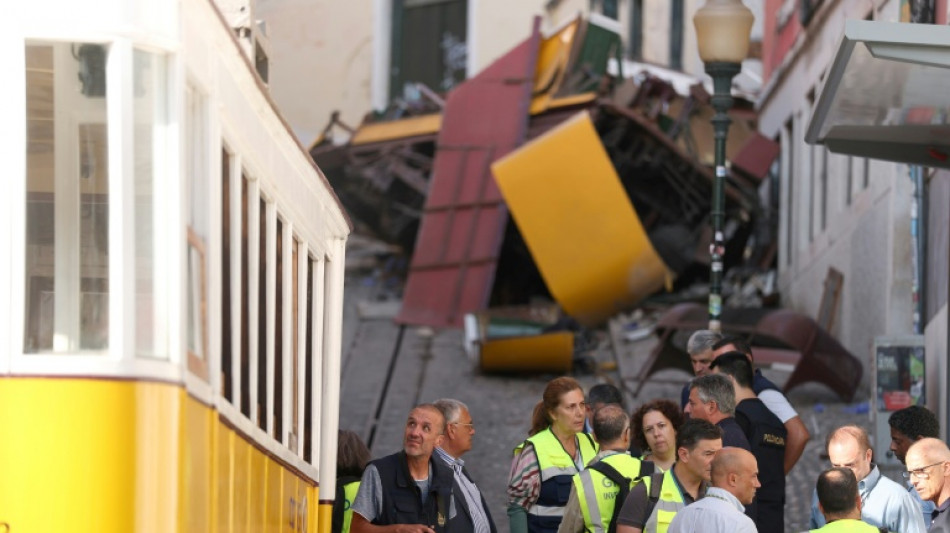
Tourists and locals united in grief after Lisbon funicular crash / Photo: PATRICIA DE MELO MOREIRA - AFP

 New space object 'black hole star' discovered by astronomers

 England captain Root tells players to be 'adults' as he ditches curfew

 US inflation slows slightly in July despite elevated fuel prices

 Total solar eclipse to cast its shadow over Europe

 US consumer inflation slows slightly in July despite elevated fuel prices
 Warholm on track in bid for fourth Euro hurdles gold

 Erdogan eyes expansion of regional defence pact

 Extreme weather, jellyfish knock one-fifth of France's nuclear capacity offline

 Skywatchers gather in Europe to see total solar eclipse

 Zhu Rongji, trailblazing ex-premier who transformed China's economy

 China tech giant Tencent's Q2 profit down as AI push builds
 China's C919 jet makes first international commercial flight
 Mideast war impact on travel bookings fading, TUI says

 Bangladesh get Das fitness boost for daunting Australia task

 One dead, 172 rescued as second ferry in days catches fire in Indonesia
 Foxconn posts quarterly profit surge on AI server demand
 Hazlewood gets Australia nod ahead of Boland for Bangladesh Test

 Toyota ex-chief Okuda, pioneer of the Prius, dead at 93

 Colombia rescuers find woman alive as quake death toll passes 200

 New Zealand PM survives leadership challenge months from election
 Passengers rescued as second ferry in days catches fire in Indonesia

 Oil prices rise, stocks mixed ahead of crucial US inflation data

 UK 'joke' candidate Binface pushes serious point about politics
 New Zealand PM Luxon survives leadership challenge months from election

 Cuba celebrates Castro's 100th as his revolution faces its toughest test
Tourists and locals wrestled with shock and dismay on Thursday in Lisbon, a day after one of city's famed funiculars -- climbing railways that serve both communities -- came off the tracks and crashed, killing 16 people.
The ruined hulk of the crashed yellow carriage is still splayed out at the site of the accident, left lying on its side against a wall.
With their 19th-century charm, the funiculars provide a way of navigating the Portuguese capital's many hills, as convenient as they are picture-postcard perfect.
That convenience makes Wednesday's crash, when the Gloria funicular veered off the tracks and smashed into a building in one of the capital's most popular tourist spots, all the more distressing for pensioner Jose Silva.
"For tourists it's just an attraction, but for us it's a way of getting about," said Silva, who used the Gloria throughout the 1960s to get to his job as a paper delivery man in the Bairro Alto quarter -- at the time a hub of printing presses and newspaper offices.
"In those days there were not so many tourists," Silva told AFP as he walked his dog in the central Baixa neighbourhood, adding that the funicular was mostly taken by Lisbon residents in the past.
Like Silva, many of the city's residents, nicknamed "Lisboetas", have fond memories of the steeply inclined line and its canary yellow carriages.
"Every Lisboeta has taken them at least once," said Adelaide Alves, a 57-year-old hairdresser who plies her trade downtown.
"It's perhaps a little silly to say this but I didn't feel entirely comfortable taking them, so I didn't often do so, but sometimes you don't have the choice," she said.
"The climb on foot is very daunting. It's as slippery as butter!"
Alves could not take her eyes off the newspaper front pages on display at a nearby newsagents, covering what the press has already christened "the Tragedy of Lisbon".
- 'Speechless' -
For residents, the Gloria funicular is deeply entwined with the history of the city.
Since opening in 1885, its two wagons have been propelled by a system of counterweights across its 265-metre (870 feet) of track, up and down a 48-metre incline.
As Portugal declared a day of national morning on Thursday in the wake of the crash, Lisbon's city hall said it had halted the capital's three other funiculars for safety checks.
With the Iberian country profiting from a tourism boom in recent years, the century-old lines, together with the tramways from the same period, have become a symbol of the Portuguese capital recognisable worldwide.
Yet that boom -- more than five million visitors flocked to Lisbon in 2023 -- has at times exasperated the locals.
The funiculars' growing popularity with tourists -- at least 11 foreigners were among those injured in the crash -- has pushed some residents to abandon the lines for modern alternatives like the underground or buses.
After Wednesday's accident, however, some visitors found themselves torn between disbelief and fright.
"When I woke up and read the news this morning, I was speechless... It's really terrible!" admitted Matteo Diaz, a 27-year-old Colombian on holiday in Lisbon.
"We were just talking about taking that funicular, and what happened was that with how big the queue was... in the end we didn't go up," Spanish tourist Antonio Javier said.
J.Oliveira--PC