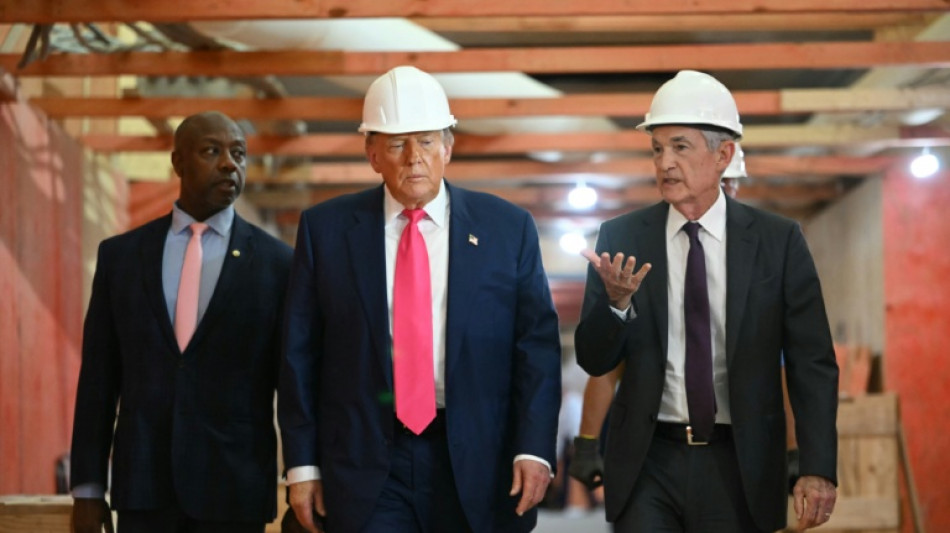
Independence of central banks tested by Trump attacks on US Fed / Photo: ANDREW CABALLERO-REYNOLDS - AFP

 Meta meets its own 'tobacco' moment in court

 Art or medicine? Japan's cosmetic tattoo artists in limbo

 Rybakina ousts Osaka to book Toronto semi-final against Gauff
 Colombia rescuers find woman alive as quake death toll passes 240

 Charges dropped against Bondi Beach attack hero

 Parched and desperate for rain, Kazakhstan turns to cloud-seeding
 The perfect storm that turbocharged Venezuela's twin quakes
 2.4 million girls banned from Afghan schools since Taliban return: UNESCO

 Colombians dig through rubble as quake death toll surpasses 240

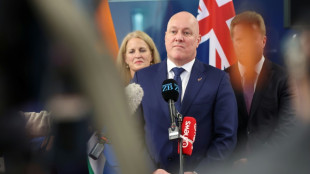 New Zealand's ruling party meets to decide PM Luxon's fate

 Total solar eclipse to spellbind Europe

 Jodar, Nakashima to make Masters semis debuts in Montreal

 Chilean veteran Sanchez signs with MLS club Montreal

 Cristiano Ronaldo marries long-term partner Georgina Rodriguez

 Oil prices higher, stocks mixed ahead of inflation report

 Jacobs into 100m final with eye on third title

 Eight-try New Zealand cruise to tour victory over Sharks

 Trump's secret plane swap triggers questions and confusion

 California calls Paramount's threat to leave state 'blackmail'

 PSG 'want to win everything', says Luis Enrique

 Barred from elections, Russia's anti-war party vows to fight on

 Jaissle states Newcastle ambition but urges patience

 NBA star Cooper Flagg trading card a slam dunk for lucky buyer
 ForumPay Expands Payment Infrastructure with New Card and Bank Transfer Acceptance Solution

 Oil prices higher, stocks flat ahead of inflation report

For months, US President Donald Trump has been piling pressure on the Federal Reserve over delayed cuts to interest rates, casting the institution's independence into doubt.
Trump's recent attacks have caused quite a stir as central bank independence is considered a key factor in protecting price stability and investor confidence in a country's economy.
– What does Trump want? -
Trump has repeatedly called out Fed chair Jerome Powell for not lowering interest rates quickly enough to support the weakening US economy.
While rates were lowered on Wednesday for the first time this year, the cuts were deemed too small by Stephen Miran, the new Fed governor appointed by Trump.
Cutting interest rates helps households borrow for consumption and businesses for investment, promoting growth but at the risk of spurring inflation.
Low rates would also make it less expensive for the US government to borrow.
Public debt has been rising for years, and with the recently extended Trump tax cuts, the deficit is expected to grow further.
Under Powell, the Fed has maintained a policy guided by data and resisted political pressure.
However, Trump is attempting to stack the Fed's leadership with loyalists and is trying to remove Governor Lisa Cook, with that case going before the Supreme Court.
In 2026, several seats, including Jerome Powell's, will be up for appointment.
– Why central bank independence? –
Christine Lagarde, president of the European Central Bank, said that a takeover of US monetary policy by Trump would be "a very serious danger" for the global economy.
Undermining the autonomy of the Fed constitutes "a very dangerous road," echoed Andrew Bailey, Governor of the Bank of England.
The Fed's institutional independence is "not a technical detail but a cornerstone of economic stability," stressed Stephan Bales, author of a study for the German public bank KfW.
More broadly, "if I can no longer rely on the fact that interest rate developments genuinely reflect, in good faith and conscience, the economic reality, then I obviously have a problem," Ingrid Hengster, head of the German branch of Barclays bank told AFP.
"I can no longer properly invest in that country," she added.
The "credibility" of a central bank, whichever it may be, is an "anchor" that prevents "a spiral of rising inflation expectations," Bales said.
– Any other examples? -
"Less independent central banks are unable to ensure price stability. Just think of Turkey," said Carsten Brzeski from ING bank.
Turkey has one of the highest annual inflation rates in the world, exceeding 30 percent in August.
Capital Economics said that central banks in emerging countries "sporadically face political pressure," as recently seen in Brazil.
However, countries with independent central banks show lower inflation rates, according to several studies.
Bales warned 2026 will be a "stress test" for the Fed's independence and consequently "for the stability of the global financial system."
"There is clearly a risk that President Trump's pressure on the Fed could motivate politicians in EMs (emerging markets)to follow suit," Capital Economics said.
The ECB also faces "indirect attacks but not against its independence," noted Brzeski.
However, he warned that "the high level of public debt" in the eurozone, particularly in France, "could increase pressure on the ECB to steer its policy toward financing states."
Countries must therefore take measures to "contain this debt," which "the ECB is fully aware of," Ingrid Hengster said.
E.Paulino--PC