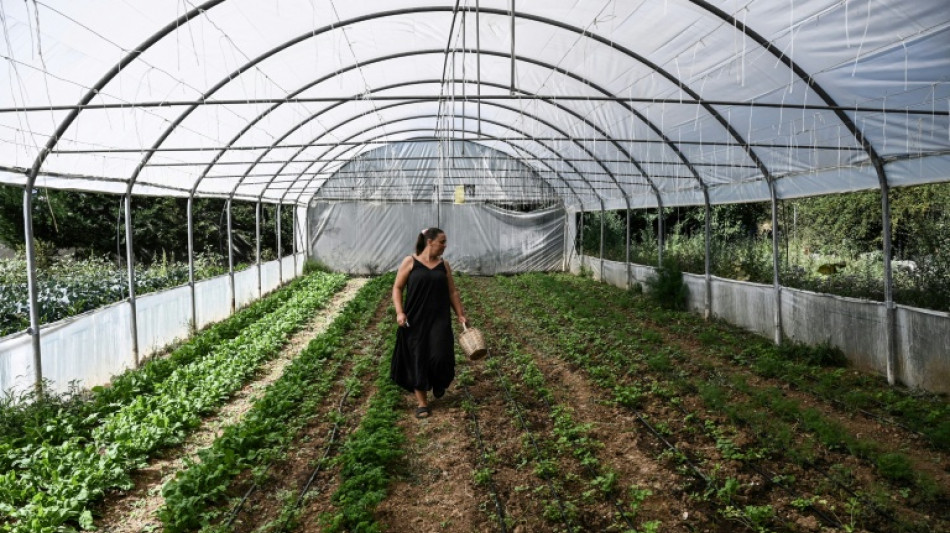
'Real' Greek farmers fume over EU subsidies scandal / Photo: Sakis Mitrolidis - AFP

 Rybakina ousts Osaka to book Toronto semi-final against Gauff
 Colombia rescuers find woman alive as quake death toll passes 240

 Charges dropped against Bondi Beach attack hero

 Parched and desperate for rain, Kazakhstan turns to cloud-seeding

 The perfect storm that turbocharged Venezuela's twin quakes
 2.4 million girls banned from Afghan schools since Taliban return: UNESCO
 Colombians dig through rubble as quake death toll surpasses 240

 New Zealand's ruling party meets to decide PM Luxon's fate

 Total solar eclipse to spellbind Europe

 Jodar, Nakashima to make Masters semis debuts in Montreal

 Chilean veteran Sanchez signs with MLS club Montreal

 Cristiano Ronaldo marries long-term partner Georgina Rodriguez

 Oil prices higher, stocks mixed ahead of inflation report
 Jacobs into 100m final with eye on third title
 Eight-try New Zealand cruise to tour victory over Sharks
 Trump's secret plane swap triggers questions and confusion
 California calls Paramount's threat to leave state 'blackmail'

 PSG 'want to win everything', says Luis Enrique

 Barred from elections, Russia's anti-war party vows to fight on

 Jaissle states Newcastle ambition but urges patience

 NBA star Cooper Flagg trading card a slam dunk for lucky buyer
 ForumPay Expands Payment Infrastructure with New Card and Bank Transfer Acceptance Solution

 Oil prices higher, stocks flat ahead of inflation report

 Orban-critic ex-judge becomes Hungary president after predecessor ouster

 US rights groups sue Trump over ICC sanctions

Thessaloniki farmer Anna Aivazidi's blood boils when she thinks of the huge sums siphoned off in a major EU farm subsidy scandal.
"I earn 300 euros ($355) in subsidies a year. I struggle to produce every day. I feel extremely wronged," the 40-year-old told AFP.
"Subsidies should go to real producers," she said.
Aivazidi is among thousands of Greek farmers who say they were penalised for years while others profited, in a massive scam allegedly assisted by government officials.
The scheme began following a change in the European Union's Common Agricultural Policy, which in 2014 shifted subsidies from livestock to land.
Greece's land registry at the time was woefully incomplete, however, meaning ownership over much of the country was unclear.
To facilitate them, farmers were allowed to declare land owned elsewhere in Greece to claim a share of the subsidies. Non-farmers with political connections got in on the action, lured by the prospect of easy money.
"The fraud essentially involved the process of appropriating or declaring public pastures by individuals who were not genuinely active farmers and who didn't own animals to use them," said Moschos Korasidis, former vice-president of OPEKEPE, the government agency that handled the EU payments.
Genuine farmers lost an estimated 70 million euros a year, he said.
"The scheme was well organised... it was a criminal organisation which naturally required political cover," said Giorgos Drosos, 65, a wheat and cotton grower in Thessaly.
Greek authorities estimate at least 23 million euros in EU farm subsidies went to fraudulent claimants. But the full cost could be even greater, according to the European public prosecutor's office.
"Our subsidies were slashed by 70 percent while phantom (farmers) pocketed thousands of euros," said Pavlos Spyropoulos, a 49-year-old cotton farmer from Trikala.
- False declarations -
An EU probe has shown widespread abuse of funds handed out by OPEKEPE, which, according to the government, annually disbursed more than three billion euros in subsidies to 680,000 farmers.
"Such illegal practice may have been organised in a systematic manner with the involvement of (OPEKEPE) officials," the European public prosecutor's office said in a statement in May.
The probe is primarily focusing on the period after 2019 under the conservative administration of Prime Minister Kyriakos Mitsotakis.
Mitsotakis has said that the fraud began in 2016, and has insisted that two agriculture ministers appointed by him, who are under investigation, bear no criminal responsibility.
"We have been clear on this -- no criminal responsibilities arise", the prime minister told Antenna TV recently.
One high-profile case is the conservative party's former coordinator for EU funds, who resigned in August. She denies any wrongdoing.
In a further blow to Mitsotakis, the EU probe has found that most of the allegedly fraudulent claims came from the island of Crete, where his family has held political influence for over a century.
According to OPEKEPE, approximately 80 percent of total subsidies granted from 2017 to 2020 for pastures ended up in Crete.
While the number of livestock farmers across Greece is decreasing, in Crete, 13,000 new farmers were registered between 2019 and 2025, with the number of declared sheep and goats doubling over the same period.
Mitsotakis on Wednesday stressed that state auditors had seized 22 million euros from 1,000 spurious tax accounts.
"You can't call that a small sum. And the checks go on," he told Antenna.
He added that it was "obvious" that members of his New Democracy party would be involved in an "extensive corruption case" because "we are the biggest party".
- Mount Olympus bananas -
Eye-catching cases under investigation are pastures declared in archaeological sites, olive trees in a military airport, and banana plantations on Mount Olympus.
"They set up a shop with European Union money. The politicians knew. It was a business," said Nikos Kakavas, head of the federation of geotechnical civil servants.
"If the European Prosecutor's Office hadn't intervened, nothing would have happened. We've been shouting about this for years, but no one listened," Kakavas said.
There was no absence of red flags, argued Athanassios Saropoulos, head of the Greek geotechnical chamber's Macedonia branch.
In the Chania region, seat of the Mitsotakis family, in the first eight months of the year, nearly one million registered sheep and goats produced 12 times less milk than in the Larissa region, he said.
"This cannot be explained by any technical or scientific terms," Saropoulos said.
L.Mesquita--PC