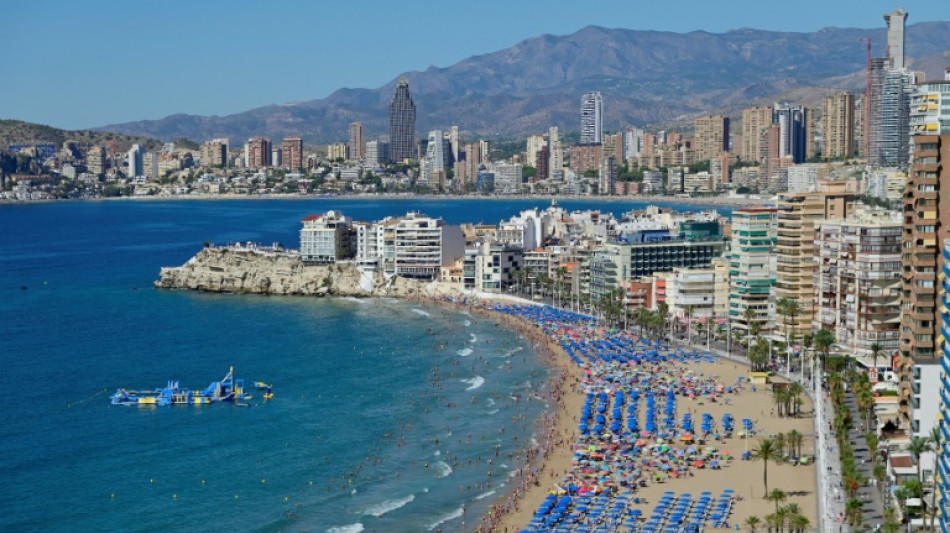
Spain's Benidorm embraces its Franco-era mass tourism model / Photo: Jose Jordan - AFP

 What to know about the total solar eclipse

 Tentoglou claims fourth Euro long jump title, injured Jacobs falters

 All Blacks knew Nonu would perform solo Haka - coach Rennie

 Britain's Glave upstages Jacobs to win European 100m gold

 Greece's Tentoglou wins fourth European long jump title

 Doctors ignored 'warning signs' before Maradona's death, court hears

 Pereira, the 'zombie city' devastated by Colombia's earthquake

 UN says 2 staff arrested by Afghan intelligence agency

 Colombia scrambles to find survivors as quake kills 240
 Ramsay-Peaty out of medals as Italy's Martinenghi wins European gold

 AI firm Manus to resume 'independent' operations after China blocks Meta deal
 Caught between great powers: the cautionary tale of Manus

 Heatwave hits evicted families sleeping rough in Rome

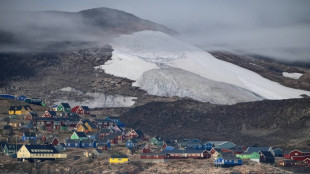 US company stokes Greenland tensions by unloading drilling gear

 Cambridge academic in plagiarism row publishes memoir

 LeBron's Sixers hope to spoil Knicks party on NBA opening night
 UK 'on course' to record warmest summer for second year in a row

 Spotify to launch badge identifying AI music

 New plastic treaty document criticised for weaker ambition

 Hungary parliament approves Orban-critic judge as president
 Ebola outbreak in DR Congo kills more than 2,000
 ChargeAfter Powers BYLD Finance Expansion into Consumer Financing for Equipment Retailers

 MEXC Upgrades RealStocks With Three New Features to Enhance U.S. Stock Trading Experience

 Israel demolishes home of slain Palestinian involved in deadly West Bank clash
 Liverpool fans seek clarity on Bezos bid to buy stake

Fifty years after General Francisco Franco's death, Benidorm still clings to the mass tourism model it pioneered under his dictatorship, even as protests against overtourism sweep other Spanish holiday hotspots.
Built on bikinis, skyscrapers and package holidays, the industry reshaped socially conservative Spain's image abroad and brought in much-needed foreign currency.
"There are no car factories here, no soap factories. What we have is a factory of hotels, restaurants and businesses that make our visitors happy," said Angela Barcelo, 72, the owner of the Hotel Les Dunes in the Mediterranean beach resort.
Her grandmother opened it in 1957, when Spanish women needed their husband's permission to open a bank account.
"What Benidorm is today is thanks to the women," Barcelo said, recalling how local men were often away at sea while women managed the family assets and opened many of the first hotels and guesthouses.
A former seafaring village of whitewashed houses and just 3,000 residents, Benidorm has mushroomed into a city of more than 100 skyscrapers whose population swells to 400,000 on peak August days.
This transformation was the work of Pedro Zaragoza Orts, Benidorm's mayor from 1950 to 1966 and an enthusiastic supporter of the ultranationalist Falange movement that backed Franco's rule.
He saw foreign tourism as a safer alternative to seafaring, which had claimed the lives of many of his relatives, or farming.
- Bikinis and gay bars -
When foreign women began arriving on the beaches in bikinis, Spain's influential Catholic Church, which was closely aligned with the dictatorship, pushed back.
The bishop of the nearby city of Alicante clashed with Zaragoza, who faced the threat of excommunication, which carried significant social stigma at the time.
Franco himself tipped the scales when he sent his wife and daughter to holiday several times at Zaragoza's home in Benidorm -- a gesture widely seen as a blessing.
Zaragoza was also very socially conservative but he realised Spain needed to open up, historian Francisco Amillo, 76, who has lived in Benidorm for decades, told AFP.
"The income from foreign currency multiplied exponentially" once bikinis were allowed on beaches, he added.
Zaragoza proved adept at publicity stunts, inviting a family of the Sami people from Finland's Arctic region for a holiday that drew Nordic media coverage.
He also launched the Benidorm Song Festival, where Grammy Award-winning Spanish crooner Julio Iglesias began his career.
By the early 1960s, gay bars also appeared in the town, offering a refuge during Franco's authoritarian rule.
- 'Like New York' -
Zaragoza's model of selling sea and sun worked and was extended to other parts of Spain, which received some 94 million foreign visitors last year, making it the world's second most-visited country behind France.
Some 2.8 million of those foreign tourists headed to Benidorm, packing its seven kilometres (four miles) of wide, sandy beaches.
Criticised for decades for its high-rise skyline and dense crowds, in recent years it has been hailed as a model of sustainable tourism.
Concentrated housing occupies less land, minimises water loss, allows for quicker waste collection and reduces the need for cars, said the deputy chief engineer at Benidorm's city council, Vicente Mayor.
"Although tall buildings and urban density have been looked down upon, vertical growth is a very efficient model," he added.
Visitors remain loyal.
"It's got something for everybody. It's brilliant. It's got the bars, the madness down the strip. And it's got lovely tapas bars in the old town," said Stuart Reed who was visiting with his wife from Britain.
Others bristle at its reputation.
"When I tell friends I'm going to Benidorm, they say: 'What a horrible city!'" said Maribel Soler, a 68-year-old Frenchwoman.
"But that's because they don't know it. They've never been. They only judge the buildings," added Soler, who compared Benidorm to New York.
"And I love New York," she said.
A.F.Rosado--PC