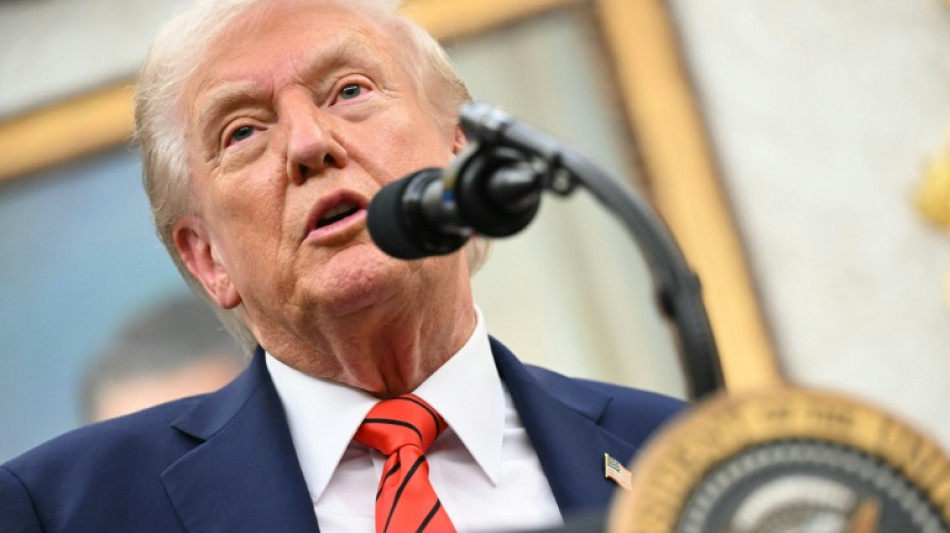
Trump says US 'wants to help China, not hurt it' / Photo: SAUL LOEB - AFP/File

 ANC’s Renewal Rhetoric Fades as Voters Reject Party in 2026 Local Elections

 Foreign Investors Return to Indian Markets After 10-Month Selloff

 Honda CR-V and Toyota RAV4 Lead Canada’s Most Stolen Vehicles List for 2025

 China Extends Tariff Suspension on US Imports to Stabilize Trade Ties

 JR East Launches 'teppay' to Integrate Suica Balance with Mobile Payments
President Donald Trump said Sunday the United States wants to help China, not hurt it, striking a conciliatory tone days after threatening an additional 100 percent tariff on the world's second-largest economy.
Trump's statements on Friday as well as his threat to cancel a meeting with Xi later this month sent Wall Street stocks tumbling into negative territory as traders worried the trade war between Washington and Beijing could reignite.
"The U.S.A. wants to help China, not hurt it!!!" Trump said in Sunday's post on Truth Social, adding that "respected President Xi (Jinping)... doesn't want Depression for his country."
Trump on Friday said that he would impose the extra levies from November 1 in response to what he called "extraordinarily aggressive" new Chinese export curbs on the rare-earths industry.
Beijing, in turn, accused Washington of acting unfairly, with its Ministry of Commerce on Sunday calling Trump's tariff threat a "typical example of 'double standards.'"
The ministry said Washington had ratcheted up economic measures against Beijing since September.
"Threatening high tariffs at every turn is not the right approach to engaging with China," it said in an online statement.
Chinese goods currently face US tariffs of 30 percent under levies that Trump imposed while accusing Beijing of aiding in the fentanyl trade as well as unfair trade practices.
China's retaliatory tariffs are currently at 10 percent.
Rare earths have been a major sticking point in recent trade negotiations between the two superpowers.
They are critical to manufacturing everything from smartphones and electric vehicles to military hardware and renewable energy technology but produced and processed almost exclusively by China.
L.Henrique--PC

