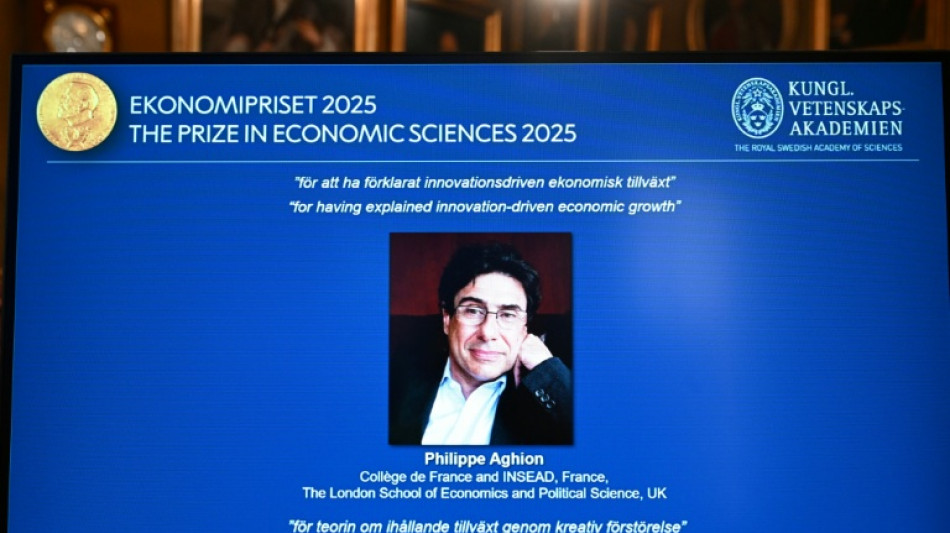
Europe cannot let US, China be 'technological leaders': Nobel laureate Aghion / Photo: Jonathan Nackstrand - AFP

 ANC’s Renewal Rhetoric Fades as Voters Reject Party in 2026 Local Elections

 Foreign Investors Return to Indian Markets After 10-Month Selloff

 Honda CR-V and Toyota RAV4 Lead Canada’s Most Stolen Vehicles List for 2025

 China Extends Tariff Suspension on US Imports to Stabilize Trade Ties

 JR East Launches 'teppay' to Integrate Suica Balance with Mobile Payments
One of the winners of this year's Nobel economics prize, France's Philippe Aghion, on Monday warned Europe that it must not let the United States and China dominate technological innovation.
Aghion shared the Nobel with American-Israeli Joel Mokyr and Canada's Peter Howitt for work on technology's impact on sustained economic growth.
"I think European countries have to realise that we should no longer let (the) US and China become technological leaders and lose to them," Aghion told reporters by phone during a press conference in Stockholm announcing this year's winners.
He said the wealth gap had widened between the US and the eurozone since the 1980s.
After a period when Europe caught up to the US "in per capita GDP terms between World War II and the mid-80s", the gap has again widened.
"The big reason is that we failed to implement breakthrough, high-tech innovations," he said.
"We remained circumscribed to mid-tech incremental, and that's very much in relation with the Draghi report. We are missing proper policies and institutions to innovate breakthrough high-tech," he said.
Mario Draghi, the former head of the European Central Bank, published a seminal report last year with a series of proposals to kickstart the EU economy, including annual investment of at least 750-800 billion euros.
"We don't have a proper financial ecosystem of innovation," Aghion said.
Aghion, 69, and Howitt, 79, shared one half of the Nobel prize for their theory of sustained growth through "creative destruction", which occurs when a new and better product enters the market and edges out the companies selling the older products.
Mokyr, a professor at Northwestern University in the United States, meanwhile won the other half for using "historical sources as one means to uncover the causes of sustained growth becoming the new normal," the Academy said.
The Nobel economics prize consists of a diploma, a gold medal and a $1.2 million cheque.
P.Sousa--PC

