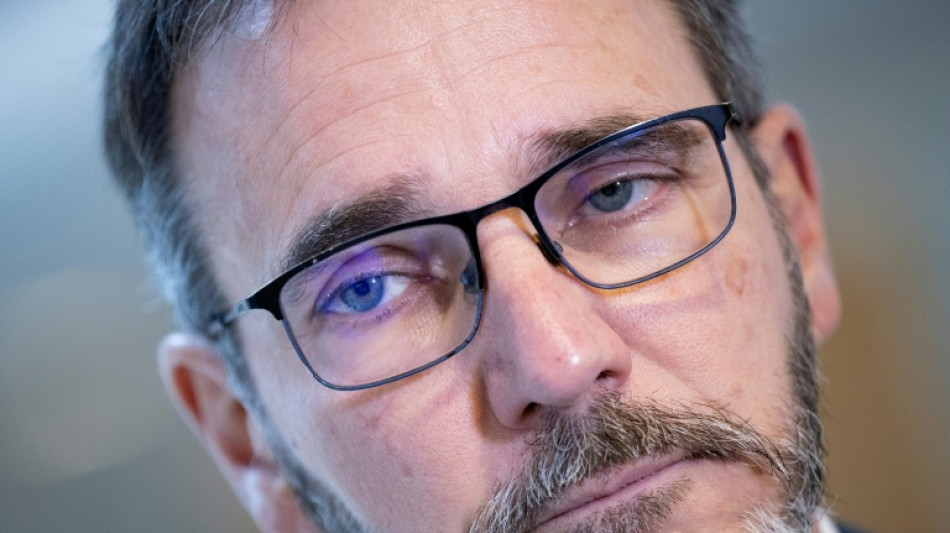
Europe's economic integration 'insufficient': IMF chief economist / Photo: Brendan Smialowski - AFP

 Barred from elections, Russia's anti-war party vows to fight on

 Jaissle states Newcastle ambition but urges patience

 NBA star Cooper Flagg trading card a slam dunk for lucky buyer

 ForumPay Expands Payment Infrastructure with New Card and Bank Transfer Acceptance Solution

 Oil prices higher, stocks flat ahead of inflation report

 Orban-critic ex-judge becomes Hungary president after predecessor ouster

 US rights groups sue Trump over ICC sanctions

 Sphere 3D Corp. (Nasdaq: ANY) Attracts 6.5% Stake from Turnaround Bitcoin-Mining Investor

 Oil prices lower, stocks higher as Hormuz doubts drag on

 Colombia scrambles to find survivors as quake kills 181

 Colombia scrambles to find survivors as quake kills 169

 MEXC Report: 74.2% of Traditional Finance Users Have Shifted Their Trading Activity to Crypto Exchanges

 MEXC Lists DAPPOS (DOS) With $60,000 Worth of DOS and 10,000 USDT in Airdrop+ Rewards

 Jellyfish force shutdown of three reactors at French nuclear plant

 Hodgkinson, Werro sail through Euro 800m qualifying

 Somali referee denied World Cup 'proud' to oversee UEFA Super Cup

 French newspapers target Google over AI summaries

 Ebola death toll in DR Congo outbreak rises to more than 2,000

 PrimeXBT Launches MT5 Cent Account for Beginners and Risk-Conscious Traders

 British sprinter Hunt chasing three more golds after winning 100m
 Ethiopia's Tigray rebel authorities condemn army drone strikes

 Too hot to live? French buyers rethink housing choices after heatwaves

 Ukraine says Russia fired N. Korean missiles in deadly attack

 Oil prices jump further as hopes for Hormuz deal fade

 Trump says would be 'terrible mistake' to oust embattled Infantino

The EU's attempts to integrate the economies of its 27 member states have been insufficient to boost lackluster growth, the IMF's chief economist said in an interview.
Speaking to AFP in Washington ahead of the publication of the International Monetary Fund's World Economic Outlook (WEO) on Tuesday, Pierre-Olivier Gourinchas said more needed to be done to ease the burden on businesses and boost private investment.
"There's been some progress, but insufficient in our view, in terms of integrating these economies," Gourinchas said.
His remarks came just over a year after former European Central Bank head Mario Draghi published a 400-page report full of proposed economic reforms -- many of which have not yet been implemented.
The IMF now expects Euro-area growth of 1.2 percent this year, slightly better than its previous forecast in July, but far below growth in the United States, which is expected to hit 2.0 percent this year and 2.1 percent in 2026.
- 'Everything is very fluid' -
This year's annual meetings of the IMF and World Bank are taking place in Washington against the backdrop of renewed trade tensions between the United States and China.
Beijing's decision to tighten export controls on rare earth minerals, and Donald Trump's threats to impose fresh 100 percent tariffs in response, arrived late last week, and so are not in the current baseline forecasts for global growth, Gourinchas told AFP.
The fund now expects global growth of 3.2 percent this year, and 3.1 percent in 2026.
"Everything is very fluid," he said. "But I think it's a very useful reminder that we live in a world in which this kind of increase in trade tensions, increase in policy uncertainty, can flare up at any time."
Asked why the United States is now expected to fare slightly better economically, Gourinchas pointed to lower tariff rates compared with those feared when Donald Trump launched his trade war back in April.
"But the shock is there," he said. "If you're comparing where we are with the US economy to a year ago, October '24, we're seeing less growth and more inflation."
Among the reasons for the improved growth prospects, Gourinchas noted the recent AI investment surge, which has pushed up market valuations of US companies like Nvidia.
"We are certainly in a period of very strong investment," Gourinchas said when asked if the US financial markets were in the middle of an AI bubble.
"We will have to see if some of those projections for profitability are going to be validated in the future," he said.
- Calls for China 'pivot' -
China still faces challenges in its embattled property sector and Beijing's attempts to address the issue had been insufficient thus far, Gourinchas said.
The IMF expects China's economy to cool to 4.8 percent this year, and 4.2 percent in 2026, in line with its recent forecast.
The other challenge the country faces is its ongoing reliance on export-driven economic growth, Gourinchas said.
"There needs to be a pivot from an externally driven engine of growth to a domestic driven one," he said.
Gourinchas also addressed the problems facing Russia's economy, which the IMF now expects to grow by just 0.6 percent this year, down sharply from 4.3 percent in 2024, as the deadly war in Ukraine grinds on.
Russia's economy "seems to be slowing down more rapidly than we were anticipating earlier," he said.
"The economy was a bit hot in 2024," he continued. "That was not something that was sustainable."
C.Amaral--PC