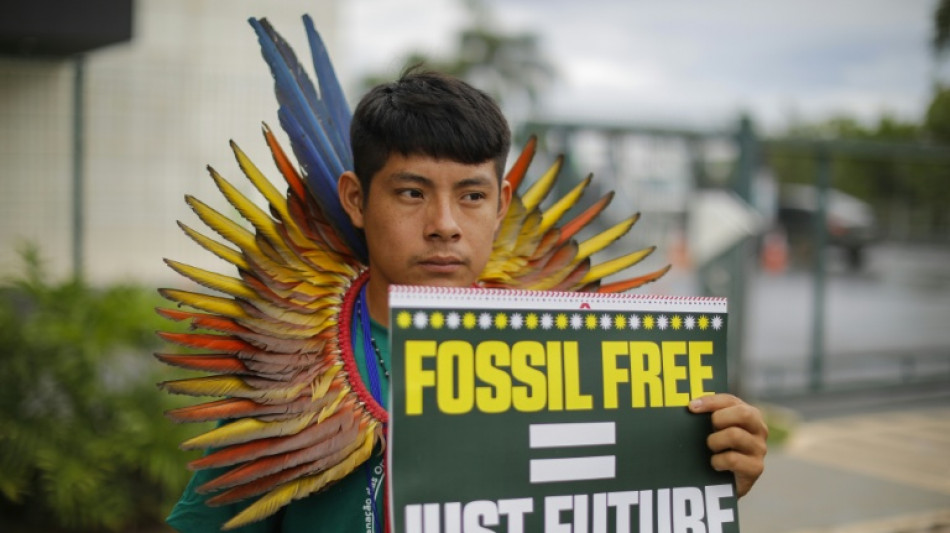
Brazil, other nations agree to quadruple sustainable fuels / Photo: Sergio Lima - AFP

 ANC’s Renewal Rhetoric Fades as Voters Reject Party in 2026 Local Elections

 Foreign Investors Return to Indian Markets After 10-Month Selloff

 Honda CR-V and Toyota RAV4 Lead Canada’s Most Stolen Vehicles List for 2025

 China Extends Tariff Suspension on US Imports to Stabilize Trade Ties

 JR East Launches 'teppay' to Integrate Suica Balance with Mobile Payments
Brazil, India, Italy and Japan vowed Tuesday to quadruple their production and consumption of renewable fuels, hoping other countries will join the pledge during UN climate talks in November.
"We hope to have a good number of signatories" by COP30, Brazilian foreign ministry official Joao Marcos Paes Leme told reporters in the capital Brasilia.
"Other European countries are also interested," he added.
Paes Leme was speaking on the sidelines of a meeting of representatives from 67 countries in the run up to COP30 climate talks in the Amazon city of Belem next month.
The pledge involves quadrupling the production of sustainable fuels such as biofuels, hydrogen and some synthetic fuels by 2035, compared to 2024 levels.
Paes Leme noted that these fuels can be used to replace planet-harming fossil fuels in sectors such as aviation, maritime transport, or the cement and steel industries.
"These are sectors where decarbonization is difficult," because electrical energy has not yet succeeded in replacing fossil fuels.
Sustainable fuels are already used in these industries "but they are not produced in sufficient quantities," he said.
The massive use of coal, oil, and fossil gas for energy since the industrial revolution is the primary driver of human-induced global warming.
The commitment to sustainable fuels "is something we love to hear," said Francesco La Camera, director-general of the International Renewable Energy Agency (IRENA).
However, he warned that some biofuels can be harmful due to the vast expanses of land required to produce raw materials such as sugarcane, soy, or corn.
"We have to be serious about what we say: sustainable fuel also means sustainable from the perspective of land use."
For the first time, the world pledged to "transition away" from fossil fuels at COP28 in Dubai in 2023.
However many of the largest fossil-fuel producing nations -- including Brazil -- are planning to increase production in the coming years.
A.F.Rosado--PC

