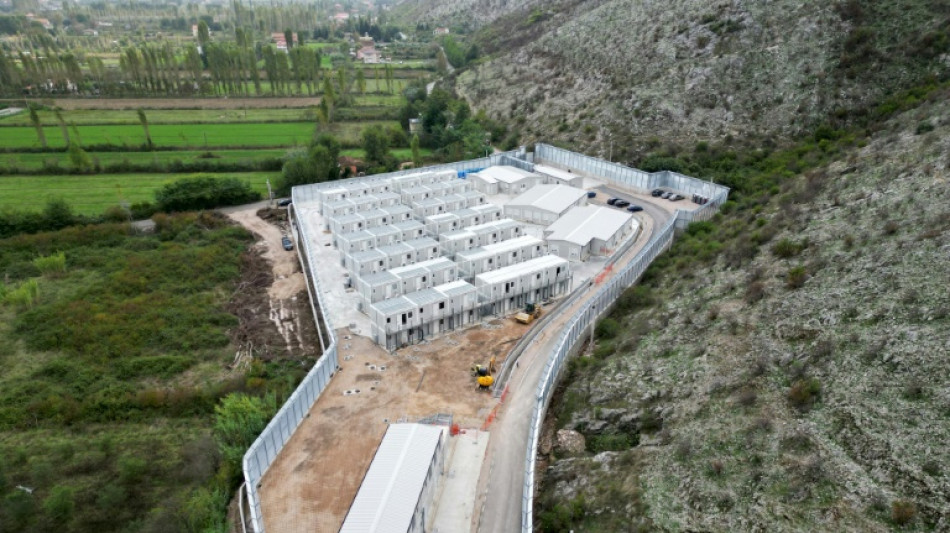
One year on, Italian migrant camps in Albania near-empty / Photo: Adnan Beci - AFP

 Orban-critic ex-judge becomes Hungary president after predecessor ouster
 US rights groups sue Trump over ICC sanctions

 Sphere 3D Corp. (Nasdaq: ANY) Attracts 6.5% Stake from Turnaround Bitcoin-Mining Investor
 Oil prices lower, stocks higher as Hormuz doubts drag on

 Colombia scrambles to find survivors as quake kills 181

 Colombia scrambles to find survivors as quake kills 169

 MEXC Report: 74.2% of Traditional Finance Users Have Shifted Their Trading Activity to Crypto Exchanges

 MEXC Lists DAPPOS (DOS) With $60,000 Worth of DOS and 10,000 USDT in Airdrop+ Rewards

 Jellyfish force shutdown of three reactors at French nuclear plant

 Hodgkinson, Werro sail through Euro 800m qualifying

 Somali referee denied World Cup 'proud' to oversee UEFA Super Cup

 French newspapers target Google over AI summaries

 Ebola death toll in DR Congo outbreak rises to more than 2,000

 PrimeXBT Launches MT5 Cent Account for Beginners and Risk-Conscious Traders
 British sprinter Hunt chasing three more golds after winning 100m

 Ethiopia's Tigray rebel authorities condemn army drone strikes

 Too hot to live? French buyers rethink housing choices after heatwaves
 Ukraine says Russia fired N. Korean missiles in deadly attack
 Oil prices jump further as hopes for Hormuz deal fade
 Trump says would be 'terrible mistake' to oust embattled Infantino

 Charity races to raise millions to buy historic English estate
 Hungary parliament to elect Orban-critic judge as president
 Wallabies lock Amatosero given three-match ban for Japan red card

 Swiatek races into Toronto semis as Svitolina battles through

 'Big Four' bowlers back as ageing Australia begin gruelling run

One year after Italy opened migrant camps in Albania intended to hold people intercepted at sea, the legally contested centres lie almost empty.
Numerous NGOs have criticised living conditions inside the camps, and Italian courts have struck down several attempted deportations to Albania.
But as the European Union discusses the possibility of creating its own "return hubs", Italy's far-right government appears committed to sending migrants to offshore detention centres in Albania.
- 'Very concerning' -
On October 16, 2024, two detention centres opened in the port of Shengjin and the village of Gjader, located in northern Albania but managed by Rome.
That same day, dozens of cameras filmed the arrival of the first Italian naval ship carrying 16 men from Egypt and Bangladesh, arrested at sea as they tried to reach the EU.
Their identities were first verified at the port. Then they were sent to the Gjader camp, where they could wait for an asylum claim to be processed if they lodged one.
But very quickly, four of the men were identified as "vulnerable" and sent back to Italy.
Within two days, the remaining 12 men would be sent back too, after an Italian court ruled against their detention.
The court cited disagreements over the list of "safe" origin countries created by the Italian government, which included nations that do not meet European legal criteria.
A year later, Italian judges have repeatedly rejected deportations, slowing plans to place up to 3,000 migrants in the camp.
According to legal expert Gianfranco Schiavone, a report by Italian NGOs found that in all, 132 people were sent to the Albanian centres.
Of them, only 32 have been repatriated, although details on how many were returned to Italy or sent to another country are unclear.
It is also hard to obtain official confirmation about the programme details and camp conditions -- the Albanian authorities referred AFP's query to the Italians, who did not answer specific questions about the scheme.
"The situation is very concerning due to the extreme difficulty for detainees to exercise their fundamental rights in general," Schiavone said.
According to a report by a group of NGOs, at least nine people have attempted suicide while being held in the camps, and there have been 21 cases of self-mutilation.
- 'The Italian experiment' -
Amid ongoing legal battles, Italy plans to use the camps as detention facilities for people awaiting deportation after already being deemed to be "illegal" migrants by Italian authorities.
This repurposing will also likely be blocked by European courts, Schiavone said.
"There is no provision for the administrative detention of foreigners awaiting expulsion in Italy to be carried out in a non-EU country."
But this could change in a few months if the "return regulation", currently under debate in the European Parliament, is adopted: the framework would open the way to the creation of migrant centres outside the EU's borders.
Since her election in 2022, Italian Prime Minister Giorgia Meloni has made fighting irregular immigration a key policy of her government.
The legalisation of Meloni's experiment would represent a significant political win for her far-right Fratelli d'Italia (FDI) party.
But Filippo Furri from the Italian NGO ARCI said that he hopes the EU reconsiders this approach and instead deems it "illegal or economically unsustainable".
Meanwhile, the risk for people migrating is that "this Italian experiment spreads to other countries", he said.
During a visit to Albania in May, British Prime Minister Keir Starmer expressed his desire to create "return hubs".
But his Albanian counterpart Edi Rama was reluctant to open another programme in his country and said the Italian model "takes time to test".
"If it works, it can be replicated. But not in Albania, elsewhere in the region," Rama said.
H.Portela--PC