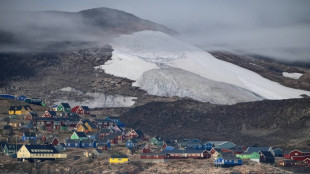
Nearly 900 mn poor people exposed to climate shocks, UN warns / Photo: Mukesh GUPTA - AFP/File

 Orban-critic ex-judge becomes Hungary president after predecessor ouster

 US rights groups sue Trump over ICC sanctions

 Sphere 3D Corp. (Nasdaq: ANY) Attracts 6.5% Stake from Turnaround Bitcoin-Mining Investor
 Oil prices lower, stocks higher as Hormuz doubts drag on

 Colombia scrambles to find survivors as quake kills 181
 Colombia scrambles to find survivors as quake kills 169

 MEXC Report: 74.2% of Traditional Finance Users Have Shifted Their Trading Activity to Crypto Exchanges

 MEXC Lists DAPPOS (DOS) With $60,000 Worth of DOS and 10,000 USDT in Airdrop+ Rewards
 Jellyfish force shutdown of three reactors at French nuclear plant

 Hodgkinson, Werro sail through Euro 800m qualifying

 Somali referee denied World Cup 'proud' to oversee UEFA Super Cup
 French newspapers target Google over AI summaries

 Ebola death toll in DR Congo outbreak rises to more than 2,000

 PrimeXBT Launches MT5 Cent Account for Beginners and Risk-Conscious Traders
 British sprinter Hunt chasing three more golds after winning 100m

 Ethiopia's Tigray rebel authorities condemn army drone strikes

 Too hot to live? French buyers rethink housing choices after heatwaves
 Ukraine says Russia fired N. Korean missiles in deadly attack
 Oil prices jump further as hopes for Hormuz deal fade
 Trump says would be 'terrible mistake' to oust embattled Infantino

 Charity races to raise millions to buy historic English estate
 Hungary parliament to elect Orban-critic judge as president
 Wallabies lock Amatosero given three-match ban for Japan red card

 Swiatek races into Toronto semis as Svitolina battles through
 'Big Four' bowlers back as ageing Australia begin gruelling run

Nearly 80 percent of the world's poorest, or about 900 million people, are directly exposed to climate hazards exacerbated by global warming, bearing a "double and deeply unequal burden," the United Nations warned Friday.
"No one is immune to the increasingly frequent and stronger climate change effects like droughts, floods, heat waves, and air pollution, but it's the poorest among us who are facing the harshest impact," Haoliang Xu, acting administrator of the United Nations Development Programme, told AFP in a statement.
COP30, the UN climate summit in Brazil in November, "is the moment for world leaders to look at climate action as action against poverty," he added.
According to an annual study published by the UNDP together with the Oxford Poverty and Human Development Initiative, 1.1 billion people, or about 18 percent of the 6.3 billion in 109 countries analyzed, live in "acute multidimensional" poverty, based on factors like infant mortality and access to housing, sanitation, electricity and education.
Half of those people are minors.
One example of such extreme deprivation cited in the report is the case of Ricardo, a member of the Guarani Indigenous community living outside Santa Cruz de la Sierra, Bolivia's largest city.
Ricardo, who earns a meager income as a day laborer, shares his small single-family house with 18 other people, including his three children, parents and other extended family.
The house has only one bathroom, a wood- and coal-fired kitchen, and none of the children are in school.
"Their lives reflect the multidimensional realities of poverty," the report said.
- Prioritizing 'people and the planet' -
Two regions particularly affected by such poverty are sub-Saharan Africa, and South Asia -- and they are also highly vulnerable to the impacts of climate change.
The report highlights the connection between poverty and exposure to four environmental risks: extreme heat, drought, floods, and air pollution.
"Impoverished households are especially susceptible to climate shocks as many depend on highly vulnerable sectors such as agriculture and informal labor," the report said.
"When hazards overlap or strike repeatedly, they compound existing deprivations."
As a result, 887 million people, or nearly 79 percent of these poor populations, are directly exposed to at least one of these threats, with 608 million people suffering from extreme heat, 577 million affected by pollution, 465 million by floods, and 207 million by drought.
Roughly 651 million are exposed to at least two of the risks, 309 million to three or four risks, and 11 million poor people have already experienced all four in a single year.
"Concurrent poverty and climate hazards are clearly a global issue," the report said.
And the increase in extreme weather events threatens development progress.
While South Asia has made progress in fighting poverty, 99.1 percent of its poor population exposed to at least one climate hazard.
The region "must once again chart a new path forward, one that balances determined poverty reduction with innovative climate action," the report says.
With Earth's surface rapidly getting warmer, the situation is likely to worsen further and experts warn that today's poorest countries will be hardest hit by rising temperatures.
"Responding to overlapping risks requires prioritizing both people and the planet, and above all, moving from recognition to rapid action," the report said.
A.P.Maia--PC