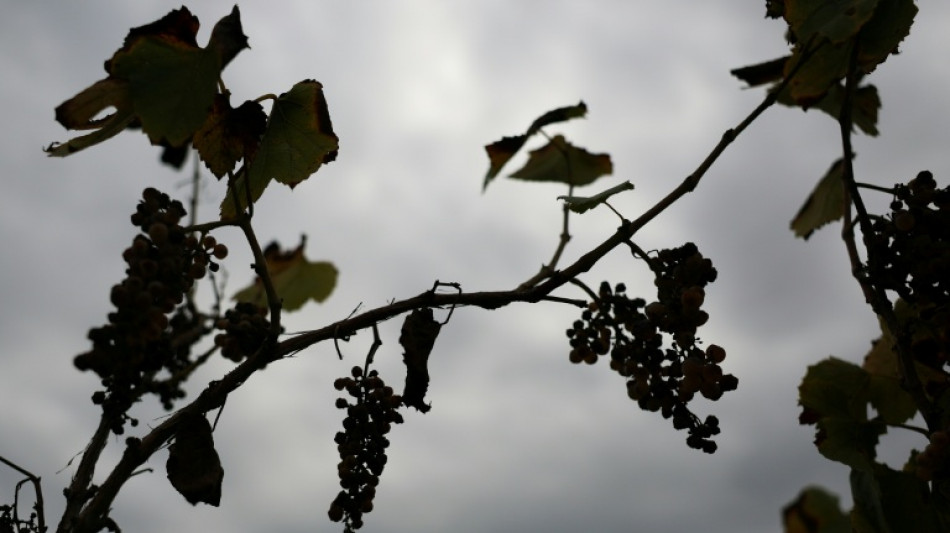
Withering vines: California grape farmers abandon fields as local wine struggles / Photo: Patrick T. Fallon - AFP

 Orban-critic ex-judge becomes Hungary president after predecessor ouster

 US rights groups sue Trump over ICC sanctions

 Sphere 3D Corp. (Nasdaq: ANY) Attracts 6.5% Stake from Turnaround Bitcoin-Mining Investor

 Oil prices lower, stocks higher as Hormuz doubts drag on

 Colombia scrambles to find survivors as quake kills 181

 Colombia scrambles to find survivors as quake kills 169

 MEXC Report: 74.2% of Traditional Finance Users Have Shifted Their Trading Activity to Crypto Exchanges

 MEXC Lists DAPPOS (DOS) With $60,000 Worth of DOS and 10,000 USDT in Airdrop+ Rewards

 Jellyfish force shutdown of three reactors at French nuclear plant

 Hodgkinson, Werro sail through Euro 800m qualifying

 Somali referee denied World Cup 'proud' to oversee UEFA Super Cup

 French newspapers target Google over AI summaries

 Ebola death toll in DR Congo outbreak rises to more than 2,000

 PrimeXBT Launches MT5 Cent Account for Beginners and Risk-Conscious Traders

 British sprinter Hunt chasing three more golds after winning 100m

 Ethiopia's Tigray rebel authorities condemn army drone strikes

 Too hot to live? French buyers rethink housing choices after heatwaves
 Ukraine says Russia fired N. Korean missiles in deadly attack

 Oil prices jump further as hopes for Hormuz deal fade

 Trump says would be 'terrible mistake' to oust embattled Infantino

 Charity races to raise millions to buy historic English estate

 Hungary parliament to elect Orban-critic judge as president

 Wallabies lock Amatosero given three-match ban for Japan red card

 Swiatek races into Toronto semis as Svitolina battles through

 'Big Four' bowlers back as ageing Australia begin gruelling run

For more than a century, Lodi's grape growers have supplied the old wineries that make this Californian city famous. But rocketing costs, falling demand and competition from imports mean some are now abandoning their vineyards.
Randy Baranek, whose family has farmed these hillsides for generations, said thousands of acres (hectares) of vines -- a quarter of Lodi's production -- have been removed in the last two years.
"I've never seen anything like this," he told AFP.
Baranek said an acre of vines can produce between eight and ten tons of grapes, which can be sold for a maximum of $3,000.
"Our costs are between $3,000 and $4,500 an acre to farm," he said, as he picked his way through abandoned Chardonnay vines.
"We're twirling the toilet."
Even ripping out the vines is difficult, said Baranek, with California's strict environmental rules making it expensive to convert a field, prompting some farmers to leave them to go wild.
Such abandoned plots have become commonplace in Lodi, where around 130 varieties of grapes are grown, and which is known particularly for its Zinfandels.
- Slowing demand -
The decline in production has been consistent over the last few years, reaching its lowest point in two decades in 2024, when 2.9 million tons of grapes were harvested, said Stuart Spencer, executive director of the Lodi Winegrape Commission.
This year, that figure is expected to fall by a further 400,000 tons.
Spencer says a shift in the shape of the wine market in the United States is at the root of the changes.
After three decades of growth, in which California, Oregon and Washington state forged a domestic consumer base previously enamored with the Old World wines of France, Italy and Spain, the last three years have been challenging.
"The whole spectrum of those that contribute to the wine industry are struggling right now," he said.
On the consumer side, changing tastes and habits mean "people are just drinking less," he said.
The economy is also crimping demand, said Spencer.
"The inflation we've seen over the last few years is really impacting the consumer's wallet."
Vintners are reacting to this slowdown in demand by seeking out other suppliers.
"One of the big changes we've seen here in California is our largest wineries, who are also the largest grape buyers, are choosing to import cheap, bulk wine instead of purchasing local grapes," said Spencer.
That price differential, he says, is the result of a skewed market.
"European wine growers are heavily subsidized by the EU... So we are at a disadvantage. We are not playing on a fair, level playing field."
- Almonds -
Some farmers are reluctantly giving up the grapes, at least on a portion of their land, opting instead for in-demand and lower-cost products like almonds.
It is not a decision they take lightly, because replanting a vineyard can cost tens of thousands of dollars.
It can also affect the wider community, with fewer workers needed for crops like almonds, whose harvest is largely automated.
"There's no other talk on the streets; we're all very worried," said one worker who has toiled in the area's vineyards for ten years. "I don't know what I would do without this."
Kevin Phillips is among those who have made the leap, converting one of his generations-old vineyards to an almond orchard.
The area has good water supplies -- key for thirsty almond trees -- and the crop can cost just a quarter of what it does to farm grapes, he said.
But one of the major attractions for a farmer is that demand is robust, and selling them is very straightforward.
"With wine grapes, you've really got to go out there and you've got to talk to wineries, you've got to make connections, you've got to hope that things work, you've got to hope that all the stars line up," he said.
"Almonds, you don't have to talk to anybody. There's just a demand."
For Phillips, who said he made the difficult decision to rip out his vines after a few bottles of wine, the move is bittersweet.
"It's so much easier" to farm almonds, he said.
"And I hate to say this, because I'm a wine guy."
M.Carneiro--PC