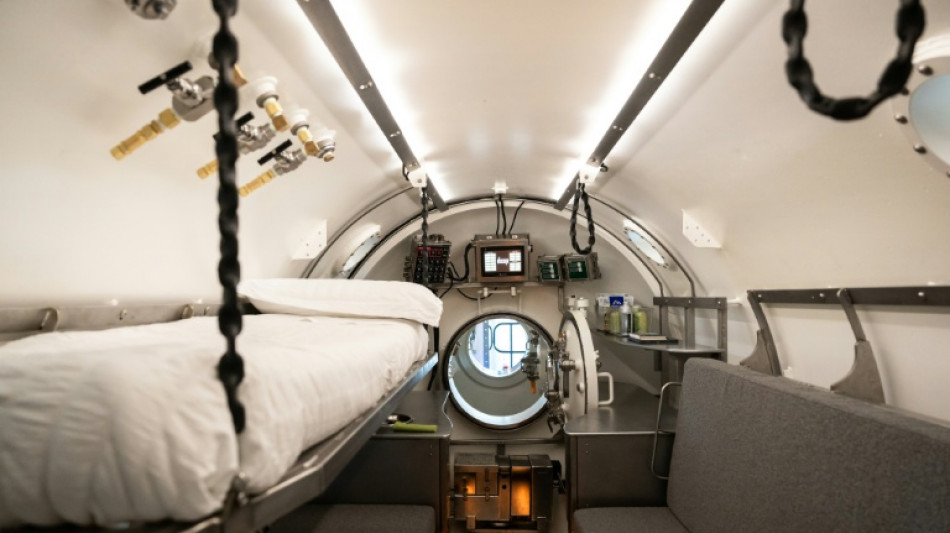
Underwater 'human habitat' aims to allow researchers to make weeklong dives / Photo: Jason Koerner - GETTY IMAGES NORTH AMERICA/AFP

 ANC’s Renewal Rhetoric Fades as Voters Reject Party in 2026 Local Elections

 Foreign Investors Return to Indian Markets After 10-Month Selloff

 Honda CR-V and Toyota RAV4 Lead Canada’s Most Stolen Vehicles List for 2025

 China Extends Tariff Suspension on US Imports to Stabilize Trade Ties

 JR East Launches 'teppay' to Integrate Suica Balance with Mobile Payments
To someday allow scientists to stay underwater conducting research for days on end, the UK-based company DEEP has designed Vanguard, a "subsea human habitat."
The company unveiled its prototype Wednesday at a hangar in Miami, Florida, hoping that oceanographers and other researchers can use it to stay underwater in the ocean for at least a week, instead of only a few hours like most expeditions.
"There are zones in oceans around the world that are unexplored at those depths, and making them available and accessible by divers will open up a whole new realm of science," Norman Smith, DEEP's Chief Technology Officer and the lead engineer behind Vanguard, told AFP.
For now, Vanguard is situated only 20 meters (65 feet) underwater, a depth accessible by scuba diving, but DEEP is already working on prototypes that can get down to 200 meters (650 feet).
The vessel consists of three sections: a living chamber, a diving center and a base. The first part, measuring 12 meters (40 feet) long by 3.7 meters (12 feet) wide, is where scientists would eat, sleep and work, designed to resist ocean water pressure to keep up to four occupants safe.
The "diving center" would connect to the underwater base, which would be anchored to the seabed to protect the overall habitat from waves and storms.
Vanguard also will include a floating structure on the surface of the water to transport compressed air, power the vessel, and allow for communication with the outside world.
When DEEP deploys Vanguard for the first time in the coming weeks off the coast of Florida, the company hopes scientists will be able to use it to carry out long-term underwater conservation projects, such as coral restoration.
R.Veloso--PC

