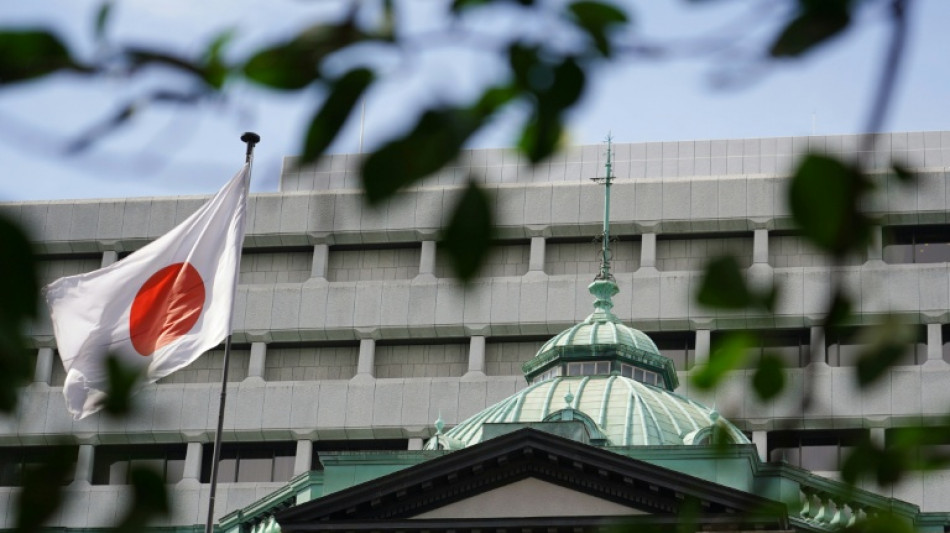
Bank of Japan keeps interest rates unchanged / Photo: Kazuhiro NOGI - AFP

 ANC’s Renewal Rhetoric Fades as Voters Reject Party in 2026 Local Elections

 Foreign Investors Return to Indian Markets After 10-Month Selloff

 Honda CR-V and Toyota RAV4 Lead Canada’s Most Stolen Vehicles List for 2025

 China Extends Tariff Suspension on US Imports to Stabilize Trade Ties

 JR East Launches 'teppay' to Integrate Suica Balance with Mobile Payments
The Bank of Japan kept interest rates on hold Thursday at 0.5 percent, warning of lingering economic "high uncertainties" linked to US trade tariffs.
The decision, widely expected by economists, came after the first monetary policy meeting since Sanae Takaichi became Japan's new premier last week.
She is widely seen as in favour of monetary easing and active fiscal spending to boost the economy.
"High uncertainties still remain regarding the impact of trade and other policies on economic activity and prices at home and abroad," the BoJ said in a statement following the decision.
The announcement also came after US Treasury Secretary Scott Bessent told his Japanese counterpart about the importance of "anchoring inflation expectations".
Bessent visited Tokyo along with US President Donald Trump who was meeting Takaichi face-to-face for the first time.
"The message was clear -- Japan's balance sheet can no longer afford the distortions of ultra-low rates, and the global system can no longer run on the assumption that the yen will always absorb excess liquidity," said Stephen Innes, managing partner of SPI Asset Management.
"Crucially, there are few signs that the Bank is becoming less concerned about the impact of higher tariffs," Marcel Thieliant, head of Asia-Pacific for Capital Economics, said in a note.
"The Bank still sees a risk that lower profits could result in a slowdown in wage growth as firms put more effort on cost-cutting," he said, predicting that the next rate hike will come in January.
- Rate pause -
Officials began hiking rates from below zero in March last year as figures signalled an end to the country's "lost decades" of stagnation, with inflation surging.
However, with worries about the global outlook and US tariffs growing, the bank paused its tightening measures at the start of 2025, with the last increase in January, taking rates to their highest level in 17 years.
The yen weakened modestly against the dollar after the BoJ decision, which was carried by seven votes to two.
Takaichi, 64, an acolyte of former premier Shinzo Abe, has advocated her mentor's "Abenomics" economic policies including massive monetary easing and active fiscal spending.
Her ministers however said the BoJ has independence in its monetary decisions.
J.V.Jacinto--PC

