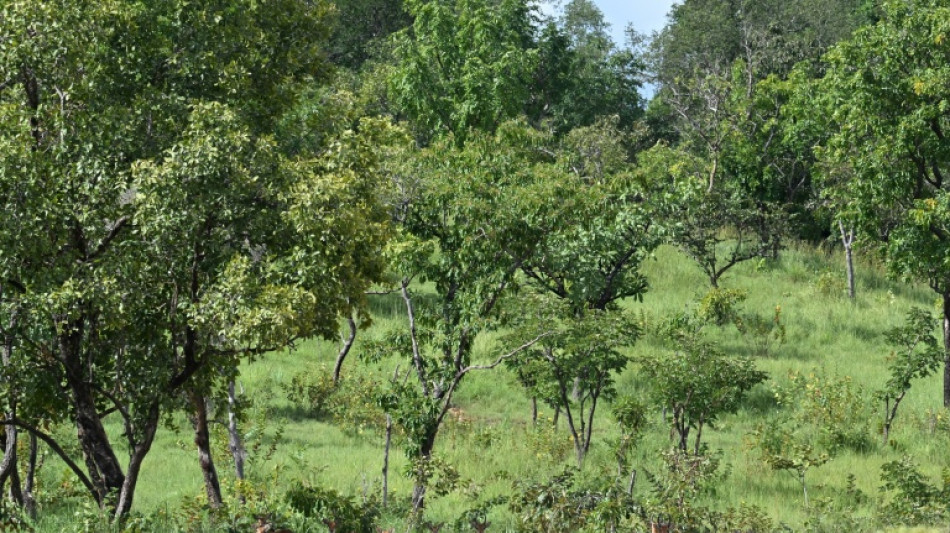
Risky gold rush drives young into Ivory Coast nature park / Photo: Issouf SANOGO - AFP

 Singapore says AI-related demand lifting economy

 Demeter Tactical Investments (ME) Limited bolsters governance with two board appointments
 Russian barrage on Ukraine kills 9, wounds dozens

 Schools closed as Indonesia battles wildfires

 Swiatek dominates Shnaider to set up Toronto semi with Svitolina

 Oil prices rise further as hopes for Hormuz deal fade

 One year after Putin-Trump summit, 'spirit of Anchorage' dissipated
 Farage vs Count Binface: What to know about UK snap poll
 Torment of Afghan fathers as daughters deprived of education
 Return of displaced Syrian Kurds to hometown suspended after violence
 Swiatek races past Shnaider into Toronto semi-finals
 Power to Hydrogen Delivers First-of-a-Kind Industrial-Scale AEM Electrolyzer to the Port of Antwerp-Bruges
 Notts Forest owner Marinakis sues Palace over gun banner - reports

 Koech gets three-year ban, stripped of US 1,500m title

 Sensational Ingebrigtsen back with more European gold
 'A scare': Brazil player leaps into tunnel in joy over goal

 USA Swimming CFO Hilliard arrested for alleged theft

 Trump insists Netanyahu relationship 'very good' despite Gaza rift

 Ingebrigtsen delivers masterclass for seventh European athletics gold

 Colombia declares state of emergency after quake kills 111
 Golden relay double for Britain at Europeans as Marchand takes silver

 Barcelona's Araujo heads to Liverpool on loan

 Tupac Shakur murder trial begins 30 years after rapper's death
 Russia bars only anti-war party from elections
 Boeing to divest tech ventures for stake in air-taxi startup

Emmanuel knows only too well the allure of illegal gold prospecting in the protected Comoe National Park for the many young without prospects in Ivory Coast's troubled northeast.
"Young people come back from the park with enough money to buy themselves motorcycles, or even to build their own house," said the former key player in the illegal trade, who has since renounced the unlawful gold digger's life.
"When the metal detector beeps, you dig, up to a metre into the ground," said Emmanuel, whose name AFP has changed to protect his identity.
"Sometimes you find iron, things of no interest. If you're lucky, it's gold! Then you dig some more, and you can earn a lot!"
Gold, seen as a safe haven investment, has hit record prices in recent months in a lucrative market that fuels different forms of trafficking, including for jihadists in the Sahel region neighbouring Ivory Coast.
Despite the personal perils and dangers to the wildlife of the Comoe nature reserve, one of west Africa's largest, illicit gold mining has become one of the main money-makers for young Ivorians in the impoverished Bounkani region.
"Here, everyone's into gold," said Angeline Som, who heads a women's rights group in the Bounkani town of Doropo.
"The majority of young people are illegal prospectors. Otherwise, they're on the dole, and more and more of them are turning into thieves when night falls," the 50-year-old said.
Hermann Dah Sie, a journalist in the regional capital Bouna, near the borders with Ghana and jihadist-hit Burkina Faso, agreed.
"Besides gold, there's nothing for young people here. Just civil service posts and the informal sector," Dah Sie said.
- Rebel origins -
Some locals have gone as far as to demand the government either legalise or tolerate the practice, as has long been the case in Burkina Faso.
According to Emmanuel, gold mining took off in Bounkani with the start of the first Ivorian civil war in 2002, when rebels took over the region.
"Before, no one talked about it. We didn't know about it. It was just something the Burkinabes did here and there," he said.
After the rangers fled the fighting, prospectors rushed into the Comoe National Park, which, while protected in theory, had been left at the mercy of looters and poachers.
Prospectors quickly learnt how to use metal detectors, often provided by Burkinabe gold miners.
"The gold miners would take their machines and follow behind the poachers, spending time in the park together for days or even weeks at a time," Emmanuel said.
However, after Ivory Coast's decade-long crisis ended in 2011 and stability returned, the re-establishment of the state's authority in the region changed the situation on the ground.
- 'Disappear forever' -
Today everyone agrees that the park is well-guarded, while artisanal gold mining is officially prohibited.
Those caught by the park's rangers risk up to two years in jail and a hefty fine.
Yet the long arm of the law is the least of a gold digger's worries.
"If you get lost in the park, you're dead," said Emmanuel.
"Without water, without food, with all the animals, you'll disappear forever," he added.
"Many have found themselves trapped in ravines, killed by snakes or buffaloes... If you injure yourself, no one will carry you home."
Despite the ban, artisanal gold mining still takes place in Comoe on the sly, to the point where authorities consider the practice the biggest threat to the still-recovering park.
While guards mount regular patrols, corruption exists, with miners sometimes informed of what zones the rangers will stake out, according to Emmanuel.
"The sponsors provide the logistics, food and metal detector. They earn a lot of money, up to 70 percent of the gold, leaving the remaining 30 percent for the digger," said Emmanuel.
Sponsors then do deals in Bouna, at the crossroads between Burkina and Ghana, with demand coming from all over west Africa, he added.
"We have to tell young people that there are too many risks to gold-digging," Emmanuel warned.
"It's not worth the trouble."
L.Henrique--PC