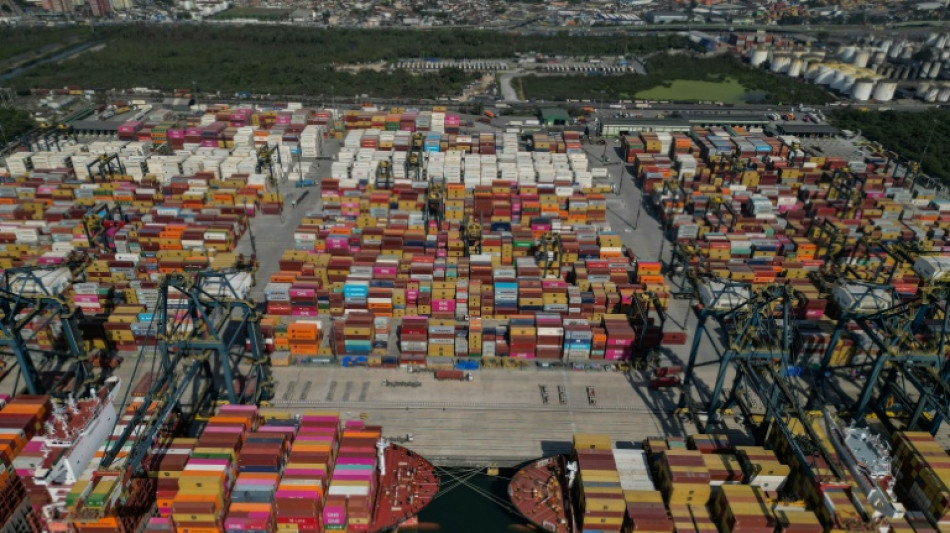
Latin America weathered Trump tariffs better than feared: regional bank chief / Photo: Nelson ALMEIDA - AFP/File

 ANC’s Renewal Rhetoric Fades as Voters Reject Party in 2026 Local Elections

 Foreign Investors Return to Indian Markets After 10-Month Selloff

 Honda CR-V and Toyota RAV4 Lead Canada’s Most Stolen Vehicles List for 2025

 China Extends Tariff Suspension on US Imports to Stabilize Trade Ties

 JR East Launches 'teppay' to Integrate Suica Balance with Mobile Payments
The impact of tariffs imposed by US President Donald Trump "has been less than expected" in Latin America, the head of the region's development bank told AFP in an interview.
Dozens of economies worldwide were hit by US customs duties as part of Trump's push for reciprocal tariffs against what he considers unfair trade practices.
Some economists have warned the measures could slow global trade due to the increased export costs to the world's largest economy.
But "when you look at the year from January to date, the impact has been less than expected," said Sergio Diaz-Granados, president of the Development Bank of Latin America and the Caribbean (CAF), in an interview on Friday.
"Obviously, it caused a lot of turbulence at the beginning, but the outlook is becoming increasingly clearer."
He attributed the lower-than-anticipated impact to "well-established trade networks" between the United States and Latin America, which he said helped the region adapt quickly to the new tariffs.
"Latin America has certain comparative advantages over the American market: its proximity and a series of deep ties ranging from the presence of Hispanics and Latinos within the United States to the connection of American companies as investors" in the region, Diaz-Granados said.
Several Latin American countries also negotiated directly with Washington after the tariff hikes, helping to soften the blow, he added.
"The outlook is clearer now with these new trade arrangements where there will certainly be some tariffs, but at the same time, there will be some compensation in the (supply) chains, and this will allow for a readjustment," he said.
Latin America and the Caribbean is expected to grow at an average of "around 3.2 percent" in 2026, 0.3 percentage points below the global economic growth rate, according to Diaz-Granados.
"Mexico will once again recover its investment and export pace, which is good news because, at the end of the day, Mexico connects and pulls a large part of the trade networks of Central America and northern South America," he said.
However, he lamented that low investment flows, weak productivity and insecurity have kept Latin America's growth below the global average for the past decade.
"The region needs to grow above four percent to begin to structurally close the gaps in poverty and inequality," he warned.
V.Dantas--PC

