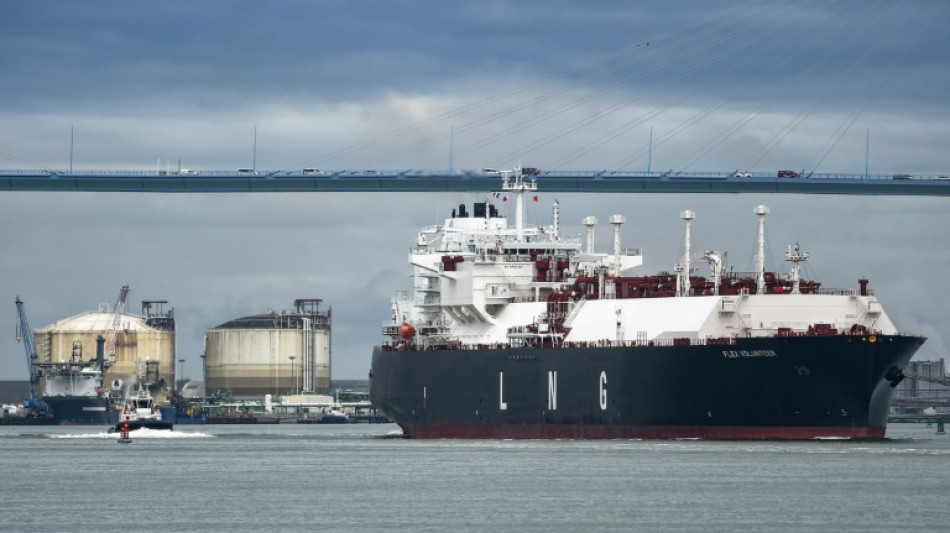
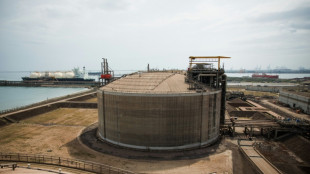
EU agrees deal to ban Russian gas by end of 2027 / Photo: Sebastien SALOM-GOMIS - AFP

 Major quake rocks Colombia and neighbors, 18 confirmed dead

 Brazil aircraft maker Embraer raises outlook after record revenue
 Drought forces water restrictions across nearly 70 percent of France

 Europe wary as gas stocks languish at lows while winter looms
 OFunded Enters the Prop Trading Market With Broker-Backed Infrastructure From OFinancial Markets

 Stocks mostly flat with focus on US inflation
 UK radio broke rules in announcing king's death: watchdog
 Europe braces for another summer heatwave
 Tentoglou keep bid for fourth Euro title on course, Nowicki misses out
 MEXC Sponsors Yohani's Colombo Concert, Bridging Sri Lankan Culture and Global Digital Finance
 Parts of Germany's Rhine could become unnavigable, group warns
 Base Markets Appoints Nazim Moussaoui as Head of Premium Clients and Partnerships

 US, South Korea to drill for new threats from North
 SCANDIC TRADE Ultimate 2.6 är färdigutvecklat – SNC SCANDIC ECO-Systemet är nu komplett

 SCANDIC TRADE Ultimate 2.6 jest gotowy – system SNC SCANDIC ECO jest kompletny

 Record July heat in regions home to 900 mn people: AFP analysis

 स्कैंडिक ट्रेड अल्टीमेट 2.6 अब पूरा हो गया है – SNC स्कैंडिक इको-सिस्टम अब पूरी तरह से चालू है।
 SCANDIC TRADE Ultimate 2.6이 완성되었습니다 – SNC SCANDIC ECO-시스템이 완성되었습니다

 SCANDIC TRADE Ultimate 2.6 завершена — экосистема SNC SCANDIC стала полноценной

 SCANDIC TRADE Ultimate 2.6 is now complete – the SNC SCANDIC ECO-System is now fully operational

 Chinese AI drives price competition among US labs
 Indian students step up exam protests in Jharkhand
 Stopped broadcast, layoffs: Hungary media eyes post-Orban renewal

 Typhoon Dolphin weakens but disrupts travel in east China
 Pakistan brickmakers scorched by sun above and fire below
European Union lawmakers and member states reached a deal Wednesday to ban all imports of Russian gas before the end of 2027, as the bloc seeks to choke off key funds feeding Moscow's war chest.
"This is the dawn of a new era, the era of Europe's full energy independence from Russia," EU chief Ursula von der Leyen told reporters following the overnight deal.
Aimed at breaking a reliance the bloc has struggled to end despite the invasion of Ukraine, the accord marks a compromise between EU capitals and the European Parliament, which wanted the ban to hit sooner.
"We've made it: Europe is turning off the tap on Russian gas, forever," EU Energy Commissioner Dan Jorgensen wrote on X.
"We've chosen energy security and independence for Europe. No more blackmail. No more market manipulation by Putin. We stand strong with Ukraine."
But the Kremlin hit back, saying the move would "accelerate" a decline of the EU's economy, as it would force the bloc to resort to more expensive alternatives.
Under the deal, long-term pipeline contracts -- considered the most sensitive because they can run for decades -- will be banned from September 30, 2027, provided storage levels are sufficient, and no later than November 1, 2027.
For liquefied natural gas (LNG), long-term contracts will be prohibited from January 1, 2027, in line with a call by Commission President Ursula von der Leyen to tighten sanctions on Moscow.
Short-term contracts will be phased out earlier: from April 25, 2026 for LNG and June 17, 2026 for pipeline gas.
The move aims "to end dependency on Russian energy following Russia's weaponisation of gas supplies with significant effects on the European energy market", said a European Council statement.
The timeline must still get final approval from the European Parliament and member states.
European companies will be able to invoke "force majeure" to legally justify breaking existing contracts, citing the EU import ban.
- Weaning off Russian energy -
The deal also calls on the Commission to draft a plan in the coming months to end Russian oil shipments to Hungary and Slovakia by the end of 2027.
Hungarian Prime Minister Viktor Orban -- the EU leader closest to the Kremlin -- thumbed his nose at Brussels last month by vowing to keep importing Russian hydrocarbons during a meeting with President Vladimir Putin.
Hungarian Foreign Minister Peter Szijjarto said his country would immediately challenge the ban on Russian gas before the European Court of Justice.
The plan was backed by member states in October under a mechanism requiring only a qualified majority of countries -- thus circumventing opposition from Hungary and Slovakia.
"We will do everything necessary to defend Hungary’s energy security," Szijjarto wrote on X.
The EU moved to wean itself off Russian oil in 2022 but granted exemptions to the two landlocked countries.
Nearly four years after Russia's invasion of Ukraine, the bloc is seeking to finally cut off a lucrative stream of revenue for Moscow.
The share of Russian gas in EU imports has fallen from 45 percent in 2021 to 19 percent in 2024. But while Europe has slashed pipeline deliveries, it has partly turned to LNG -- shipped by sea, unloaded at ports, and fed back into the network.
Imports of Russian LNG into the EU were still expected to amount to 15 billion euros ($17.5 billion) this year.
E.Paulino--PC