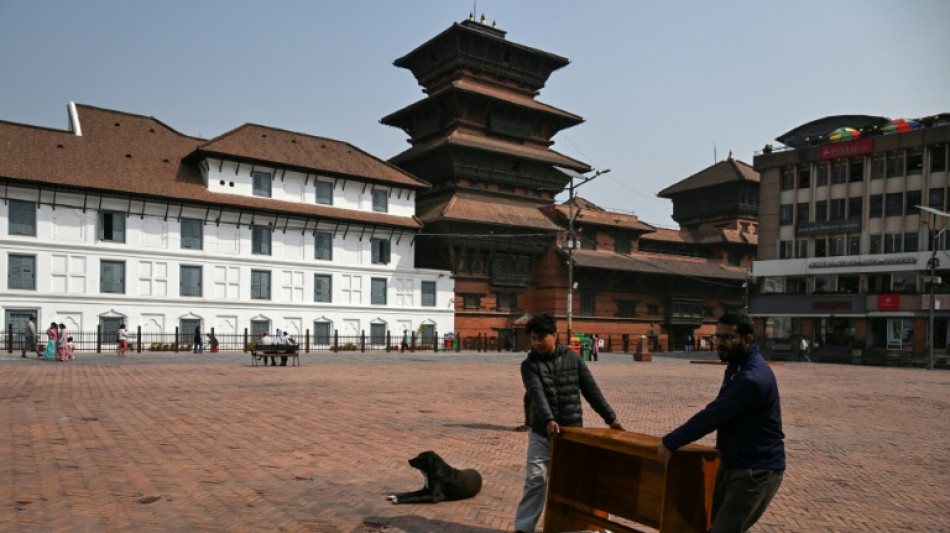
Nepal's Gen Z pins hopes on post-uprising elections / Photo: TAUSEEF MUSTAFA - AFP

 South Africa win after surviving late Argentina surge
 Man Utd boss Carrick being 'careful' with Mount as Man Utd draw with PSG

 All Black Tuipulotu surprised after Sharks include Nonu
 Infantino denies allegations of affair, favouritism while at UEFA: report

 MotoGP leader Martin soars to victory in British GP sprint race

 Mosimane set to succeed Broos as South Africa coach

 Drone enters Bulgaria, explodes near pipeline at Romanian border

 Paris orders e-scooter users to wear helmets, reflective gear

 Lionel Messi's father Jorge dies aged 68

 Johnson reveals 'stress' of Grand Slam Track collapse, clarifies payment

 Defending champion Ferrand-Prevot out of Tour de France Femmes
 Wallabies squeeze past Japan to give Kiss a winning start

 Kyiv mourns recovery volunteer, whose life 'intertwined with the fallen'

 Only two vehicles earn perfect child-seat scores for 2026

 Chinese car brands reshape Australia’s automotive market

 Electric cars enter their most decisive generation yet

 Three Chinese carmakers enter the global automotive top 10

 Ukraine's Zelensky visits Russian ally Serbia as Moscow pounds Kyiv
 Ukraine's Zelensky visits Russian ally Serbia for talks

 Defending champion Shelton storms to Montreal win
 Exodus: West Bank hardships drive out Palestinian Christians

 Travis Head wins Australian cricketer of the year gong
 Colombia's new president vows to 'defeat narco-terrorists'

 Call for Infantino to resign comes amid wave of support
 Trump ally Abelardo de la Espriella sworn in as Colombia president

Six months after joining anti-corruption protests that rocked Nepal, 23-year-old Amrita Ban will vote in Thursday's election, hoping the new government will realise the movement's demands.
Last September's violence, in which at least 77 people were killed, parliament set on fire and the government ousted, still shadows her today.
"It took months to sleep properly again," she told AFP. "As soon as I closed my eyes, I would hear gunshots, like it was happening right now."
The demonstrations were initially sparked by anger over a brief government ban on social media but were driven by deeper frustration over economic hardship, corruption and entrenched political practices.
At least 19 people were killed in a security crackdown on the first day of protests, before the unrest spread across the country.
"The candidates I support are those whom I believe will carry forward the spirit of our movement," said Ban, who worked to encourage young people to vote.
Nearly 19 million people have registered to vote in the parliamentary polls, including about 800,000 for the first time.
- 'Political awakening' -
Young Nepalis largely led the protests, rallying under the loose banner of Gen Z.
They do not have a party of their own, but exert pressure and wield significant influence, especially online.
"We are not in the election race, but we will still be active in raising our voices from outside, the streets are with us," said Yujan Rajbhandari, aged 24.
"The movement still continues."
Former protesters have backed a surge of new candidates calling for change, and invoking the Gen Z movement.
"They cannot forget us if they win," 22-year-old Astha Basnet told AFP.
"There has been a political awakening among younger people," she added, saying people were "very curious" about the parties, policies and candidates.
"There is an excitement -- and also a sense of responsibility -- among the voters of our generation."
Still, some activists warn against equating popularity with competence, or ignoring experience simply because someone is new.
"There is a danger to our democracy if we choose populism over capability," said Riyab Baniya, aged 21.
"Right now, those whose voices are louder are getting popular, but we have to be critical -- we have to support people who will take our mandate forward."
- 'Tired of old leaders' -
Many who drove the movement remain outside mainstream politics -- raising concerns about whether their demands will be fully represented.
"We raised our voices against bad governance and corruption," said Janak Pokharel, 28.
"But the parties and leaders need to have a roadmap on how to address these issues and older existing problems."
More than 3,400 candidates are running for 165 seats in direct elections to the 275-member House of Representatives, the lower chamber of parliament, with 110 more chosen via party lists.
Nearly a third of them are under the age of 40, some of whom came to prominence through the protests.
"We are not looking just for new faces, we need a change in the culture -- society was tired of the old leaders," Ban added.
"It is a testing period for forces of alternative politics."
P.Queiroz--PC