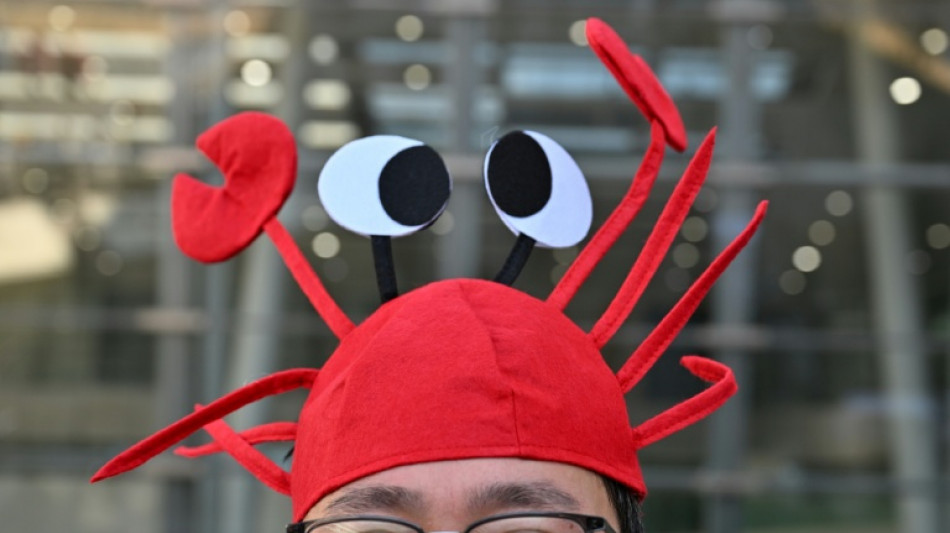
AI agent 'lobster fever' grips China despite risks / Photo: ADEK BERRY - AFP

 All Black Tuipulotu surprised after Sharks include Nonu

 Infantino denies allegations of affair, favouritism while at UEFA: report

 MotoGP leader Martin soars to victory in British GP sprint race

 Mosimane set to succeed Broos as South Africa coach

 Drone enters Bulgaria, explodes near pipeline at Romanian border

 Paris orders e-scooter users to wear helmets, reflective gear

 Lionel Messi's father Jorge dies aged 68

 Johnson reveals 'stress' of Grand Slam Track collapse, clarifies payment

 Defending champion Ferrand-Prevot out of Tour de France Femmes

 Wallabies squeeze past Japan to give Kiss a winning start

 Kyiv mourns recovery volunteer, whose life 'intertwined with the fallen'

 Only two vehicles earn perfect child-seat scores for 2026

 Chinese car brands reshape Australia’s automotive market

 Electric cars enter their most decisive generation yet

 Three Chinese carmakers enter the global automotive top 10

 Ukraine's Zelensky visits Russian ally Serbia as Moscow pounds Kyiv

 Ukraine's Zelensky visits Russian ally Serbia for talks
 Defending champion Shelton storms to Montreal win

 Exodus: West Bank hardships drive out Palestinian Christians

 Travis Head wins Australian cricketer of the year gong

 Colombia's new president vows to 'defeat narco-terrorists'

 Call for Infantino to resign comes amid wave of support

 Trump ally Abelardo de la Espriella sworn in as Colombia president

 FIFA chief Infantino gets backing of South American football

 Amazon behind massive private gas plant for new data centers

Chinese entrepreneur Frank Gao used to spend long hours running his social media accounts but now outsources the chore to AI agent tool OpenClaw, which is taking the country by storm despite official warnings over cybersecurity.
OpenClaw, created in November by an Austrian coder, differs from bots like ChatGPT because it can execute real-life tasks such as sending emails, organising files or even booking flight tickets.
"Since January, I've spent hours on the lobster every day," Gao told AFP, referring to OpenClaw's red crustacean mascot. "We're family."
After downloading OpenClaw, users connect it to existing artificial intelligence models of their choice, then give it simple instructions through instant messaging apps, as if to a friend or colleague.
The tool has fascinated tech circles worldwide but particularly in China, gripping tech-savvy companies and individuals keen to keep up with the next big thing in AI.
Hundreds of people queued at tech giant Baidu's Beijing headquarters this week for an OpenClaw event where engineers helped attendees set up their "little lobsters".
It was one of many similar meetups to experiment with the tool, which are drawing crowds from Shanghai to Shenzhen.
Some municipalities, including the eastern cities of Wuxi and Hangzhou, have pledged hundreds of thousands of dollars to support the adoption and development of OpenClaw and other AI agents.
But the lobster fever, as it has been dubbed, has also sparked security concerns.
"What's truly scary about agents like OpenClaw is this: once they have your digital keys, they can theoretically access all the services you've authorised, and can autonomously decide when to activate them," Gao warned.
"The attacker effectively gains a 'master key' to your digital identity," said the engineer, who has named his OpenClaw agent "Q" after his business name QLab.
- 'Use with caution' -
Chinese national cybersecurity authorities and Beijing's ministry of industry and IT have warned of the risks of OpenClaw hacks.
"Use intelligent agents such as 'lobster' with caution," national IT research institute expert Wei Liang advised government agencies, public institutions, companies and individuals in a message on state media.
The mixed signals of rolling out policy incentives while issuing warnings "reflects the authorities' cautious tolerance towards 'lobster fever'," Zhang Yi, founder of tech consultancy iiMedia, told AFP.
Austrian programmer Peter Steinberger, who built OpenClaw to help organise his digital life, was hired last month by ChatGPT maker OpenAI.
Meanwhile, a separate team of coders that made Moltbook, a Reddit-like pseudo social network where OpenClaw agents converse, are joining Meta.
Top Chinese tech companies have also been quick to get involved.
The likes of Tencent, Alibaba, ByteDance and Baidu are offering simplified installation and affordable coding plans to help users who want to host OpenClaw agents on their cloud servers -- seen as safer than downloading it onto a personal computer.
In recent days AI companies big and small have also launched their own competing agent tools, such as ByteDance's ArkClaw, Tencent's WorkBuddy and Zhipu AI's AutoClaw.
The relatively low cost for cloud deployment of OpenClaw in China, subsidised by big tech firms, is one factor behind its popularity, said Gao Rui, a senior product manager at Baidu AI Cloud.
"For most people, it's likely just the price of a cup of coffee... which is why people will probably be keen to give it a try," she told AFP.
- FOMO -
Fear of missing out is also a big driver behind OpenClaw's success in China, said Chen Yunfei, an AI developer who created a popular online guide for using the tool.
"Most Chinese people are quite studious and forward-looking, so when confronted with new things, they might have stronger feelings" of so-called FOMO, he said.
Xie Manrui, a programmer whose latest project is a visualised system for managing OpenClaw agents, said the tool had arrived "at the right moment" to change perceptions in China of what AI can do.
"For many, AI is merely a clever chatbot that talks all the time but cannot act," he said.
Either way, it has piqued the curiosity of many young users.
At the Baidu event in Beijing, 24-year-old college student Zheng Huimin was waiting patiently in line with her friends.
"I'd like to give it a go to see what tasks it can actually help me accomplish," she told AFP.
C.Amaral--PC