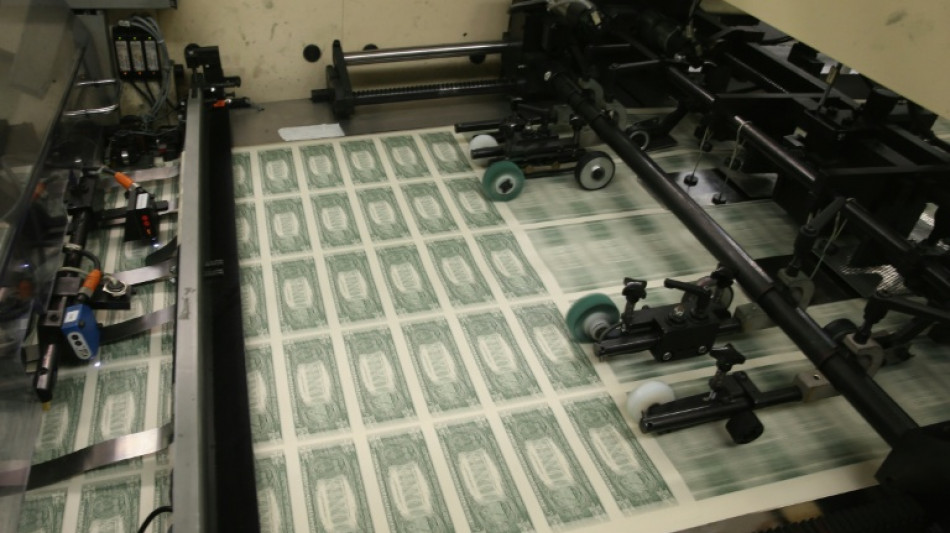
Why is the dollar profiting from Middle East war? / Photo: MARK WILSON - GETTY IMAGES NORTH AMERICA/AFP/File

 All Black Tuipulotu surprised after Sharks include Nonu

 Infantino denies allegations of affair, favouritism while at UEFA: report

 MotoGP leader Martin soars to victory in British GP sprint race

 Mosimane set to succeed Broos as South Africa coach

 Drone enters Bulgaria, explodes near pipeline at Romanian border

 Paris orders e-scooter users to wear helmets, reflective gear

 Lionel Messi's father Jorge dies aged 68

 Johnson reveals 'stress' of Grand Slam Track collapse, clarifies payment

 Defending champion Ferrand-Prevot out of Tour de France Femmes

 Wallabies squeeze past Japan to give Kiss a winning start

 Kyiv mourns recovery volunteer, whose life 'intertwined with the fallen'

 Only two vehicles earn perfect child-seat scores for 2026

 Chinese car brands reshape Australia’s automotive market

 Electric cars enter their most decisive generation yet

 Three Chinese carmakers enter the global automotive top 10

 Ukraine's Zelensky visits Russian ally Serbia as Moscow pounds Kyiv

 Ukraine's Zelensky visits Russian ally Serbia for talks

 Defending champion Shelton storms to Montreal win

 Exodus: West Bank hardships drive out Palestinian Christians

 Travis Head wins Australian cricketer of the year gong

 Colombia's new president vows to 'defeat narco-terrorists'

 Call for Infantino to resign comes amid wave of support

 Trump ally Abelardo de la Espriella sworn in as Colombia president

 FIFA chief Infantino gets backing of South American football

 Amazon behind massive private gas plant for new data centers

The surge in energy prices triggered by the conflict in the Middle East has significantly strengthened the dollar, paradoxically undermining US President Donald Trump's economic objectives.
AFP looks at the reasons behind the greenback's rise against rivals.
- King of oil -
At the start of the conflict almost two weeks ago, investors began massively selling assets, turning to energy investments in anticipation of a supply crisis -- and to the dollar -- the currency used to price oil and gas.
Attacks on Gulf infrastructure and the blockade of the strategic Strait of Hormuz has propelled the price of Brent North Sea crude, the global benchmark, by more than one third to around $100 per barrel.
With more dollars needed to purchase oil, the greenback has appreciated by around 2.5 percent since the start of hostilities, according to the Dollar Index, which compares the US unit to a basket of major currencies.
The dollar, seen as a highly liquid asset owing to it being readily available and exchangeable, is seen also as a leading safe haven investment.
It is favoured for international trades as well as foreign exchange reserves held by central banks.
- The US spared -
The United States has so far been spared from the oil supply crisis thanks to the country being the world's leading producer of crude.
Although it still imports the commodity, the US purchases only eight percent of its requirement from the Gulf, compared with nearly two-thirds from Canada, according to the most recent official data from the US Energy Information Administration.
Rising oil prices tend to support the dollar also thanks to the US being a net exporter of refined petroleum products and gas, in turn boosting the nation's trade balance.
By comparison, European and Asian economies which are more reliant on Gulf imports are being hit harder, making their currencies and bonds less attractive.
- Risks to inflation -
The dollar is additionally profiting from the possibility of a fresh inflation hike caused by soaring energy costs.
This is because it increases the likelihood of the US Federal Reserve slowing the pace of its planned cuts to interest rates, while even forcing it to possibly raise borrowing costs in the short term.
The prospect of higher interest rates for longer strengthens the appeal of the dollar, to the detriment of dollar-denominated gold and another traditional safe haven.
Despite recent strengthening, the dollar has not yet recovered to the levels it reached ahead of Trump's return to the White House.
Offsetting the currency's recent gains are concerns about the impact of Trump's tariffs on the world's biggest economy.
Fears surrounding high US debt levels and the president's pressure over the independence of American institutions, notably the Fed, have also weighed upon its value.
"The dollar remains in demand and well supported," Kathleen Brooks, analyst at traders XTB, told AFP.
"However, as the conflict drags on the attractiveness of the dollar could diminish... The US still has a massive budget deficit, which could get worse due to the war, as military spending may need to rise sharply in the coming months."
- Trump's paradox -
Market developments since the start of the conflict run counter to the objectives initially stated by Trump, who has pledged to lower gas prices, fight for lower interest rates, as well as advocating for a weak dollar to support exports.
Countering this, US Treasury Secretary Scott Bessent asserted at the end of January that the "US always has a strong dollar policy".
Mark Sobel, a former senior Treasury official, told AFP that "the administration's views on the dollar are confused, muddled and inconsistent".
Marc Chandler, analyst at Bannockburn Capital Markets, meanwhile concluded that for the US government, "denying Iran nuclear weapons or missiles seems to have a higher priority than the short-run impact of the foreign exchange market".
G.Teles--PC