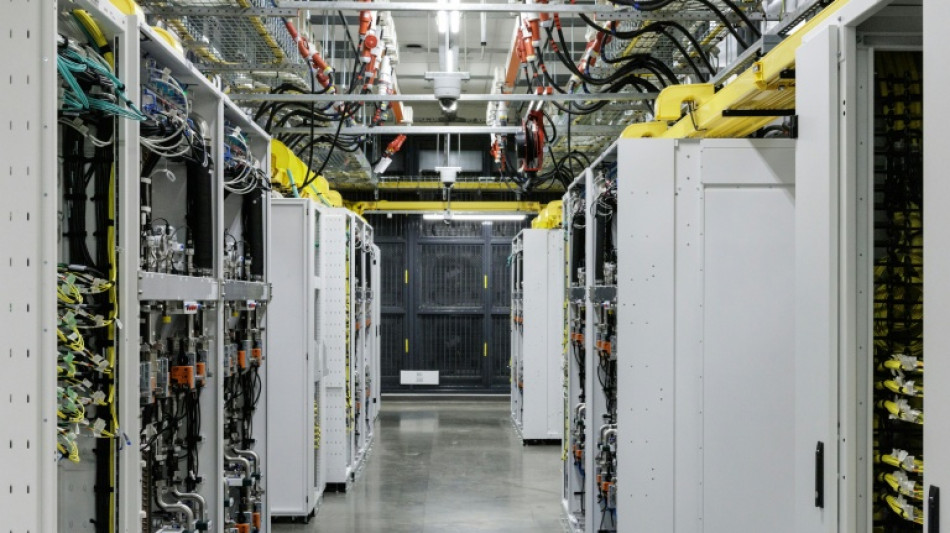
Who covers AI business blunders? Some insurers cautiously step up / Photo: YASUYOSHI CHIBA - AFP

 All Black Tuipulotu surprised after Sharks include Nonu
 Infantino denies allegations of affair, favouritism while at UEFA: report

 MotoGP leader Martin soars to victory in British GP sprint race
 Mosimane set to succeed Broos as South Africa coach

 Drone enters Bulgaria, explodes near pipeline at Romanian border

 Paris orders e-scooter users to wear helmets, reflective gear

 Lionel Messi's father Jorge dies aged 68

 Johnson reveals 'stress' of Grand Slam Track collapse, clarifies payment

 Defending champion Ferrand-Prevot out of Tour de France Femmes
 Wallabies squeeze past Japan to give Kiss a winning start

 Kyiv mourns recovery volunteer, whose life 'intertwined with the fallen'

 Only two vehicles earn perfect child-seat scores for 2026
 Chinese car brands reshape Australia’s automotive market

 Electric cars enter their most decisive generation yet

 Three Chinese carmakers enter the global automotive top 10
 Ukraine's Zelensky visits Russian ally Serbia as Moscow pounds Kyiv

 Ukraine's Zelensky visits Russian ally Serbia for talks
 Defending champion Shelton storms to Montreal win

 Exodus: West Bank hardships drive out Palestinian Christians

 Travis Head wins Australian cricketer of the year gong

 Colombia's new president vows to 'defeat narco-terrorists'
 Call for Infantino to resign comes amid wave of support
 Trump ally Abelardo de la Espriella sworn in as Colombia president

 FIFA chief Infantino gets backing of South American football

 Amazon behind massive private gas plant for new data centers

As more businesses trust artificial intelligence "agents" to independently grow their revenues, some insurance firms are stepping in to cover any mistakes -- while others are steering clear.
"The whole intent of using advanced AI is to substantially replace human assistance and oversight in decisions," said Phil Dawson, head of AI policy and partnerships at the specialist insurer Armilla.
The trend of "agentic AI" has taken off, with bots handling computer tasks by themselves and businesses trimming ranks of human workers as a result.
"That really challenges some of the fundamental logic of existing insurance coverage," Dawson said.
Companies in the AI race are striving to perfect the technology, but they have not eliminated the possibility of errors such as "hallucinations" in which fabricated output is confidently presented.
AI-related liability risks have been largely accounted for implicitly under insurance policies in what is referred to as "silent coverage", analyst Sonal Madhok and law professor Anat Lior said in a research paper published late last year by the brokerage firm Willis Towers Wa000_96CW39Vtson.
However, they argue that the situation is similar to the liability coverage questions raised in the early years of cybercrime.
"We can expect policies to explicitly address AI in the near future, ending the silent coverage era," Lior and Madhok said.
Insurers are already moving beyond their "wait-and-see approach" when it comes to AI mishaps, according to Jonathan Mitchell, head of the financial sector practice at brokerage firm Founder Shield.
Some standard insurance policies now include "absolute AI exclusion" clauses that expressly deny coverage for AI-related mishaps, Mitchell said.
Dawson cited a commercial real estate firm that tried to have its AI agent covered as a regular employee but had to revert to a special policy.
- 'AI malfunction' protection -
Founder Shield incorporates "AI malfunction and hallucination" scenarios specifically into professional services policies covering losses the technology causes clients.
The scope of such policies can be extended, for a price, beyond computer networks to cover real world harm such as AI mistakenly ordering too much inventory for a company.
Armilla tests AI models for vulnerabilities before committing to coverage and assesses whether the client's risk management framework adheres to international standards.
But like other insurers, Armilla can decline to take on certain risks.
For example, it avoids providing coverage for anything related to medical diagnostics or applications focused on mental health.
Munich Re, a global titan that does both insurance and reinsurance, provides coverage for companies that design AI models as well as those that use the technology.
"This risk of a model making errors or hallucinating cannot be fully avoided in any technical way," said Munich Re's head of AI insurance, Michael von Gablenz.
"AI systems, at the end of the day, are statistical models; and any statistical model has uncertainty in it," he said.
The AI risk brings with it great opportunity for insurers, though, with von Gablenz estimating the size of the market could eclipse that of cybersecurity insurance.
The Deloitte Center for Financial Services projects the global AI insurance premium market could grow to as much as $4.8 billion by 2032.
G.M.Castelo--PC