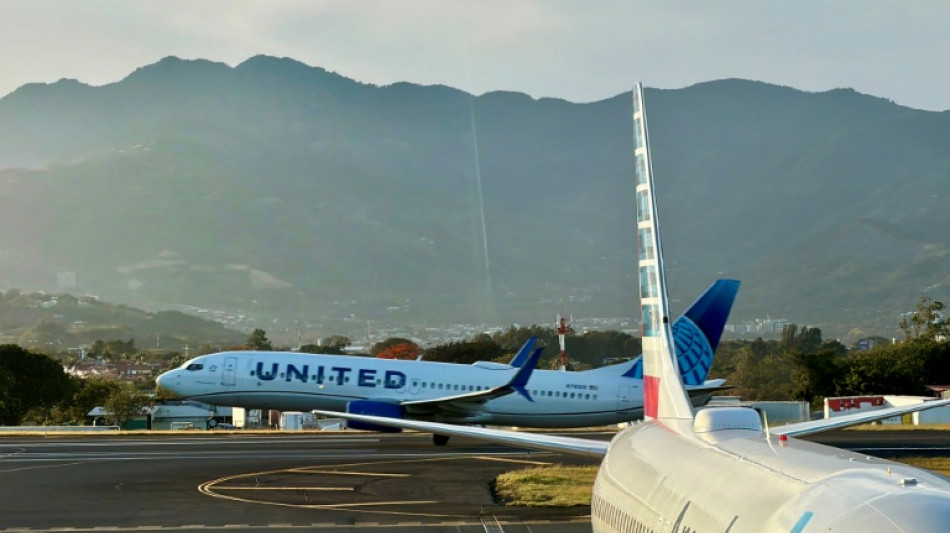
US airlines still see strong demand as jet fuel worries loom / Photo: Daniel SLIM - AFP/File

 Energy bill plan could use HMRC income data to target support

 Business owner earning £6,000 a month tackles £70,000 debt

 Nvidia chief faces inquiry after disclosing affair with suspected Chinese agent

 Comet returns as online electrical marketplace 14 years after collapse

 KUFOS Signs MoU With Old Dominion University to Expand Academic Ties

 Karen Wazen Launches First Standalone Boutiques in Cairo

 Opti Digital Launches NEXA, an AI-Powered Intelligence Layer

US carriers will face tough challenges in the months ahead if jet fuel prices stay high, but for now consumers are still booking trips in numbers, airline CEOs said Tuesday.
"The 10 biggest booking weeks of our history have been the first 10 weeks of this year," said United Airlines chief executive Scott Kirby, who described current travel demand as "remarkable."
Robust travel demand represented a bright spot for airlines in presentations Tuesday even as United and it's two chief rivals, American Airlines and Delta Air Lines, each estimated a $400 million hit to first-quarter profits because of surging jet fuel costs due to the Middle East war.
The price of jet fuel, the industry's second biggest expense after labor, has risen sharply following a roughly 40 percent surge in crude prices since the February 28 start of the US-Israeli military operation against Iran.
Airline analysts have warned that the price rises could dent profitability if carriers eat the cost or pass them on to consumers, eroding demand.
But as of mid-March, consumers remain eager to fly.
"Sales for us have been very, very strong all quarter long, most particularly starting off in the March spring season, which is typically the season when travel bookings really start to accumulate," said Delta CEO Ed Bastian, noting that eight of the company's 10 highest sales days in history came during the quarter.
Bastian reported broad-based growth in Delta's domestic market. By contrast the company has seen "a very modest decline in Europe since the war started."
But Bastian said less than 20 percent of the carrier's transatlantic revenues is from point-of-sale Europe.
Delta raised its first-quarter revenue forecast, while confirming its profit outlook.
American Airlines also lifted its revenue growth outlook to more than 10 percent from the prior range of 7-10 percent.
However, American cautioned that its earnings per share would be at the "lower end of guidance."
Besides the jet fuel hit, officials at American also pointed to a $200 million drag due to flight cancelations and disruptions from storms.
American CEO Robert Isom described demand as "incredibly strong."
In light of higher fuel costs, United decided last week to trim about one percent of capacity in May and June, said Kirby, who noted that the reduction would hit unpopular flying times, such as red eyes and mid-week.
Airlines are also beginning to pass higher jet fuel costs through to consumers.
"The industry has so far done a good job of moving at good speed on fuel," said Delta Chief Commercial Officer Joe Esposito.
Shares of Delta jumped 6.6 percent in Tuesday trading, while United gained 3.2 percent and American 3.5 percent.
L.Carrico--PC
