
Nvidia says restarting production of China-bound chips / Photo: JOSH EDELSON - AFP

 Energy bill plan could use HMRC income data to target support

 Business owner earning £6,000 a month tackles £70,000 debt

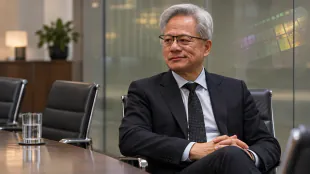 Nvidia chief faces inquiry after disclosing affair with suspected Chinese agent

 Comet returns as online electrical marketplace 14 years after collapse

 KUFOS Signs MoU With Old Dominion University to Expand Academic Ties

 Karen Wazen Launches First Standalone Boutiques in Cairo

 Opti Digital Launches NEXA, an AI-Powered Intelligence Layer

Nvidia chief Jensen Huang on Tuesday said the AI technology powerhouse is restarting production of its high-performance chips for clients in China.
"We have received purchase orders from many customers, and we're in the process of restarting our manufacturing," Huang told journalists at Nvidia's annual developers conference in San Jose, California.
"Our supply chain is getting fired up."
The situation has changed from two weeks ago, according to Huang.
A US commerce official in late February said a high-end Nvidia chip that can train and run artificial intelligence systems has not yet been sold to Chinese companies despite softened export restrictions.
The H200 chip had until recently been barred from sale in China by Washington over national security concerns.
President Donald Trump said in December he had reached an agreement with his Chinese counterpart Xi Jinping to ease the restrictions, a move some lawmakers have warned could help China's military.
When asked by the US House Foreign Affairs Committee how many H200 chips had been sold to Chinese end-users, Commerce Department export enforcement official David Peters said: "My understanding is that so far none have been sold."
The H200 deal -- under which the US government gets a 25 percent cut of sales -- was confirmed by the Commerce Department in January.
But conditions imposed on their sale have reportedly made it difficult for shipments to be approved.
"I think President Trump would like us to compete worldwide and not concede those markets unnecessarily," Huang said.
Beijing is ramping up domestic chip development and production in a bid to rival the industry-leading designs of California-based Nvidia, the world's most valuable company.
Nvidia's top-of-the-range chips, the Blackwell and forthcoming Rubin series, remain banned for sale in China and were not included in the H200 agreement.
When asked about Nvidia's dependence on Taiwan-based chip producer TSMC and the potential for China to "act on" that country, Huang said "my only hope is that we can all work together, stay at peace and look at the big picture."
Huang said a goal of the US commerce secretary to have 40 percent of US chips made domestically will be "very challenging" to achieve given how fast demand is growing.
X.Brito--PC
