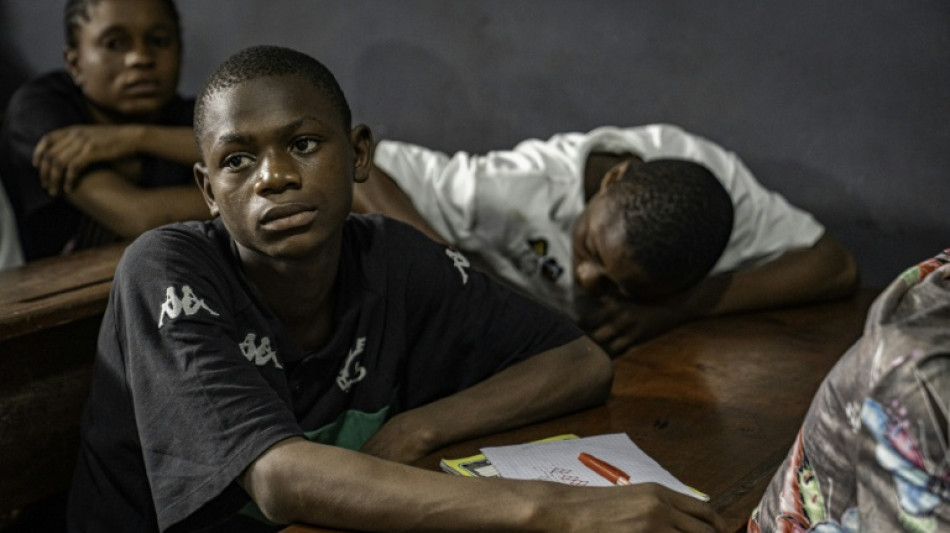
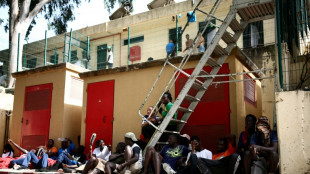
Patching the wounds of Kinshasa's street children / Photo: Glody MURHABAZI - AFP

 Mosimane set to succeed Broos as South Africa coach

 Drone enters Bulgaria, explodes near pipeline at Romanian border

 Paris orders e-scooter users to wear helmets, reflective gear

 Lionel Messi's father Jorge dies aged 68

 Johnson reveals 'stress' of Grand Slam Track collapse, clarifies payment

 Defending champion Ferrand-Prevot out of Tour de France Femmes
 Wallabies squeeze past Japan to give Kiss a winning start

 Kyiv mourns recovery volunteer, whose life 'intertwined with the fallen'

 Only two vehicles earn perfect child-seat scores for 2026

 Chinese car brands reshape Australia’s automotive market
 Electric cars enter their most decisive generation yet

 Three Chinese carmakers enter the global automotive top 10
 Ukraine's Zelensky visits Russian ally Serbia as Moscow pounds Kyiv
 Ukraine's Zelensky visits Russian ally Serbia for talks

 Defending champion Shelton storms to Montreal win
 Exodus: West Bank hardships drive out Palestinian Christians
 Travis Head wins Australian cricketer of the year gong
 Colombia's new president vows to 'defeat narco-terrorists'
 Call for Infantino to resign comes amid wave of support
 Trump ally Abelardo de la Espriella sworn in as Colombia president

 FIFA chief Infantino gets backing of South American football

 Amazon behind massive private gas plant for new data centers

 Apple and OpenAI escalate legal battle over devices

 All Blacks strike late to secure opening win against Stormers
 Saudi Arabia, Turkey, Pakistan sign defence pact amid regional war

In the back of a 4X4, a nurse cleaned a gash in a boy's arm, picked up from living rough on the streets of Kinshasa, the capital of one of the world's poorest countries.
Several thousand street children, known locally as "shegues", are estimated to live in the megacity of nearly 17 million, where NGOs are trying to give them a future.
Many of the children and teenagers are pushed onto the streets because of dire poverty or because their parents accused them of witchcraft.
They manage by doing odd jobs and begging at roundabouts or on the city's long roads.
"We encounter new cases every day," said Georges Kabongo, sadly.
The educator has been running an outreach programme for more than 11 years for the Work to Rehabilitate and Protect Street Children (ORPER) NGO.
Every day, teams crisscross Kinshasa's poorest neighbourhoods to bring care and assistance to the neglected and unschooled homeless youths.
The Democratic Republic of Congo is one of the poorest countries in the world despite its vast mineral wealth that includes deposits of lucrative and sought-after cobalt, coltan, copper and lithium.
Nearly three quarters of the population lives on less than $3 a day, according to the World Bank.
- Rejected as 'witches' -
The little boy receiving treatment for his arm also had scratches on his legs.
"The others cut him with a razor blade. They do that to the new ones," Willie Masale, dressed in a white tunic, said.
A girl also laid comatose in the back of the truck, while another aged just 13 hid her pregnancy under a baggy dirty sweatshirt.
In the working-class eastern district of Limete, the street kids' lives are marked by violence, drugs and prostitution.
"Girls are also victims of rape; we make them aware about the risks of infection and HIV transmission," Kabongo said.
The NGO's mobile team says it helps more than 800 homeless minors every year.
Some of the children have been pushed onto the streets because their families accused them of witchcraft. "It's an excuse to be rid of them," Kabongo said.
Evangelical churches are flourishing in the capital of the vast central African nation and fake pastors claim to be able to exorcise the youngsters for payment.
"Some even go so far as to hold them captive, deprive them of food and subject them to unbearable practices," Kabongo said.
An 11-year-old girl stepped forward, barefoot, and with scars all over her body.
"It was my family that poured burning oil over me," said the girl, who ran away with her two older sisters two years ago.
The NGO teams tried to convince her to come to a centre where she could be housed and fed.
- 'Useful in society' -
Another association also works in the same district to "restore hope" to the street children through education.
"When you graduate, you can become entrepreneurs," the French teacher for the Programme for Monitoring, Educating and Protecting Street Children (OSEPER) said.
It teaches the youngest and gives lessons in reading and writing to those who have dropped out of school, as well as professional training.
Around a hundred youngsters are learning carpentry, sewing and how to be a baker.
"When they reach adulthood, they will be able to work and be independent. The aim is for these children to reintegrate and become useful in society," Christophe Moke, an OSEPER educator said.
In the kitchen, Daniel was shaping pieces of dough.
Before being abandoned by his mother, and then his grandmother, he dreamt of having a career as a church singer.
Now, marked by the violence of living on the streets, the 17-year-old just hopes for a "stable" life.
"I often cry at night when I think of the past," the teen, who spent several months living among a group of street children, said.
"Over there, you have to be tough like them. They hit you every day and you have to steal to eat. I regret a lot of the things I did," he confided, adding he no longer had contact with his family.
Desiree Dila, who helps run the OSEPER centre, said the NGOs were "doing the job of the parents and the state".
The association is not subsidised and depends on private donations and partner organisations such as France's Apprentis d'Auteuil, which helps vulnerable young people.
Against a background of cuts in global humanitarian funding, the NGOs worry about the impact on their work helping Kinshasa's "shegues".
P.Sousa--PC