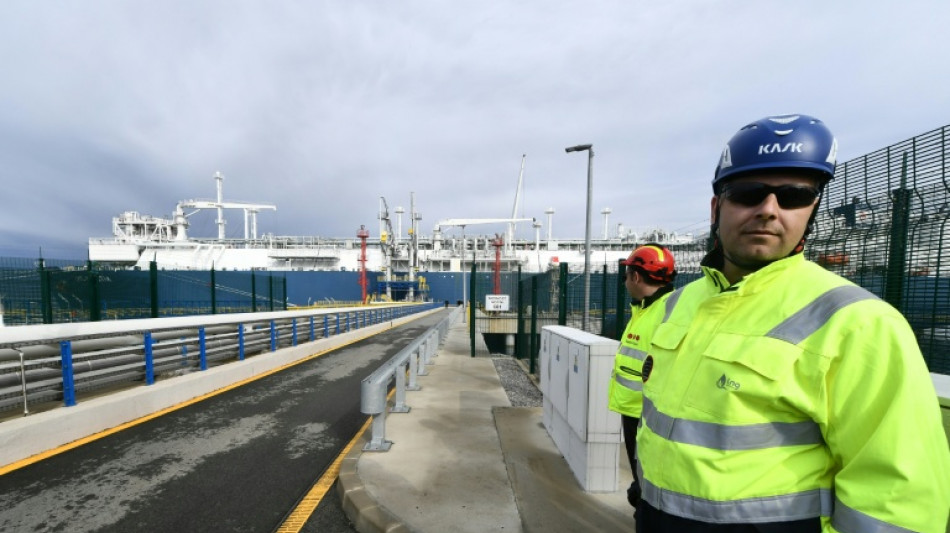
Croatia, Bosnia sign major gas pipeline deal / Photo: Denis LOVROVIC - AFP

 Belgian PM Bart De Wever Given New Deadline to Resolve €10 Billion Budget Deadlock

 $1.8 Billion Pledged for Biodiversity at COP17 as Monaco Reaffirms Commitment

 Phoenix Symphony Resumes Performances Amid Financial Uncertainty

 Turkish Energy Minister Highlights Qatar as Key Partner for Regional and Global Energy Security

 London Museum Granted 24/7 License Ahead of November Opening

Croatia and Bosnia on Tuesday signed a deal to build a major gas pipeline backed by investors close to US President Donald Trump, aiming to cut Sarajevo's reliance on Russian gas.
The pipeline will connect Bosnia to the European gas network, notably the liquefied natural gas terminal on Croatia's northern island of Krk, which receives significant volumes of US gas.
Hailing it as a "major step forward", Bosnian Prime Minister Borjana Kristo also thanked US partners.
"I signed with Croatia the Southern Interconnection Agreement, boosting energy security and supply diversification," Kristo said in a post on X.
The agreement was also signed by her Croatian counterpart Andrej Plenkovic on the sidelines of a Three Seas Initiative summit in Dubrovnik.
The agreement sets out cooperation between the two countries to build a gas interconnection on both sides of the border.
The project is being pushed by the AAFS Infrastructure and Energy company, headed by Jesse Binnall, a former lawyer to President Trump, and Joseph Flynn, brother of retired general Michael Flynn.
The latter served as national security adviser during Trump's first term.
But the proposal has sparked a warning from Brussels, with the EU's ambassador to Bosnia, which is a candidate for membership, penning a letter urging the country to "carefully consider its obligations" when signing contracts for energy projects.
In addition to a pipeline, the $1.5 billion project would build gas-fired power plants to reduce coal-based electricity production in a country badly affected by air pollution.
No construction dates have yet been announced, but the project is considered of major importance to Bosnia, which would be affected by the EU's ban on Russian gas imports set to take effect in 2027.
O.Gaspar--PC

