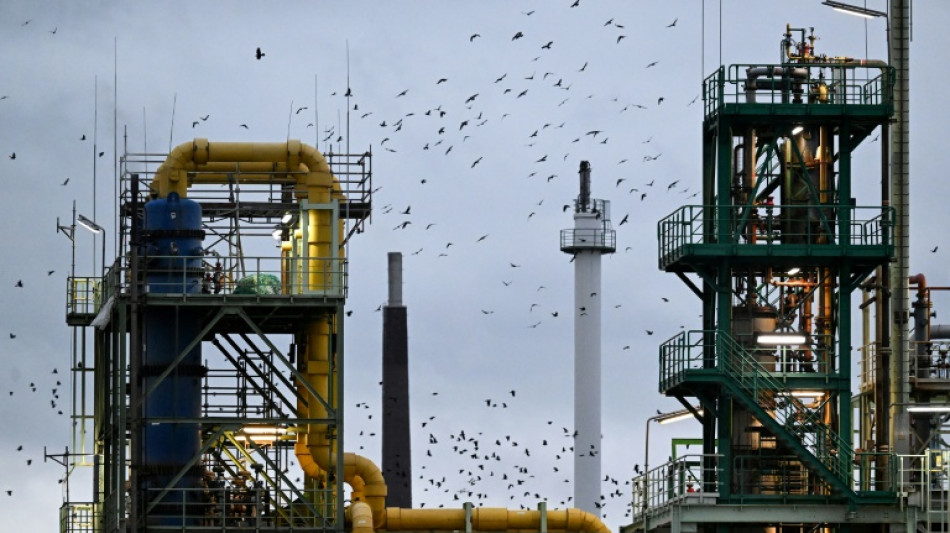
Energy-hungry German industries in decline since Ukraine war: data / Photo: Kirill KUDRYAVTSEV - AFP

 KUFOS Signs MoU With Old Dominion University to Expand Academic Ties

 Karen Wazen Launches First Standalone Boutiques in Cairo

 Municipal Elections: How Service Failure Becomes a Public Health Crisis in South Africa

 Rene Eyre Revisits Autobiographical Performance 'Say A Little Prayer' in London

 UAE's HCT Holds Record Graduation and Announces Major Training Expansion

 NASA Awards $10B Lunar Contract Framework to SpaceX, Blue Origin

 Katy Perry Tells Fans Ex-Husband Russell Brand 'Should Be in Jail' During UK Concert
Germany's energy-hungry industries have suffered sharp falls in output since the start of the Ukraine war, data showed Friday, with little hope of an imminent rebound.
After Russia launched its invasion of Ukraine in 2022, Moscow slashed gas supplies to Europe amid soaring tensions with the West, sending up power costs for German industry.
Production in Germany's most energy-intensive sectors fell by 15.2 percent between February 2022, the month when the conflict began, and March this year, according to statistics agency Destatis.
The decline in these sectors, ranging from chemicals and metal processing to glass and paper production, was sharper than for industry as a whole over the period, it said.
Over 53,000 fewer people were employed in the country's energy-intensive industries by March this year, a 6.3 percent decline.
It is the latest bleak news for Europe's biggest economy, which has been stagnating for years due to a manufacturing slump, weak demand for exports and the US tariff blitz.
There had been hopes the economy would recover this year, helped by hefty public spending on defence and infrastructure, but the energy shock unleashed by the Iran war is weighing heavily.
After an encouraging start to the year, recent indicators "point to a significant setback in the second quarter", the economy ministry warned Friday.
"Rising prices, supply chain problems, and uncertainty are weighing on sentiment in both businesses and private households," it said in a monthly report.
"The further economic outlook depends on how long the conflict in the Middle East persists and continues to disrupt trade routes and production capacities," it added.
F.Moura--PC

