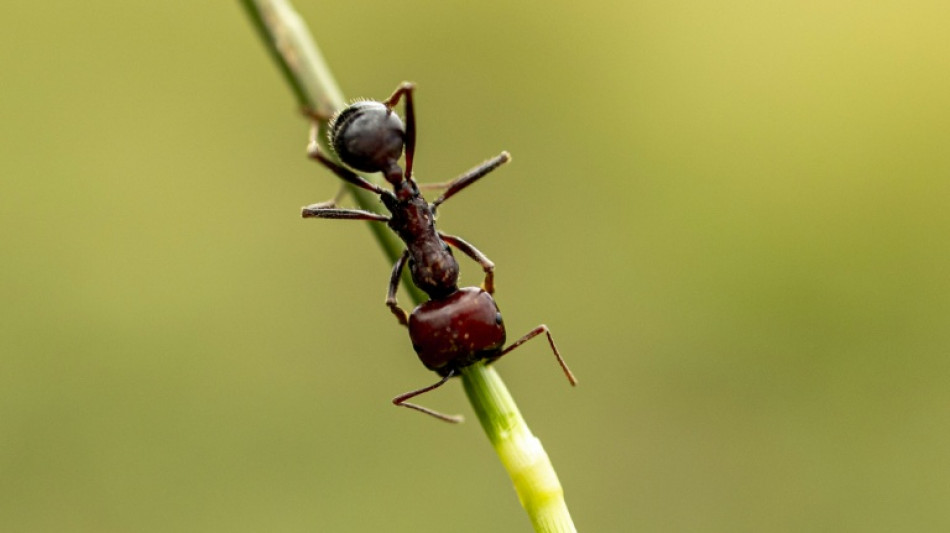
Kenya's new poaching problem: smuggling Giant Harvester Ants / Photo: SIMON MAINA - AFP

 British Grand Prix stays on MotoGP calendar until 2028

 Britain's EasyJet flies into US hands as takeover confirmed

 Real Madrid sign Ivory Coast winger Yan Diomande

 How online disinformation fuelled Ceuta migrant surge

 Inevitable AI Group Raises $6M From Aleph to Launch AI-Native SaaS Companies
 Suspected Ebola death on boat heading for DR Congo capital

 England selector North not 'hung up' on Stokes absence

 UK Anti-Doping confirm former world champ Parker's ban lifted

 French winemakers dread 'smoky taste' after wildfires
 Stocks diverge with earnings, tech in focus

 England recall batsman Lawrence for Pakistan series

 Siemens shares plunge on disappointing guidance raise

 New Australia coach Kiss gives Japan starts to Ross, Amatosero

 'Stretch our money': Romanians face highest EU inflation

 Iran says close to Hormuz plan with Oman, but reopening depends on US

 Messi scores twice to set Leagues Cup record in Miami victory

 Asian stocks mostly down with tech firms back under pressure
 Back to the future as world champion Springboks host All Blacks

 India youth protests highlight mistrust in 'lapdog' media
 Pacific islands alarmed by Trump-backed push for deep-sea mining
 Erratic rains dictate menu at three-star Michelin restaurant in Brazil

 Zverev, Auger-Aliassime and Medvedev exit Montreal Masters
 Loar Holdings Inc. Reports Q2 2026 Record Results and Upward Revision to 2026 Outlook

 Embattled Infantino sees minnows Malawi reach WAFCON quarter-finals

 Seeds Rybakina, Pegula and Gauff advance at WTA Toronto event

Kenyan ant expert Dino Martins gushes over the red and black insects that have become the centre of an international smuggling trade.
Martins has been visiting the network of nests of these Giant African Harvester Ants outside Nairobi for 40 years.
"They're big and bold... They're the tigers of the ant world," the entomologist told AFP.
"Each nest here has just one queen and she is the mother who founded this nest 40, 50 or even 60 years ago," he said.
Martins was shocked when he learned that thousands of queens from this Messor cephalotes species were being harvested and shipped abroad in syringes and test tubes to be sold for hundreds of dollars each.
The trade came to light in Kenya last year when two Belgian teenagers were arrested in possession of nearly 5,000 queen ants, and accused of "biopiracy".
Kenyan authorities fear a new form of poaching, focused less on ivory and furs, and more on insects, reptiles and rare plants.
The judge even compared it to the slave trade.
"Imagine being violently removed from your home and packed into a container with many others like you... It almost sounds as if the reference above is to the slave trade," he said in his ruling.
The Belgians were handed a fine of around $8,000, but as more cases have emerged, sentences have hardened: last month a Chinese national was sentenced to one year in prison for attempting to traffic 2,000 ants.
On several European websites, the queens go for around 200 euros ($230).
Though marked as unavailable, they are increasingly easy to buy with the right connections, said Ryan, a 25-year-old from France who gave only his first name.
He finds ants "hypnotising", and wanted the largest harvesters, so he bought a starter kit including a queen and 12 workers from an authorised seller for 450 euros.
That's "very reasonable," he said -- a decade ago, a queen could fetch 1,000 euros.
In the end, however, Ryan found they proved too tricky to raise and he gave them away.
Giant Harvester Ants are common from the Mediterranean to the Cape. They work together almost 24 hours a day, gathering and chopping grasses for their larvae.
They have captivated people for centuries. In the Old Testament, King Solomon famously exhorted the lazy to "Go to the ant... Consider its ways and become wise".
"He was observing the same ant in Jerusalem that we are now," said Martins.
- 'Ants have feelings' -
Colonies can take 20-30 years to produce new queens. They provide all manner of services to the ecosystem: dispersing grass seeds, aerating the soil, and providing food for animals like pangolins.
Martins also considers the smuggling trade unethical simply because "ants have feelings".
The trade "exploded" with the arrival of the internet, said Jerome Gippet, a researcher at the Swiss University of Fribourg.
Formerly the interest of a few passionate individuals, it eventually gave way to sophisticated networks of collectors, intermediaries and smugglers.
A study Gippet published in 2017 found more than 500 ant species -- a third of the total -- were sold online. More than 10 percent were potentially invasive with uncertain impacts on foreign ecosystems.
He says regulated trade -- as exists in Australia, for example -- can work well.
"I'm not advocating for a ban on the ant trade. It's very useful in educational terms, in terms of reconnecting with nature, or simply providing enjoyment... But it has to be done responsibly," he said.
H.Portela--PC