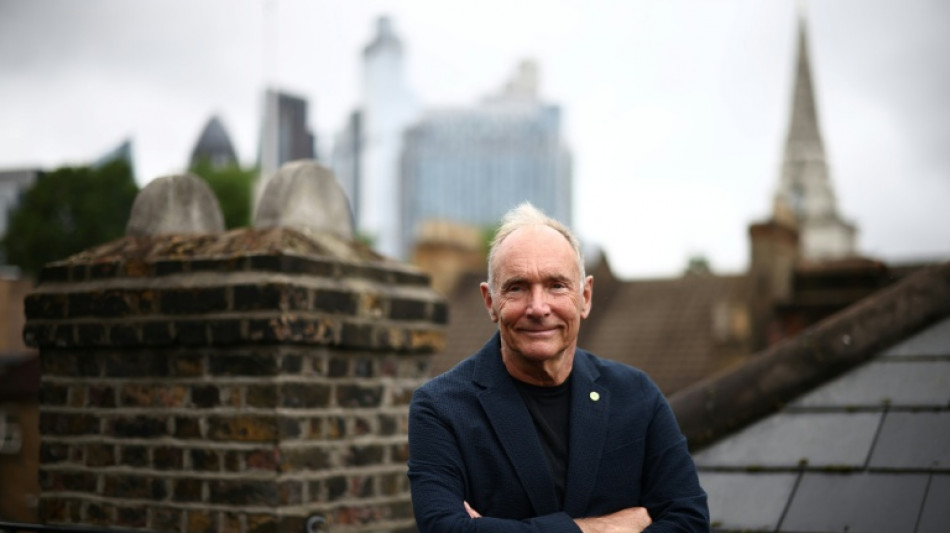
Tim Berners-Lee calls for AI to preserve 'original values' of web / Photo: Henry NICHOLLS - AFP

 Stocks mixed with tech firms back under pressure

 How Blundell's old school tactic ended England's 'Bazball' era

 Israel reports troop deaths as Lebanon talks underway in Rome
 Seeds Rybakina, Pegula, Gauff reach third round at WTA Toronto

 Police raid South Korea FA in probe into World Cup coach appointment

 Low water on Germany's Rhine river threatens new blow to economy

 Ex-Wallabies Foley, Phipps rejoin Waratahs ahead of home World Cup

 Rising Kenyan lakes push crocodiles closer to homes

 Istanbul cymbals: From Ottoman war tool to pulse of global music

 Myanmar ex-junta chief on first Thailand trip as civilian leader

 Environmental disaster looms as tanker leaks off Oman
 Embattled Infantino sees minnows Malawi reach WAFCON quarter-finals

 Seeds Rybakina, Pegula and Gauff advance at WTA Toronto event
 Zverev, Auger-Aliassime exit star-short Montreal Masters

 Embattled FIFA chief Infantino in emergency talks in Morocco
 Castaway SpaceX rocket stage crashed into Moon, scientists say

 Dow edges to record as markets parse prospects for Hormuz deal

 Salah arrives in Turkey to complete Trabzonspor move

 AFP journalist to be honored at International Press Freedom Awards

 Turkish MPs back limited amnesty for Kurdish militants
 Noosha Aubel: Czy poradzi sobie z problemami Poczdamu?

 Noosha Aubel: Klarar hon av Potsdams problem?

 Noosha Aubel: Zvládne problémy Postupimi?

 Brazil hits new diplomatic lows with US and Argentina

 NZ boxer Parker promises ring return after doping ban 'lifted'

World Wide Web pioneer Tim Berners-Lee says he wants to see artificial intelligence preserve "the original values" of his invention while allowing users to filter personal data sent to tech giants.
The primacy "of the person, of the individual" was at the heart of the internet and should apply to AI too, he told AFP Wednesday in an interview on the sidelines of the SXSW tech festival in London.
The British physicist-turned-computer scientist conceived the web in 1989 while working at CERN, the European particle physics lab in Switzerland.
Berners-Lee hailed AI as an "exciting" development -- but one that would benefit from being regulated.
AI models "use the fact that the web has got so much data on it to be trained", he said.
"It's important that people use this technology to make sure that their customers, their citizens, have got control over their own data," he said.
Berners-Lee said that AI does not have anything like the World Wide Web Consortium, the international internet standards organisation he founded.
As a result, AI pioneers have not been able to "benefit from the collaboration that they would get if they did have something like that".
- Web free for all -
Berners-Lee originally proposed his world-changing invention as a way for scientists around the world to share information about their research.
He named this new network the World Wide Web (WWW), joining forces with Belgian Robert Cailliau in 1990 to develop it.
The web was based on two pillars: the HTML language that allows the creation of a website, and the HTTP hypertext system that lets the user request and then receive a web page.
Determined to make the web freely available to everyone, he did not patent his programme, ensuring it took off and spread rapidly.
With the use of personal data by AI models preoccupying authorities, particularly in Europe, Berners-Lee has made data protection his main cause in recent years, notably through the startup Inrupt.
"Without data, (AI models) can't exist. And they've had unfettered access to everybody's data now, and if we don't watch it, we're going to get to a really bad spot," warned the company's co-founder John Bruce.
Launched in 2018, Inrupt relies on secure data wallets that remain in the hands of users.
It is also working to create an AI assistant called Charlie that will be able to filter users' requests to tools such as ChatGPT or Claude.
"When you ask a question... it looks at what the question is... and decides which information to send" to the AI tool, Berners-Lee said.
If there is personal information in there, Charlie will "tweak it" so the AI tool "gets a picture... but then it can't really use that to identify you".
"Charlie is about preserving the original values of the web," he added.
P.Mira--PC