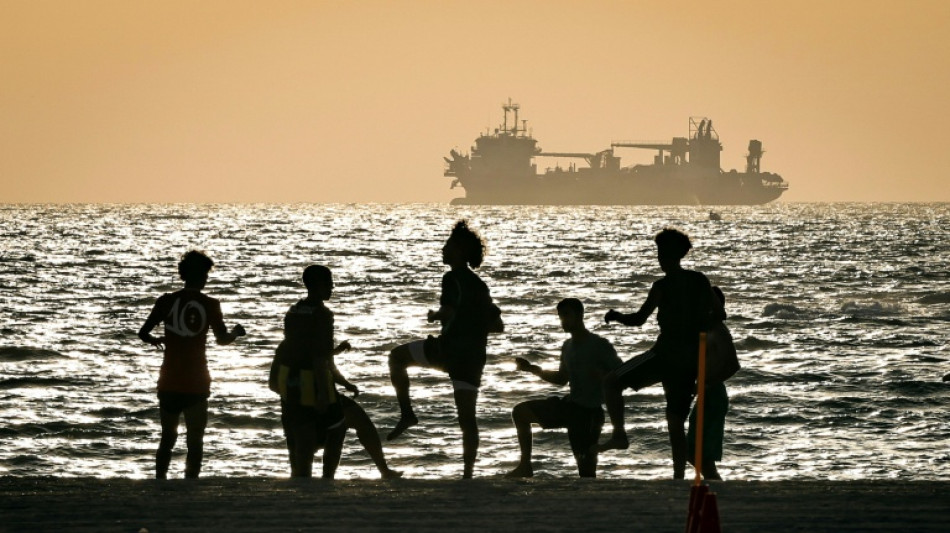
Dubai luxury hotels woo staycationers as tourists flee / Photo: FADEL SENNA - AFP

 How Blundell's old school tactic ended England's 'Bazball' era

 Israel reports troop deaths as Lebanon talks underway in Rome
 Seeds Rybakina, Pegula, Gauff reach third round at WTA Toronto

 Police raid South Korea FA in probe into World Cup coach appointment

 Low water on Germany's Rhine river threatens new blow to economy

 Ex-Wallabies Foley, Phipps rejoin Waratahs ahead of home World Cup

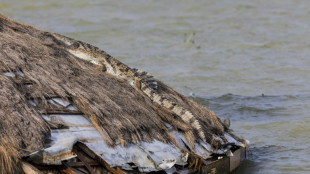 Rising Kenyan lakes push crocodiles closer to homes

 Istanbul cymbals: From Ottoman war tool to pulse of global music

 Myanmar ex-junta chief on first Thailand trip as civilian leader

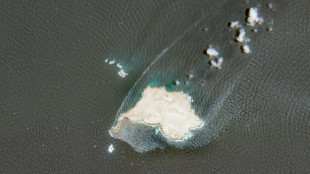 Environmental disaster looms as tanker leaks off Oman

 Embattled Infantino sees minnows Malawi reach WAFCON quarter-finals

 Seeds Rybakina, Pegula and Gauff advance at WTA Toronto event

 Zverev, Auger-Aliassime exit star-short Montreal Masters

 Embattled FIFA chief Infantino in emergency talks in Morocco

 Castaway SpaceX rocket stage crashed into Moon, scientists say

 Dow edges to record as markets parse prospects for Hormuz deal

 Salah arrives in Turkey to complete Trabzonspor move

 AFP journalist to be honored at International Press Freedom Awards

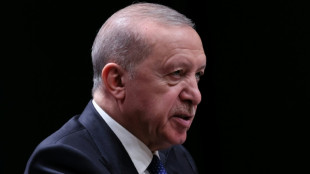 Turkish MPs back limited amnesty for Kurdish militants

 Noosha Aubel: Czy poradzi sobie z problemami Poczdamu?

 Noosha Aubel: Klarar hon av Potsdams problem?

 Noosha Aubel: Zvládne problémy Postupimi?

 Brazil hits new diplomatic lows with US and Argentina

 NZ boxer Parker promises ring return after doping ban 'lifted'

 Disney profits top estimates on strength in theme park business

Once reserved for wealthy travellers, Dubai's top-notch hotels have become almost exclusively reliant on residents, drawn in by dizzying staycation offers as war drives tourists away.
On the Palm, an artificial island that has become synonymous with Dubai opulence, five-star hotels are busy on weekends and holidays once more, despite having been deserted by tourists.
The clientele is driven by hotels offering residents-only deals that have become a lifeline for Dubai's luxury tourism.
"I had never been in a hotel on the Palm because the prices were crazy," said Fadi Iskandarani, a doctor in his sixties who just spent his first weekend at a luxury resort on the tree-shaped island.
The Lebanese national, who has lived in Dubai for five years, decided to opt for a staycation after he saw that a hotel on the Palm had slashed its rates by a factor of four.
The hotel was not packed, with some floors closed because there were not enough guests.
But the pool-side area was filled with people, he said, who came to the Palm to enjoy a slice of luxury that had long been unattainable.
"Luxury in Dubai has become affordable for residents, before it was just for the rich, very rich people," he said.
- A lifeline -
With 19.5 million yearly tourists, Dubai is among the region's top destinations and was long seen as a playground for the world's rich and famous.
Its 827 hotels — including 173 five-star establishments — boasted an average occupancy rate of more than 80 percent.
But the war, which was triggered by US-Israeli strikes on Iran on February 28, shattered the Gulf's image as a haven of stability, with Tehran directing its fury at the oil-rich region.
The United Arab Emirates bore the brunt of Iran's missiles and drones, which hit hotels, including on the Palm, as well as its landmark Burj Al Arab resort.
Since a shaky ceasefire came into effect on April 8 some tourists have trickled in, but hotels are mostly relying on local guests, said Michael Robinson, the general manager of the Anantara The Palm Dubai Resort.
With its overwater villas, artificial lagoons and Thai-inspired decor, the luxury hotel is packed with Dubai residents, who get special discounts of up to 50 percent.
On Fridays and Saturdays, hotel occupancy sits between 70 and 90 percent, he said.
Sunday through to Thursday, it has an average occupancy of around 20 to 30 percent.
This new clientele has offered hotels a lifeline, allowing Anantara The Palm to remain "cash positive" without resorting to layoffs.
- 'No return' -
But staycations are not enough on the long term.
"Your staycation business is essentially one to two nights and that's it... Whereas previously, the international market, they might come for one week," Robinson said.
Should tourists stay away come July, when schools are closed and many families return home for the summer, "there won't be as many people wishing to do staycations", he said.
Some hotels, including Burj Al Arab, have temporarily closed for renovations as business slowed.
Others have cut staff or salaries, particularly hotels in downtown Dubai, which are dependent on business tourism.
An employee at one Dubai hotel, who spoke on condition of anonymity, said his salary had been cut by up to 40 percent during and after the war, before it returned to normal in recent weeks.
Another employee at a hotel in neighbouring Abu Dhabi said he was put on unpaid leave for two months but that he is set to return to work soon with his salary restored.
Talks to end the war have dragged on for two months and sporadic strikes still punctuate life in the Gulf, straining tourism.
Yet Robinson remains hopeful.
"If we see some form of resolution in the next month or so... I think you'll see tourists come back faster than everyone anticipates," he said.
E.Borba--PC