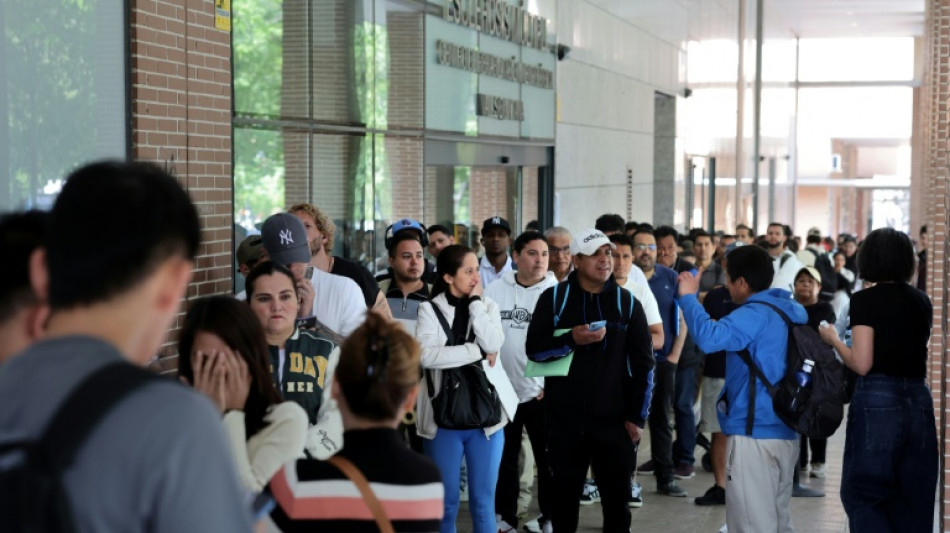
Over 1 million migrants apply for Spain's mass regularisation: PM / Photo: Thomas COEX - AFP

 $1.8 Billion Pledged for Biodiversity at COP17 as Monaco Reaffirms Commitment

 Phoenix Symphony Resumes Performances Amid Financial Uncertainty

 Turkish Energy Minister Highlights Qatar as Key Partner for Regional and Global Energy Security

 London Museum Granted 24/7 License Ahead of November Opening

 Dana White Confirms Flight to Washington for Trump Meeting on Press Secretary Role

 Dengue Fever Expands Into High Himalayas as Climate Change Warms Nepal

 IoT Refrigerator Hacks Disrupt Blood Labs and Supermarkets Across Europe and US
More than one million undocumented migrants in Spain have sought legal status under a scheme that has defied a wider European crackdown on irregular immigration, the government said on Tuesday, the final day for submissions.
The vast scheme was predicted to benefit around 500,000 people, most from Latin America, when the left-wing government launched it in April.
"The more than one million applications submitted... show how necessary this recognition of rights and responsibilities was," Socialist Prime Minister Pedro Sanchez told an event in Madrid.
Sanchez has become a standard bearer of more open immigration policies as his European neighbours -- including some Socialist peers -- toughen measures in response to pressure from ascendant far-right parties.
He has long argued that immigrants are needed to sustain the economy, the welfare state and pensions amid Spain's ageing population and depopulation in rural regions.
The number of applications submitted does not necessarily indicate how many migrants will secure their legal status.
Applicants must prove they have a clean criminal record and spent at least five consecutive months in Spain before January 1.
The authorities have three months to process their paperwork and decide whether to issue a work and residence permit only valid in Spain.
"When we condemn a person to invisibility, I think we make our country a worse country. We all lose," Sanchez explained, saying his government aimed to "offer an opportunity and future" to migrants.
"We want the world to view Spain as a country that respects, protects and upholds human rights."
- Economic boost -
For Juana Hernandez, a 59-year-old Cuban who has lived in Spain for two and a half years and whose application was recently approved, the plan "is a huge opportunity".
She told AFP she had paid a lawyer roughly 200 euros ($225) to handle the administrative formalities "to be on the safe side", as well as receiving help from a migrant aid association.
Although she was "a little worried" at the start, the English degree holder now aims to work at Madrid airport.
A land of emigrants for centuries, Spain is a key entry point into the European Union for tens of thousands of undocumented asylum seekers and migrants, alongside Italy and Greece.
Many come via a long and perilous Atlantic route from West Africa to the Canary Islands, although numbers dropped last year after peaking in 2024.
Since April, streams of men, women and children have queued in the streets to obtain documents and attend appointments for their regularisation, in addition to online applicants.
Although fears arose of a saturation of the services handling the scheme, Mohamed, a Moroccan who lives in the northern region of Cantabria, felt the administrative journey was "relatively easy".
The 23-year-old jobseeker, who declined to give his surname, has been in Spain irregularly for about four years and hopes "to be able to work legally, to pay contributions".
Gaining legal status will also spare him from unscrupulous employers who "take advantage" of irregular migrants "by paying low salaries, without any rights or... don't pay at all," he told AFP.
Sanchez, who has presided over one of the world's fastest-growing developed economies in the last few years, has touted the benefits of immigration for sectors such as construction that need to boost their workforce.
Spanish business leaders have welcomed the regularisation drive but the conservative and far-right opposition are furious about a policy they claim will encourage more irregular immigration.
While accepting "tensions" and "challenges" linked to immigration and integration, Sanchez on Tuesday accused the right of "fuelling fear (and) stirring up xenophobic discourse that does not solve any problem".
A.Motta--PC

