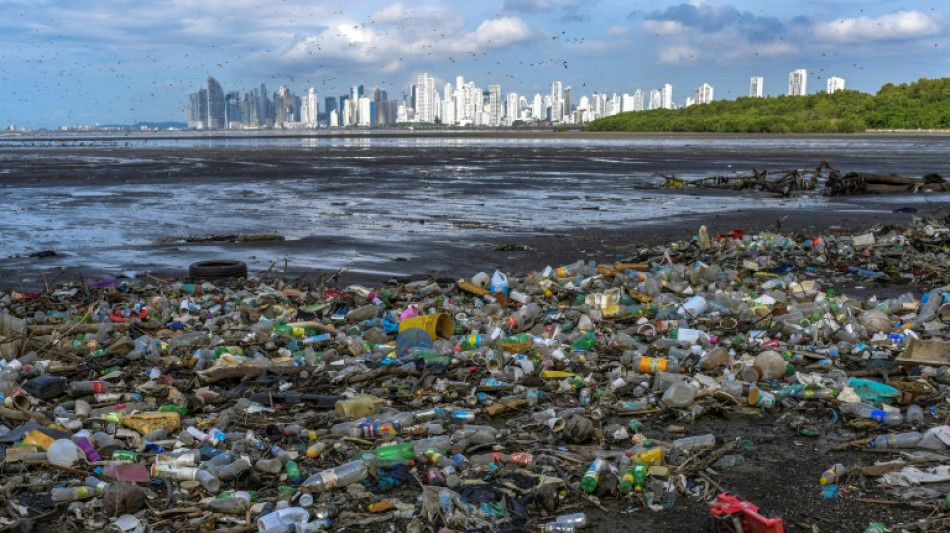
World must work together to tackle plastic ocean threat: WWF

 Stocks mostly rise tracking earnings, US-Iran hopes

 Pakistan team reaches base camp with body of renowned climber killed in avalanche

 Ceuta warns of 'unsustainable' situation for child migrants after influx

 SpaceX rocket stage believed to have slammed into Moon

 India monsoon floods, landslides kill more than 100 since July: officials
 South Korea pro baseball league cancels games over heatwave
 Taiwan probes 17 China-funded firms over high-tech talent poaching

 Trump warns Iran to open Hormuz or get 'hit very hard'

 Factories shed workers in Bangladesh garment sector

 North Korea warns of 'military options' over Japan rearmament
 Tiny light, big dream: Harvesting power from soil in Japan

 Trump admin to review 'closed' AI models before release: reports
 De Minaur fights past Duckworth in all-Aussie Montreal battle
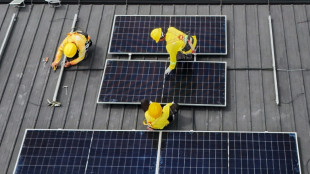 High bills, cheap panels drive a Philippine solar surge

 Russian barrage on Ukraine kills 2, wounds dozens more

 RE Royalties Announces Third Investment in Solaris Energy's Portfolio and Letter of Intent for Expanded Royalty Partnership for a Further US$62.7 Million
 Kgatlana strikes as South Africa reach WAFCON quarter-finals

 Pakistan close on series-levelling win against West Indies

 Paramount CEO says politics fueling Warner Bros. merger battle

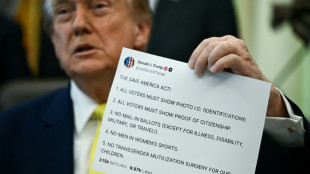 Trump's sale of access to Truth Social raises eyebrows

 SpaceX rocket stage expected to slam into Moon

 US hopeful Hormuz strait deal will be done 'today or tomorrow'

 Michigan primary puts Democratic divide on the ballot

 South Africa captain Kolisi to make Test return in Argentina

 Cuba's famed resilience comes at a growing mental cost

Plastic has infiltrated all parts of the ocean and is now found "in the smallest plankton up to the largest whale" wildlife group WWF said on Tuesday, calling for urgent efforts to create an international treaty on plastics.
Tiny fragments of plastic have reached even the most remote and seemingly-pristine regions of the planet: it peppers Arctic sea ice and has been found inside fish in the deepest recesses of the ocean, the Mariana Trench.
There is no international agreement in place to address the problem, although delegates meeting in Nairobi for a United Nations environment meeting this month are expected to launch talks on a worldwide plastics treaty.
WWF sought to bolster the case for action in its latest report, which synthesises more than 2,000 separate scientific studies on the impacts of plastic pollution on the oceans, biodiversity and marine ecosystems.
The report acknowledged that there is currently insufficient evidence to estimate the potential repercussions on humans.
But it found that the fossil-fuel derived substance "has reached every part of the ocean, from the sea surface to the deep ocean floor, from the poles to coastlines of the most remote islands and is detectable in the smallest plankton up to the largest whale".
- 'Saturation point' -
According to some estimates, between 19 and 23 million tons of plastic waste is washed into the world's waterways every year, the WWF report said.
This is largely from single-use plastics, which still constitute more than 60 percent of marine pollution, although more and more countries are acting to ban their use.
"In many places (we are) reaching some kind of saturation point for marine ecosystems, where we're approaching levels that pose a significant threat," said Eirik Lindebjerg, Global Plastics Policy Manager at WWF.
In some places there is a risk of "ecosystem collapse", he said.
Many people have seen images of seabirds choking on plastic straws or turtles wrapped in discarded fishing nets, but he said the danger is across the entire marine food web.
It "will affect not only the whale and the seal and the turtle, but huge fish stocks and the animals that depend on those", he added.
In one 2021 study, 386 fish species were found to have ingested plastic, out of 555 tested.
Separate research, looking at the major commercially fished species, found up to 30 percent of cod in a sample caught in the North Sea had microplastics in their stomach.
Once in the water, the plastic begins to degrade, becoming smaller and smaller until it is a "nanoplastic", invisible to the naked eye.
So even if all plastic pollution stopped completely, the volume of microplastics in the oceans could still double by 2050.
But plastic production continues to rise, potentially doubling by 2040, according to projections cited by WWF, with ocean plastic pollution expected to triple during the same period.
- Enduring risk -
Lindebjerg compares the situation to the climate crisis -- and the concept of a "carbon budget", that caps the maximum amount of CO2 that can be released into the atmosphere before a global warming cap is exceeded.
"There is actually a limit to how much plastic pollution our marine ecosystems can absorb," he said.
Those limits have already been reached for microplastics in several parts of the world, according to WWF, particularly in the Mediterranean, the Yellow and East China Seas (between China, Taiwan and the Korean Peninsula) and in the Arctic sea ice.
"We need to treat it as a fixed system that doesn't absorb plastic, and that's why we need to go towards zero emissions, zero pollution as fast as possible," said Lindebjerg.
WWF is calling for talks aimed at drawing up an international agreement on plastics at the UN environment meeting, from February 28 to March 2 in Nairobi.
It wants any treaty to lead to global standards of production and real "recyclability".
Trying to clean up the oceans is "extremely difficult and extremely expensive", Lindebjerg said, adding that it was better on all metrics not to pollute in the first place.
X.Matos--PC