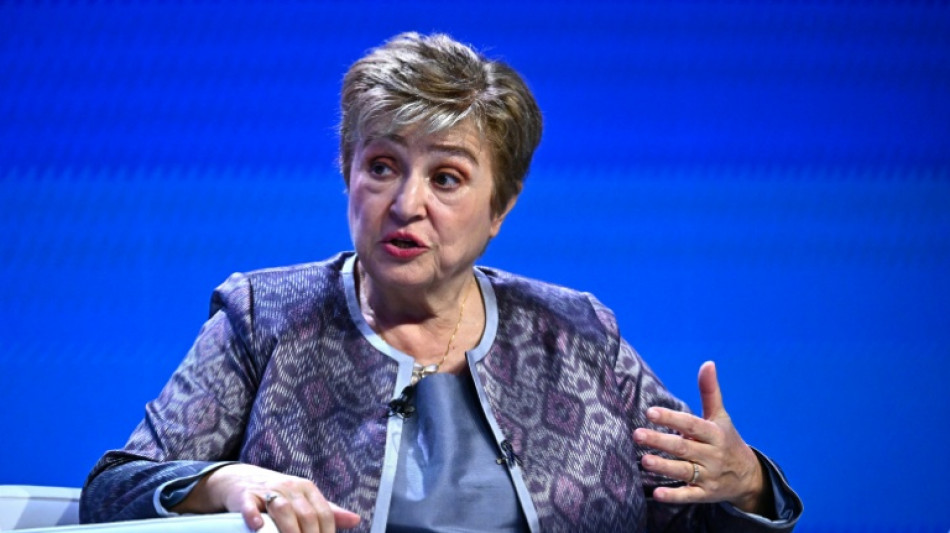
Leaders weigh 'huge benefit', risks of AI for global economy / Photo: Lillian SUWANRUMPHA - AFP

 Turkish Energy Minister Highlights Qatar as Key Partner for Regional and Global Energy Security

 London Museum Granted 24/7 License Ahead of November Opening

 Dana White Confirms Flight to Washington for Trump Meeting on Press Secretary Role

 Dengue Fever Expands Into High Himalayas as Climate Change Warms Nepal

 IoT Refrigerator Hacks Disrupt Blood Labs and Supermarkets Across Europe and US

 Post-election pressures complicate US and Israeli decisions on Iran

 UN members approve talks on treaty protocol against environmental crime

 Family-run West Sussex beach café prepares for first winter season

 CT scans reveal health and burial clues from Egypt’s Braided Lady mummy

 Oxford faces complaints over lecturer’s classroom attire

 Kyren Wilson and John Higgins reach International Championship snooker final

 New Zealand and Tonga meet for place in Rugby League World Cup final

 Reports of unsafe AI-toy responses renew calls for child-safety rules

The artificial intelligence boom has been a key driver of global growth, but also poses economic risks should investment in the technology falter, experts and policymakers said this week at the IMF-World Bank Annual Meetings in Bangkok.
Propelled by spending on data centres and microchips, AI has helped cushion the economic shock of rising global energy prices caused by war in the Middle East, the International Monetary Fund (IMF) said in a report on Tuesday.
The fund's chief economist Silvana Tenreyro noted this week that global trade rose 8.3 percent between 2023 and 2025 -- a figure she said would be closer to 4.6 percent without AI-related products.
"It is everywhere in the global economy," Bank of Canada Governor Tiff Macklem said of AI on Friday.
"You see it in GDP. You see it in the stock market. You see it in the bond market... So it is here, and it's just the beginning."
But some top officials gathered in Bangkok this week cautioned against relying too heavily on AI investment.
Federal Reserve Chair Kevin Warsh called AI the "most consequential change" to the global economy in his lifetime, and said it had "a huge benefit". Still, he warned the road ahead would be "bumpy".
"The path from where we are to there is likely to be a very bumpy one, bumpy in our understanding of the technology, bumpy because we really don't know what the market structure is going to be of these new technologies," he said.
IMF chief Kristalina Georgieva similarly noted the AI boom's boost to global growth, but she told AFP that any slowdown in the industry "would be felt across the world".
"If there is loss of confidence and money runs away from AI, that can lead to financial stability risks," Georgieva said.
An IMF report released this week projected that a decline in AI investment could reduce global GDP by 0.4 percent by 2028.
"Weaker or less durable AI investments and profitability could be a shock that triggers a market correction," the report said.
- War and regulation -
While AI investment and trade have softened the global economic impact of the Middle East war, economists at Moody's Analytics have warned that if the conflict drags on it could "puncture" the boom.
They said higher energy prices and tighter financial conditions could push up operating costs and interest rates, adding to doubts over "the long-term profitability and viability of AI business models".
"A drawn-out conflict would put serious strain on the economics behind AI investment," the group said.
The uncertainty around regulation has also clouded the technology's outlook.
Leaders like US President Donald Trump have urged more limited government regulation, even as some in the industry have called for legislation to mitigate risks.
Georgieva, the IMF chief, appeared on Friday to link such regulation to future investment.
"If there are no safeguards, then the risks may exceed the opportunities," she said in Bangkok.
A.Santos--PC

