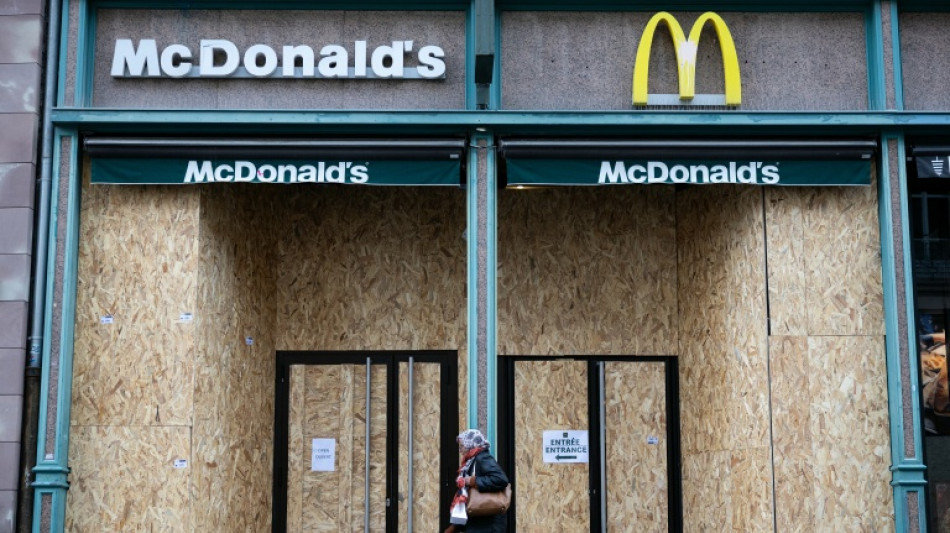
Police fire tear gas as new French demonstrations kick off / Photo: ROMEO BOETZLE - AFP

 Turkish Energy Minister Highlights Qatar as Key Partner for Regional and Global Energy Security

 London Museum Granted 24/7 License Ahead of November Opening

 Dana White Confirms Flight to Washington for Trump Meeting on Press Secretary Role

 Dengue Fever Expands Into High Himalayas as Climate Change Warms Nepal

 IoT Refrigerator Hacks Disrupt Blood Labs and Supermarkets Across Europe and US

 Post-election pressures complicate US and Israeli decisions on Iran

 UN members approve talks on treaty protocol against environmental crime

 Family-run West Sussex beach café prepares for first winter season

 CT scans reveal health and burial clues from Egypt’s Braided Lady mummy

 Oxford faces complaints over lecturer’s classroom attire

 Kyren Wilson and John Higgins reach International Championship snooker final

 New Zealand and Tonga meet for place in Rugby League World Cup final
 Reports of unsafe AI-toy responses renew calls for child-safety rules

French police started firing tear gas at protesters Saturday as they stepped up security in major cities aiming to prevent a repeat of rioting a week ago, on a day of fresh nationwide demonstrations over the high cost of living.
Police in the southeast city of Lyon fired tear gas to disperse some 150 protesters near the city centre -- where demonstrations had been banned -- when they briefly tried to block a road, an AFP journalist saw.
Elsewhere, authorities and rattled shopkeepers geared up for potential new street violence.
Near Paris's Bastille neighbourhood, a clothing store had removed all its merchandise from shelves ahead of the demonstrations, while a nearby restaurant was boarded up with signs insisting it was "still open". Many other retailers in the capital also had wooden boards covering their windows.
The Louvre and the Musee d'Orsay museums were closed.
Police were seen readying riot gear in zones that bore the brunt of last weekend's clashes and looting.
They were among 70,000 security personnel the interior ministry said were mobilised to counter the "high" threat of violence.
"We will not tolerate any unrest," Interior Minister Laurent Nunez said on Friday, adding that calls had been circulating on social media calling for violence and looting.
- Protest against far-right party -
Adding to tensions, far-right leader Marine Le Pen's National Rally (RN) party was holding a weekend congress in the central city of Orleans to kick off her campaign for elections in six months to choose President Emmanuel Macron's successor.
Thousands of people yelling anti-fascist slogans marched on Saturday against Le Pen, and also against Macron, a pro-business centrist leader. "Macron resign. Le Pen in prison," the crowd yelled.
The violence last weekend and the heightened tensions over this weekend's demonstrations highlighted the febrile atmosphere in France ahead of that vote, which Le Pen is best-placed, according to surveys, to win.
Last weekend saw rioters on the margins of the nationwide demonstrations clash with police, vandalise public buildings and loot hundreds of stores. Some 2,700 people were arrested and the retail sector said shopowners were left with damage and stolen stock totalling hundreds of millions of euros.
Macron attributed the worst of the violence to "ultra-left" groups that he said "want to bring down the republic".
Groups organising Saturday's renewed demonstrations have accused Macron and his government of ignoring widespread public anger over rising costs, and over classroom conditions for students.
Inflation in France, as elsewhere, has been sent surging by the Middle East war, started in February by US President Donald Trump and Israel.
Protests have also been taking place in Italy, Belgium, Spain and Portugal over different issues, yet with some overlap on inflation and education problems. Italy has sent 500 troops to try to quell street violence in Milan.
- Boarded-up shops -
In Paris, streets on Saturday were unusually quiet, with many shop windows boarded up, and some of the bigger retailers sent messages to customers warning that they were closed for the day.
The capital's police at the last minute ordered a union-organised march in the city be moved from Bastille, in the centre-east, to the more remote eastern Porte d'Italie on the southern rim of the capital.
Unions said they reluctantly would go along with that. But the Yellow Vest movement -- a loosely organised grouping that staged disruptive street protests against Macron eight years ago -- indicated it would not comply.
Macron and his government have sought to draw a line between the legitimate demands of protesters and the looting, burning and ransacking that erupted on the sidelines of demonstrations last Saturday.
Courts have already sent 217 people, half of them first-time offenders, to prison over the events on Saturday, officials said.
Macron has said authorities would accept only union-led demonstrations and would counter any others they deemed "illegitimate".
Authorities in Marseille had banned all protests but announced Friday that a union-organised demonstration would be allowed on an "exceptional basis".
The restrictions, including outright bans on protests in some cities, have drawn criticism.
"Police have a responsibility both to ensure that protests can take place peacefully and safely and to protect the public from violent disorder," said Eva Cosse, senior Europe researcher at Human Rights Watch.
G.Machado--PC

