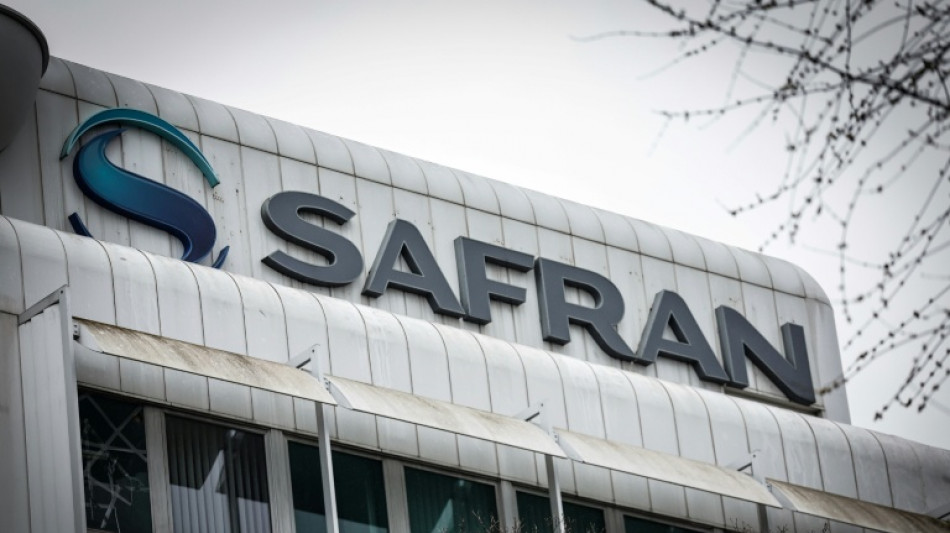
French firm Safran helps build aircraft wings of the future in UK factory / Photo: STEPHANE DE SAKUTIN - AFP/File

 Turkish Energy Minister Highlights Qatar as Key Partner for Regional and Global Energy Security

 London Museum Granted 24/7 License Ahead of November Opening

 Dana White Confirms Flight to Washington for Trump Meeting on Press Secretary Role

 Dengue Fever Expands Into High Himalayas as Climate Change Warms Nepal

 IoT Refrigerator Hacks Disrupt Blood Labs and Supermarkets Across Europe and US

 Post-election pressures complicate US and Israeli decisions on Iran

 UN members approve talks on treaty protocol against environmental crime

 Family-run West Sussex beach café prepares for first winter season

 CT scans reveal health and burial clues from Egypt’s Braided Lady mummy

 Oxford faces complaints over lecturer’s classroom attire

 Kyren Wilson and John Higgins reach International Championship snooker final

 New Zealand and Tonga meet for place in Rugby League World Cup final

 Reports of unsafe AI-toy responses renew calls for child-safety rules

For the French aerospace company Safran the future runs through a century-old factory in Britain where it aims to manufacture mechanisms key for the folding wings that will enable the next-generation of Airbus planes to meet ambitious fuel reduction targets.
These new thinner and folding wings will require twice as many small motors, or actuators, that control the movement of an aircraft's movable surfaces.
Behind the red-brick facades at the plant in Wolverhampton, western England -- once typical of the UK's industrial heartlands -- Safran is developing its new business of actuation systems.
Previously better known as an aircraft engine manufacturer, the pivot follows its 2025 acquisition of the flight controls and actuation activities of US-based Collins Aerospace for $1.8 billion.
Actuation refers to the mechanisms that control the movement of wings and surfaces, allowing an aircraft to climb, descend, bank, or turn.
Their proper functioning is essential for maintaining the aircraft's trajectory and ensuring flight safety.
"It was the last critical piece of equipment which Safran was lacking," said Franck Saudo, president of Safran Electronics & Defense.
Safran also manufactures landing gear, aircraft seats, and lavatories.
The Wolverhampton plant, opened in 1903 and which employs more than 1,500 people, is a key site among the 11 facilities acquired by Safran from Collins Aerospace.
In the defence sector, the site manufactures actuation systems for missiles and for the weapons-bay doors of the F-35.
According to Saudo, this technology helps preserve the stealth capabilities of the American fighter jet.
- Less fuel -
Airbus plans to launch the successor to its best-selling A320 family of single-aisle medium-haul aircraft around 2030 with 20 to 30 percent better fuel efficiency than current models.
Safran is seeking to contribute to this fuel savings with its wing actuators.
These mechanisms are used, among other things, to deploy wing flaps during the plane's landing approach, helping to slow the aircraft.
"When a bird lands, it spreads its feathers to increase the size of its wings. An aircraft does exactly the same thing," Saudo explained.
For the so-called wing of tomorrow -- a longer, folding wing being developed by Airbus in Britain -- twice as many actuators will be needed, he noted.
Flight tests of this experimental new wing, which is longer and lighter to maximise aerodynamic efficiency and reduce fuel burn, are scheduled to begin this year.
Another challenge is the limited space. Since the wing is thinner, there is less room for actuators, which must therefore be smaller.
This innovative wing structure means the aircraft would exceed the current maximum wingspan limit set by airports of 36 meters (118 feet) by 4.5 meters on each side.
Actuators would therefore also be needed to fold the wing tips while the aircraft is taxiing on the ground.
Today actuators are predominantly hydraulic. But in the next generation of aircraft about half are expected to be electric, making them lighter.
The acquisition of Collins, a hydraulic systems specialist, has allowed Safran to combine that expertise with its own strengths in electrical systems.
- Open fans -
To prepare for increased production rates, a robot installed a year ago now assembles gearbox units.
Other robots are used in the manufacture of metal parts, but many assembly operations are still performed by hand.
"Humans are more agile," Eric Valentin, head of actuation, told AFP.
For the aircraft of tomorrow, Safran is also developing an "open fan" engine free of the nacelle or encasing, which traditionally encloses and protects the fan blades.
The company says this technology could reduce fuel consumption by 20 percent, but development on these fans is less advanced, with flight testing not expected until around 2029.
"Historically in aviation, the main driver of fuel-burn reduction was the engine," Bruno Fichefeux, Airbus head of future programs, told AFP at the Farnborough Airshow in July.
"Today, we realise that the engine remains a major contributor, but it's no longer the dominant contributor," he said.
"Wing shape delivers an equivalent contribution in terms of fuel-burn reduction."
A.Santos--PC

