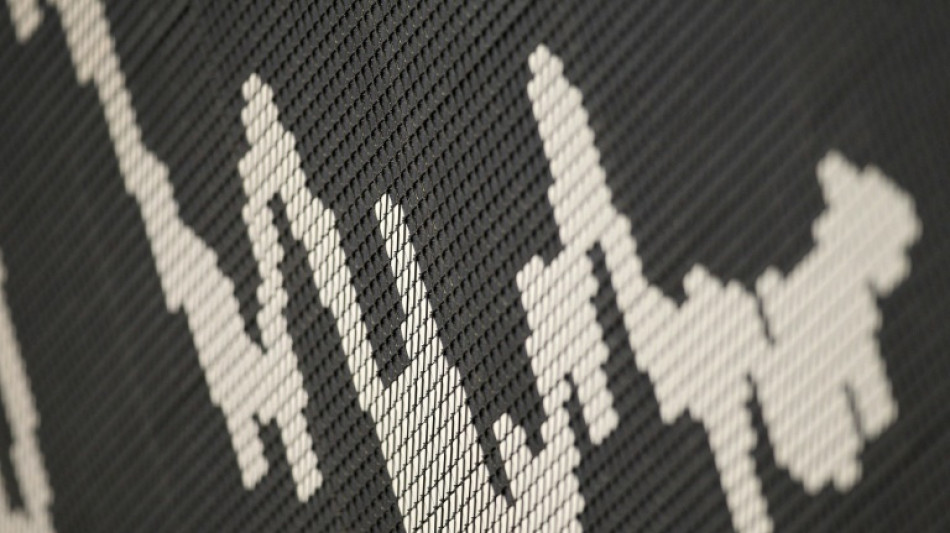
Equities, oil prices slide on recession fears / Photo: Daniel ROLAND - AFP

 Physicians Urge Arizona to Ban Medical Gag Clauses and Enable Private Lawsuits

 New Campaign Highlights Knowledge Gaps on Carbon Monoxide Safety Among Americans

 GoodData.AI Launches the Agentic Serving Plane, a New Category of Enterprise Data Infrastructure for AI Agents

 US Government Questions Effectiveness of Waymo’s School Bus Software Fix

 Panthers expected to begin 2027 NRL season away from new stadium

 Sweet As app launches restaurant discovery platform

 MLA seeks inquiry into reported sectarian gestures on Ormeau Road

 Louise O’Reilly attacks Simon Harris over unemployment remarks

 Virginia overwhelms Arkansas 91-72 behind balanced scoring

 Second major storm brings destructive winds and outages to British Columbia

 Godzilla Minus Zero leads North American box office with $31.6m

Stock markets and oil prices slumped Tuesday as investors grow increasingly fearful that more big interest rate hikes will tip economies into deep recessions.
The mood darkened also on the worsening Ukraine war and weaker demand expectations in China.
With the focus on inflation, analysts said US consumer price index data released later this week will be crucial to the direction of risk assets.
Another big reading could spark a fresh equity selloff and a surge in the dollar.
"There is growing pessimism in the markets now and with some big data points to come from the US this week, not to mention the start of earnings season," noted Craig Erlam, analyst at OANDA trading group.
"Investors should probably brace for more volatility."
Traders had hoped that bumper rate increases by the US Federal Reserve this year would begin to drag on the economy and slow runaway prices, allowing policymakers to reduce the pace of monetary tightening.
But a forecast-beating US jobs report on Friday highlighted the tough work the country's central bank has slowing inflation from four-decade highs, and many observers warn recession is virtually inevitable.
- 'Real danger' -
World Bank chief David Malpass said there was a "real danger" of a global contraction next year, adding that the surge in the dollar was weakening the developing nations' currencies and pushing their debt to "burdensome" levels.
And JP Morgan boss Jamie Dimon told CNBC that while the US economy was holding up, it faced several headwinds including rising rates, surging inflation, Fed tightening and the Ukraine war.
He added that he saw a US recession in six to nine months, and that the S&P 500 could fall another 20 percent.
Barings strategist Christopher Smart said: "It's little wonder investors enter the week in a dreary mood, especially with headlines from Ukraine signalling a further escalation in geopolitical tensions."
Chip manufacturers globally took a pounding from new US export controls aimed at restricting China's ability to buy and make high-end chips with military applications.
The Philadelphia Stock Exchange Semiconductor Index saw its lowest close since late 2020, while Bloomberg News reported that $240 billion had been slashed from companies' market values worldwide.
- Dollar dips -
Taipei led the losses in Asia -- diving more than four percent -- as chip giant TSMC plunged 8.3 percent, while a hefty selloff in Samsung Electronics dragged Seoul down 1.6 percent. Tokyo was also sharply lower owing to a hit to tech firms.
All three markets had been closed Monday and were reacting to Friday's US announcement for the first time.
On currency markets, the dollar dipped after recent strong gains as the United States heads the monetary tightening drive.
The pound nevertheless remained under pressure despite the Bank of England unveiling further measures to calm markets rocked by a UK budget, saying it would increase purchases of government bonds.
"Investors fear that the UK government is borrowing too much and that it won't be able to balance its books," said City Index and FOREX.com analyst Fawad Razaqzada.
Oil prices fell sharply, with concerns about Chinese demand front and centre.
"Covid cases are picking up in the country, and the Chinese Communist Party's newspaper, the People's Daily, ran a commentary saying the Covid Zero policy is 'sustainable', indicating that the country is likely to keep following it if not double down," said Stephen Innes at SPI Asset Management.
- Key figures around 1330 GMT -
London - FTSE 100: DOWN 0.8 percent at 6,903.83 points
Frankfurt - DAX: DOWN 0.6 percent at 12,198.54
Paris - CAC 40: DOWN 0.4 percent at 5,815.38
EURO STOXX 50: DOWN 0.6 percent at 3,336.12
New York - Dow: DOWN 0.3 percent at 29,114.89
Tokyo - Nikkei 225: DOWN 2.6 percent at 26,401.25 (close)
Hong Kong - Hang Seng Index: DOWN 2.2 percent at 16,832.36 (close)
Shanghai - Composite: UP 0.2 percent at 2,979.79 (close)
Euro/dollar: UP at $0.9716 from $0.9708 on Monday
Pound/dollar: UP at $1.1085 from $1.1059
Euro/pound: DOWN at 87.74 pence from 87.76 pence
Dollar/yen: DOWN at 145.68 yen from 145.72 yen
West Texas Intermediate: DOWN 2.0 percent at $89.03 per barrel
Brent North Sea crude: DOWN 1.8 percent at $94.45 per barrel
burs-rl/imm
P.Cavaco--PC

