UK church court to decide on slave-link memorial

 Kennedy Center: future unclear for iconic Washington arts hub

 Trump claims 'infinite' Greenland security deal with Denmark

 Helicopters battle wildfire threatening Ecuador's capital

 Brentford batter Chelsea to undo Alonso's promising start

 Kane hits Bundesliga century as Bayern rout Union

 Trump says CNN, MS NOW, Politico banned from White House

 Hushing and hedging: US companies retreat on climate

 Springboks to face Fiji before 2027 Rugby World Cup

 Nigeria miners struggled to breathe in cell before 37 died: survivors

 McIlroy on the charge at PGA Championship as Reed withdraws

 McIlroy on the charge at PGA Championship

 Crisis-wracked Volkswagen warns of 10-bn-euro hit to profits

 Costa Rica's Grynspan tops third informal poll for UN chief: diplomat

 Stock markets retreat after central bank rate hikes

 Russia labels director of Cannes Grand Prix winner a 'foreign agent'

 Macron warns of Russian 'hybrid' threat after meeting presidential hopefuls

 UN holds third informal poll for new chief

 Kulusevski return can spark Spurs: De Zerbi

 Shakira to cap off world tour with Madrid 12-gig run

 Isolated Syrian-Druze city blames Damascus for shortages

 Isolated Syrian-Druze city shortages

 Dutch drop Depay for Germany match in Xavi's first pick
 Ronaldo named in Portugal squad for Nations League

 Stock markets diverge after central bank rate hikes

 Anti-Assad music star makes triumphant return to Syria
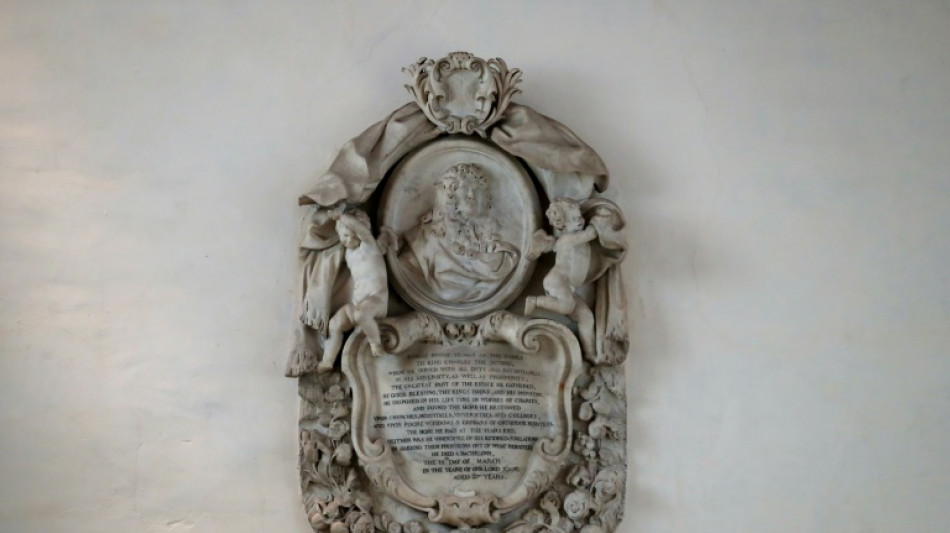
An ecclesiastical judge on Wednesday began hearing arguments for and against the removal of a Cambridge University college chapel memorial honouring a donor with slave trade links.
The case is being heard by a Church of England court convened in the chapel in question at Jesus College because the item, an ornate marble plaque to Tobias Rustat, is on Church property.
Rustat was a 17th century slave-trade investor and a major donor to the college, which was founded in 1496.
The hearing comes as Britain reckons with the toxic legacy of its colonial past, and just weeks after four protesters were cleared of criminal damage for toppling a statue of 17th-century slave trader Edward Colston in Bristol.
Both Colston and Rustat were leading figures in the Royal Africa Company, which made a fortune from the trade in transporting some 150,000 human beings from West Africa.
Jesus College last year handed back a Benin Bronze cockerel sculpture to a Nigerian delegation, after it was looted in a 19th-century British expedition.
The memorial to Rustat, who was a courtier to king Charles II, dominates the west wall of the 12th-century college chapel.
The college said he "had financial and administrative involvement in the trading of enslaved human beings over a substantial period of time".
- 'Heightened feelings' -
After an introductory prayer, lawyer Mark Hill, representing the college, said it wants to display the plaque, featuring a portrait of Rustat, in another building with information on historical context.
This would mean Rustat's "life and his contribution to the college can be more fully understood", he argued at the hearing, which is expected to last several days.
Hill stressed the plan was "not in any way to erase the name of Rustat, who was a generous benefactor to the college".
A group of graduate students stood outside, holding placards with slogans backing the college's plan: "Moving not erasing" and "Churches are people not marble".
"The Rustat memorial is an obstruction to the whole college community enjoying the use of the Chapel," said one student, who declined to give his name.
The college chapel's dean James Crockford said the college acted due to "heightened feelings" about the memorial, with some students "disturbed and upset by being faced with it".
"The inscription on the memorial behind me focuses very much on the financial virtues of Tobias Rustat," he said.
The epitaph, commissioned by Rustat himself, says he earned a fortune "by God's blessing, the King's Valour and his industry".
It makes no mention of slavery, which Britain outlawed in 1833.
- 'Cancelling' a donor? -
Some alumni and descendants of Rustat however oppose removal of the memorial, arguing Rustat's donations were not profits from slavery.
In court, lawyer Justin Gau was representing a group of around 65 former students, whom he is not naming.
He attacked the college's initial proposal to put the memorial in a wine cellar and questioned the need for the chapel to be a "safe space".
"Why cannot Rustat's whole life be put into context in this building?" he asked.
Crockford said any student entering or exiting the chapel "would have to face not only the memorial but also the contextualising efforts of the college", adding he did not believe this would be "fair".
Some preservationists have criticised the planned removal, since the memorial is believed to be the work of Grinling Gibbons, a renowned Anglo-Dutch sculptor and wood carver.
The right-wing tabloid the Daily Mail has criticised the college's proposal as a move to "cancel" a historical donor, a charge the college has denied.
The newspaper also accused the college of hypocrisy since it has accepted large donations from China.
Rustat gave around £3,230 (some £500,000 or $675,000 in current money) to Jesus College, mostly to fund scholarships for children of clergy.
The Cambridge University Library said in a statement that Rustat also gave it an endowment in 1667 and was now in discussions about the fund and a statue at the original site of the facility.
"No firm decisions have been taken but preliminary inquiries are being made with Historic England to understand the process for removing a statue from the exterior of a Grade I listed building," it added.
P.Mira--PC