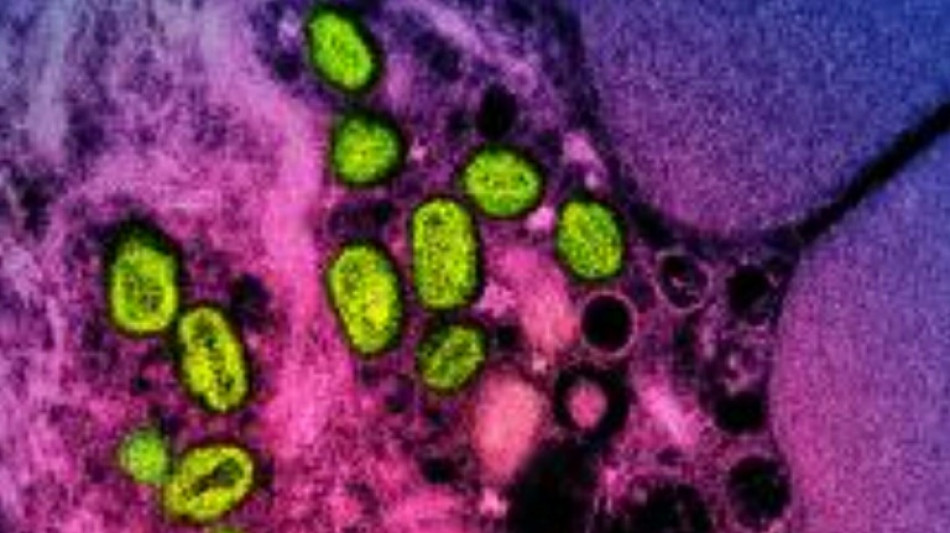
Monkeypox to be renamed mpox: WHO / Photo: Handout - National Institute of Allergy and Infectious Diseases/AFP

 US warns of rapid escalation in Mideast war

 Iran 'put hearts on the court' to win Asian Games basketball bronze

 School girl Yu helps China dominate in Asian Games swimming openers

 Myanmar win first Asian Games teqball gold as Spain great Puyol watches

 China's 13-year-old Yu scorches to first major gold at Asian Games

 Russians vote on last day of parliamentary elections

 Hong Kong pays final respects to former city leader Tung

 Typhoon put people off Asian Games opening ceremony, official says

 China's 13-year-old Yu cruises as Asian Games swimming begins

 AI 'warning shots' focus Beijing on national security risks

 Philippine tribe in limbo over US-led tech hub

 Leo XIV, first US pope transcends his restrained style

 Singer Ed Sheeran says Gaza situation 'unjustifiable' following controversy

 In 'Tenzing', a Sherpa mountaineer gets his due

 Ed Sheeran set to return to stage after Palestinian controversy

 Toulouse edge Vannes, Lyon beat Pau to take Top 14 summit

 Germans arrested for Louvre stunt in Mona Lisa hall

 Saudi-led coalition says Houthis fired ballistic missile at Riyadh

 France's debt climbs to highest since 1978: ministry

 McIlroy two shots off the lead at Wentworth after eagle on 18

 Martinez brace saves Inter in Serie A top-two clash with Roma

 Rosenior abused but guides Paris FC past old club Strasbourg

 Seven-try Lyon beat Pau, climb to Top 14 summit

 Brighton defeat a 'big lesson' against complacency for Arsenal, says Arteta

 Thousands protest inaction over climate crisis in Switzerland

Monkeypox is to be renamed mpox, the World Health Organization announced Monday, in a bid to avoid stigmatisation stemming from the existing name.
Monkeypox received its name because the virus was originally identified in monkeys kept for research in Denmark in 1958, but the disease is found in a number of animals, and most frequently in rodents.
A surge in monkeypox infections has been reported since early May among men who have sex with men, outside the African countries where it has long been endemic.
"When the outbreak of monkeypox expanded earlier this year, racist and stigmatising language online, in other settings and in some communities was observed and reported to WHO," the UN health agency said in a statement.
"Following a series of consultations with global experts, WHO will begin using a new preferred term 'mpox' as a synonym for monkeypox. Both names will be used simultaneously for one year while 'monkeypox' is phased out."
The disease was first discovered in humans in 1970 in the Democratic Republic of Congo, with the spread among humans since then mainly limited to certain West and Central African nations.
But in May, cases of the disease, which causes fever, muscular aches and large boil-like skin lesions, began spreading rapidly around the world.
The WHO triggered its highest level of alarm on July 24, classifying it as a public health emergency of international concern, alongside Covid-19.
- More than 80,000 cases -
Some 81,107 confirmed cases and 55 deaths have been reported to the WHO this year, from 110 countries.
Where the given dataset was known, 97 percent were men, with a median age of 34 years old; 85 percent identified as men who had sex with men, according to the WHO's case dashboard.
The 10 most affected countries globally are: the United States (29,001), Brazil (9,905), Spain (7,405), France (4,107), Colombia (3,803), Britain (3,720), Germany (3,672), Peru (3,444), Mexico (3,292), and Canada (1,449). They account for 86 percent of the global number of cases.
A total of 588 cases were reported last week. Over the past four weeks, 92 percent of cases were reported from the Americas and six percent from Europe.
Seventy-one countries have reported no new cases in the past 21 days.
It is down to the WHO to assign names to diseases, as it did with Covid-19.
The WHO announced in August it was looking for a new name for the virus, seeking suggestions from experts, countries and the public.
According to WHO best practices in disease naming adopted in 2015, names should aim to minimise unnecessary negative impact.
Considerations include scientific appropriateness, pronounceability, and usability in different languages.
"WHO will adopt the term mpox in its communications, and encourages others to follow these recommendations, to minimise any ongoing negative impact of the current name," it said.
The one-year transition is to avoid confusion caused by changing the name in the midst of a global outbreak.
L.Mesquita--PC