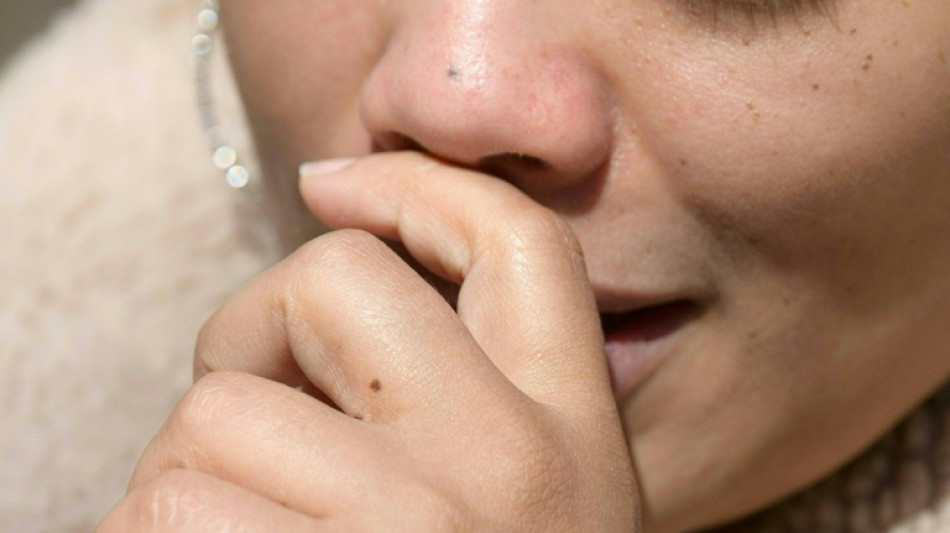
Warmer noses are better at fighting colds: study / Photo: Angela Weiss - AFP

 US warns of rapid escalation in Mideast war

 Iran 'put hearts on the court' to win Asian Games basketball bronze

 School girl Yu helps China dominate in Asian Games swimming openers

 Myanmar win first Asian Games teqball gold as Spain great Puyol watches

 China's 13-year-old Yu scorches to first major gold at Asian Games

 Russians vote on last day of parliamentary elections

 Hong Kong pays final respects to former city leader Tung

 Typhoon put people off Asian Games opening ceremony, official says

 China's 13-year-old Yu cruises as Asian Games swimming begins

 AI 'warning shots' focus Beijing on national security risks

 Philippine tribe in limbo over US-led tech hub

 Leo XIV, first US pope transcends his restrained style

 Singer Ed Sheeran says Gaza situation 'unjustifiable' following controversy

 In 'Tenzing', a Sherpa mountaineer gets his due

 Ed Sheeran set to return to stage after Palestinian controversy

 Toulouse edge Vannes, Lyon beat Pau to take Top 14 summit

 Germans arrested for Louvre stunt in Mona Lisa hall

 Saudi-led coalition says Houthis fired ballistic missile at Riyadh

 France's debt climbs to highest since 1978: ministry

 McIlroy two shots off the lead at Wentworth after eagle on 18

 Martinez brace saves Inter in Serie A top-two clash with Roma

 Rosenior abused but guides Paris FC past old club Strasbourg

 Seven-try Lyon beat Pau, climb to Top 14 summit

 Brighton defeat a 'big lesson' against complacency for Arsenal, says Arteta

 Thousands protest inaction over climate crisis in Switzerland

Chilly weather and common respiratory infections often go hand in hand.
Reasons for this include people gather inside more in winter, and viruses survive better in low-humidity indoor air. But there has been less certainty about whether lower temperatures actually impair human immunity and, if so, how.
Now, a new study published Tuesday in The Journal of Allergy and Clinical Immunology details a previously unknown way that the immune system attacks viral intruders inside the nose -- and finds it works better when it's warm.
These discoveries could pave the way for an eventual treatment against the common cold and other viruses, Mansoor Amiji, a pharmaceutical sciences professor at Northeastern University, who co-led the research, told AFP.
The starting point was previous research by Amiji and colleagues in 2018, which found that nasal cells released "extracellular vesicles" (EVs) —- a spray of tiny sacs that swarmed and destroyed bacteria upon inhalation.
"The best analogy that we have is a hornet's nest," said Amiji. Like hornets defending a nest from attack, EVs swarm, bind to, and kill invaders.
For the new research, the team set out to answer two questions: are EVs also secreted in the nose in the presence of viral infections? And, if they are, is the strength of their response linked to temperature?
To answer the first question, they used a test substance which mimics a viral infection to stimulate nasal mucosa -- a thin tissue that lines the nose -- that was taken from volunteers who had surgery to remove polyps.
They found it did in fact produce EVs that target viruses.
In order to tackle the second question, they divided the nasal cell samples into two groups and cultured them in a lab, subjecting one set of samples to 37 degrees Celsius, and the other to 32C.
These temperatures were chosen based on a separate test that found the temperature inside the nose falls by about 5C when outside air drops from 23C to 4C.
Under regular body heat conditions, the EVs were successfully able to fight off viruses, by presenting them with "decoy" targets that they latch on to instead of the receptors they would otherwise target on cells.
But under the reduced temperatures, fewer EVs were produced, and those that were made packed less punch against the invaders tested: two rhinoviruses and a non-Covid coronavirus, which are typically found in winter cold season.
"There's never been a convincing reason why you have this very clear increase in viral infectivity in the cold months," said co-author Benjamin Bleier, a surgeon at Harvard Medical School and Massachusetts Eye and Ear, in a statement.
"This is the first quantitative and biologically plausible explanation that has been developed."
One of the most exciting aspects of the work is the potential to rev up the body's natural production of virus-targeting EVs in order to fight or even fend off the cold -- or even the flu and Covid, said Amiji.
"That's an area of great interest for us and we certainly continue to pursue that," he said.
N.Esteves--PC