Ukrainian soldiers learn first aid near the front line / Photo: Genya SAVILOV - AFP

 Battling Norrie survives match point to oust de Minaur at Montreal
 Venezuela's political transition talks start: AFP
 Real Madrid extend Vinicius deal, sign Diomande in title bid boost
 PSG sign France midfielder Akliouche from Monaco
 CONMEBOL 'expresses concern regarding repeated unilateral actions' by FIFA
 Warren coy over whether Fury-Joshua will be in UK or US

 Taiwan blocks key bridge in drill for potential Chinese invasion

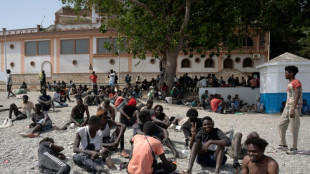 Migrant children risk abuse on streets of Ceuta, aid groups warn

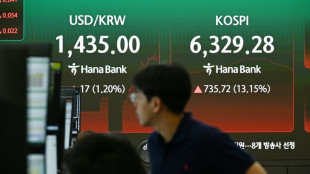 Oil price shoots up as stocks tread water

 British Grand Prix stays on MotoGP calendar until 2028
 Britain's EasyJet flies into US hands as takeover confirmed
 Real Madrid sign Ivory Coast winger Yan Diomande

 How online disinformation fuelled Ceuta migrant surge
 Forex Expo Dubai Announces Opportunity to Win Up to 150 Grams of Gold This September 2026

 Suspected Ebola death on boat heading for DR Congo capital

 England selector North not 'hung up' on Stokes absence
 UK Anti-Doping confirm former world champ Parker's ban lifted

 French winemakers dread 'smoky taste' after wildfires

 Stocks diverge with earnings, tech in focus
 England recall batsman Lawrence for Pakistan series
 Siemens shares plunge on disappointing guidance raise
 New Australia coach Kiss gives Japan starts to Ross, Amatosero
 'Stretch our money': Romanians face highest EU inflation
 Iran says close to Hormuz plan with Oman, but reopening depends on US
 Messi scores twice to set Leagues Cup record in Miami victory
For soldiers fighting on Ukraine's front lines, a split second first aid decision can be the difference between life or death.
Whether learning to apply a tourniquet, wrap a bandage or carry a wounded person, regular basic medical training is an essential part of their skill set in the field.
"It's crucial training, because every soldier needs to know how to save his own life and that of others nearby," said Victor Pylypenko, a 36-year-old medic in the 72nd Ukrainian brigade.
According to analysts, at least tens of thousands of soldiers have been wounded and killed on both sides since Russia's invasion on Ukraine on February 24, 2022, although neither Kyiv nor Moscow have disclosed their losses.
Near the town of Kurakhove, situated 15 kilometres (nine miles) from the eastern front, some 15 soldiers from Pylypenko's unit gathered for a course delivered by intensive care nurse Mossy, an Australian volunteer.
Starting inside, and then moving to work in the undergrowth, the soldiers practiced applying tourniquets to an arm or leg to stop massive external bleeding, which can lead to death in a matter of minutes.
Every soldier is equipped with an individual first aid kit (IFAK), which includes one or two tourniquet straps.
Measuring roughly 70 centimetres (28 inches) and fitted with a twisting handle, the straps grip the limb above the wound and thus stop the bleeding.
"The most common wounds in the field are (shrapnel) wounds in the limbs," Pylypenko said.
The chest and back are also often hit, because "the bullet-proof vest doesn't fully protect you," he added.
- 'Fake tourniquets' -
"There are frequent cases of massive haemorrhaging, and tourniquets have really saved hundreds, if not thousands, of lives," said Pylypenko, adding that it was "essential" that soldiers knew how to use them correctly.
Both the way they are applied and the quality of the tourniquet determines their effectiveness.
"The government provides us with IFAKs, but they are not always good quality," said Pylypenko, lamenting "fake tourniquets that are deadly on the battlefield."
Ukrainian NGOs and combat unit nurses this summer criticised the lack of standardisation and poor quality of first aid equipment provided by the government.
Faced with backlash and after 19 months of war, Ukraine's defence ministry has only recently announced the creation of a medical department within its ranks.
"We are working with our Western partners on the possibility of a rapid decision to confirm the quality of tourniquets produced in Ukraine," deputy defence minister Natalia Kalmykova said in a TV interview.
During the training course, Mossy advised soldiers to check the origin of their equipment, noting that he had seen "very poor quality" tourniquets coming from China.
"I can't read the language on some" first aid items, he told AFP, using Pylypenko as a translator to communicate with the soldiers.
"Sometimes when we ask the guys to show this part, they point to something else," he said.
Although most of the soldiers had already undergone first aid training and applied it in combat, trainers say it is essential to practice and repeat the gestures regularly.
- Survived three times -
To illustrate his point, Mossy told the story of some soldiers who had placed a tourniquet on a wounded man, which then loosened in transit.
"They didn't think to check the tourniquet while they were transporting him. It came off and their friend died on the stretcher," he said.
"You have to continually revise (knowledge). It comes with training and experience, but unfortunately, these lessons are learned in blood," he added.
Vasyl, a 52-year-old sergeant, listened keenly to the medical training.
He had been wounded three times since the start of the war, including his right eye which appeared a little sunken.
He said that basic medical knowledge "enabled me to survive three times".
"The second year of the war is almost over. Those who are left have learned to survive," he said.
For 39-year-old Arkady, "in a stressful situation, with a lot of adrenaline, you don't always understand what you're doing".
"So it's important that you're constantly reminded of these (first aid) gestures, so you can save your life of someone else's," he said.
F.Ferraz--PC