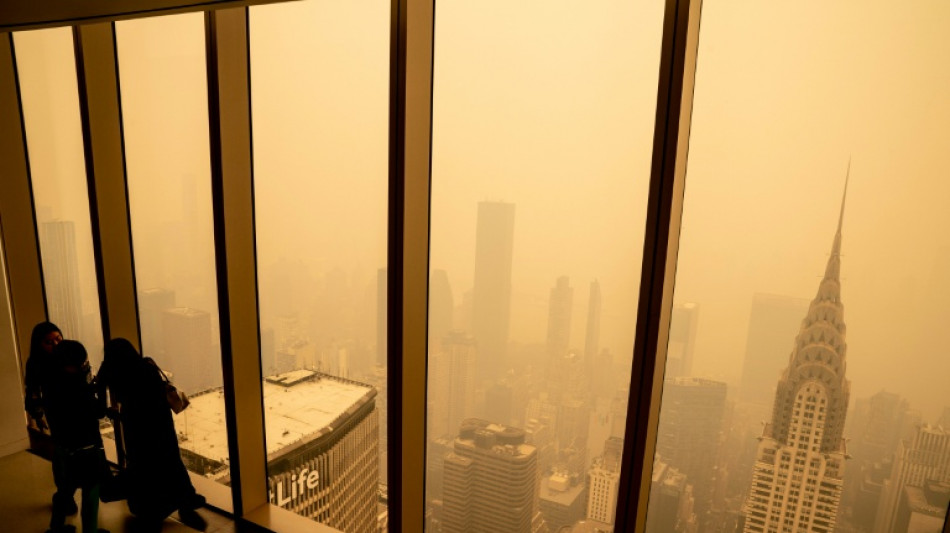
Wildfire smoke kills more than 24,000 Americans a year: study / Photo: David Dee Delgado - GETTY IMAGES NORTH AMERICA/AFP/File

 Trump's beef policies irk Texas ranchers, testing their loyalty

 Nvidia, OpenAI CEOs to attend Xi dinner at White House

 Anthropic picks Accenture for in-house AI safety evaluation

 Balogun returns as Monaco beat Lens to continue strong Ligue 1 start

 'Pause' on overt repression in Venezuela, but reforms still needed: HRW

 Global stocks mixed as yen falls despite Bank of Japan rate hike

 Cuba hit with seventh major blackout of the year

 Murray out with concussion so Wentz will start for Vikings

 UN chief 'deeply regrets' US visa refusal to Abbas for annual meeting

 England quick Carse to face no charges over alleged nightclub assault

 Mancini brings nine newcomers into the first squad of his Italy comeback

 Czechs level Davis Cup tie against USA as South Korea eye Finals

 New France boss Zidane confirms Mbappe as captain after naming first squad

 California governor signs order to explore AI 'kill switch'

 Head leads run spree as Australia win Zimbabwe ODI series

 In-form Raphinha wants to finish career at Barcelona

 Warren Buffett steps down as Berkshire Hathaway chairman

 Carrick confident Man Utd can 'work through' tough time

 Mbappe ends Nike partnership to join Swiss brand On

 Liverpool boss Iraola puts Bournemouth love affair on hold

 'A disaster' if Man City do not win says Maresca after flawless start

 Kerry James Marshall: American 'blackness' painter celebrated in Europe

 Spain coach De la Fuente offers 'full support' to people of Ceuta

 Russia seizes assets of Nestle, French firms over West's Ukraine support

 England can build on World Cup 'spirit', says Tuchel

Wildfires are growing larger, lasting longer and happening more often as the climate warms -- but the toll from their toxic smoke, especially from long-term exposure, remains poorly understood.
A study published Wednesday in the journal Science Advances estimates that wildfire smoke caused about 24,100 deaths a year across the contiguous United States between 2006 and 2020, a figure the authors say underscores the need for urgent policy shifts.
"That's a big number," lead author Min Zhang, a postdoctoral researcher at Mount Sinai's Icahn School of Medicine in New York, told AFP. "We found no evidence of a safe threshold for the chronic exposure to wildfire smoke...that's a very concerning public health problem.
The findings come as President Donald Trump's government has turned its back on global efforts to tackle human-caused warming -- boosting instead the fossil fuel industry that is its main driver.
"They know what to do to, you know, fight against climate change: you need to promote cleaner energy, electric cars, more funding to do research," senior author Yaguang Wei, an assistant professor at Mount Sinai's Icahn School of Medicine in New York, told AFP.
But on a more granular level, he added, local governments need to develop early warning systems that anticipate the arrival of dangerous pollutants and deploy portable filters in homes, offices, schools and hospitals.
Canada's record-breaking 2023 wildfires exposed hundreds of millions of people downwind to toxic fumes, yet local authorities have still failed to develop advanced response plans.
- Satellite data and death records -
To conduct their analysis, the researchers had to devise a method to isolate the cumulative effects of fine particulate matter from wildfire smoke -- known to contain carcinogenic volatile organic compounds and heavy metals.
While the acute impacts of smoke are easier to trace -- including inhalation injuries, hospitalizations and deaths -- attributing cause becomes far more challenging when toxins linger in the body and later trigger respiratory illness, cardiovascular disease or neurological damage.
The team analyzed annual mortality data from 3,068 counties across the mainland United States, excluding Alaska and Hawaii, and linked it with satellite imagery.
Statistical techniques were used to rule out other factors that could explain changes in death rates. To boost confidence in their findings, the researchers examined "negative control" outcomes -- such as deaths from car accidents or falls, which should not be influenced by wildfire pollution -- and found no corresponding increase.
- Brain most vulnerable -
The result was a clear rise in all-cause mortality, with neurological diseases such as dementia and Parkinson's showing the strongest association, followed by circulatory system illness, endocrine diseases and cancers.
"Usually people look at the cardiovascular respiratory disease from the wildfire smoke, however, we found that the neurological disorder is more affected," said Wei. "It seems like our brain is the most vulnerable part."
Effects were more pronounced in rural areas, which may be closer to wildfire sources. Younger people were more impacted, perhaps because they spend more time outdoors. Lower temperatures were also linked to increased deaths. People go outside more in cool summers, while cool winters prevent smoke dissipation, wrote the authors.
The figure of 24,100 deaths per year is more than double a previous estimate of 11,415 deaths published in the Proceedings of the National Academy of Sciences in 2024.
But according to Wei, the new number is still likely an underestimate simply because analysis at the level of counties doesn't offer the kind of precision that a zip code or block-by-block investigation would.
He's now looking at more studies that tease out the health impacts of wildfires from different sources, because the chemical mixtures vary greatly from forest to forest.
F.Santana--PC



