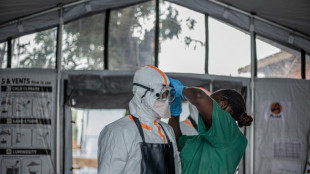
WHO weighs up AI risks and benefits for healthcare / Photo: Fabrice COFFRINI - AFP

 2 killed, 13 wounded in bus blast near Syrian capital: state media

 All Blacks skipper Taylor cautiously recovering from calf strain

 UN chief denounces Russia, Ukraine for civilian deaths

 UEFA turn up the pressure on Infantino and repeat boycott threat

 Rodri approves Barcelona transfer talks with Man City: Barca source to AFP

 Venezuela unable to tally missing from cataclysmic quakes

 Le Court sprints to stage six Tour de France Femmes win
 Doping body says Parker's positive cocaine test caused by nutritionist

 UEFA says boycott of World Cups stands despite FIFA backdown on private investment

 Rheinmetall sales keep surging despite cancelled naval frigate project

 Pogacar teammate Del Toro gets new UAE deal after Tour podium

 Stocks tread water with earnings, tech in focus

 Inevitable AI Group Raises $6M From Aleph to Launch AI-Native SaaS Companies

 Forlan named new Uruguay head coach

 UEFA chief Ceferin: 'Underdog' leader taking fight to FIFA's Infantino

 Salah completes move to Turkey's Trabzonspor

 UK clears Paramount's takeover of Warner Bros
 North Korea fires ballistic missile: South Korea military

 'Don't have to hide': Thai IDs, legal work give hope to Myanmar refugees

 Stocks mixed with tech firms back under pressure

 How Blundell's old school tactic ended England's 'Bazball' era

 Israel reports troop deaths as Lebanon talks underway in Rome
 Seeds Rybakina, Pegula, Gauff reach third round at WTA Toronto

 Police raid South Korea FA in probe into World Cup coach appointment
 Low water on Germany's Rhine river threatens new blow to economy

Generative artificial intelligence could transform healthcare through things like drug development and quicker diagnoses, but the World Health Organization warned Thursday of the potential pitfalls in rushing to embrace AI.
The WHO has been examining the likely dangers and benefits posed by AI large multi-modal models (LMMs), which are relatively new and are quickly being adopted in health.
In generative AI, algorithms trained on data sets can be used to produce new content.
LMMs are a type of generative AI which can use multiple types of data input, including text, images and video, and generate outputs that are not limited to the type of data fed into the algorithm.
"Some say this mimics human thinking and behaviour, and the way it engages in interactive problem-solving," WHO digital health and innovation director Alain Labrique told a press conference.
The WHO said LMMs were predicted to have wide use and application in health care, scientific research, public health and drug development.
The UN health agency outlined five broad areas where the technology could be applied.
These are: diagnosis, such as responding to patients' written queries; scientific research and drug development; medical and nursing education; clerical tasks; and patient-guided use, such as investigating symptoms.
- Misuse, harm 'inevitable' -
While this holds potential, WHO warned there were documented risks that LMMs could produce false, inaccurate, biased or incomplete outcomes.
They might also be trained on poor quality data, or data containing biases relating to race, ethnicity, ancestry, sex, gender identity or age.
"As LMMs gain broader use in health care and medicine, errors, misuse and ultimately harm to individuals are inevitable," the WHO cautioned.
They could lead to "automation bias", where users blindly rely on the algorithm -- even if they have good grounds to disagree.
On Thursday the WHO issued recommendations on the ethics and governance of LMMs, to help governments, tech firms and healthcare providers take advantage of the technology safely.
The WHO said it did not want to wait for roll-out in healthcare settings to discover the flaws and then try to fix them afterwards.
"Generative AI technologies have the potential to improve health care but only if those who develop, regulate and use these technologies identify and fully account for the associated risks," said WHO chief scientist Jeremy Farrar.
"We need transparent information and policies to manage the design, development and use of LMMs."
The WHO said liability rules were needed to "ensure that users harmed by an LMM are adequately compensated or have other forms of redress".
- Tech giants' role -
AI has been used in public health and clinical medicine for more than a decade, for example to help in radiology and medical imaging.
The WHO stressed, however, that LMM formats presented "risks that societies, health systems and end-users may not yet be prepared to address fully".
This included concerns as to whether LMMs complied with existing regulation, including on data protection -- and the fact they were often developed by tech giants, due to the significant resources required, and so could entrench these companies' dominance.
The guidance recommended that LMMs should be developed not just by scientists and engineers alone but with medical professionals and patients included.
Governments will have to ensure privacy when patients' sensitive health information is fed in as data -- and give people the chance to opt out of involvement, said Rohit Malpani, of the WHO's research for health department.
The WHO warned that LMMs were vulnerable to cyber-security risks that could endanger patient information, or even the trustworthiness of healthcare provision.
The WHO said governments should assign a regulator to approve LMM use in health care, and there should be auditing and impact assessments.
The guidance "paves the way for a future where AI contributes to the well-being of humanity, adhering to the highest ethical standards", said Labrique.
A.P.Maia--PC