New hope to help advanced Parkinson's patients walk, sleep again / Photo: Kenzo TRIBOUILLARD - AFP/File

 Drones hit Moscow as Russians go to the polls

 New England boss Fleming says 'wrong' to ask Stokes to end retirement

 Germans vote in elections threatening fresh blow to Merz

 US fears rapid escalation in Mideast after Houthis attack Riyadh

 Japan triathlete Hojo wins first gold of Asian Games

 IOC president impressed by 'beautiful' Asian Games wooden huts

 First Asian Games gold goes to Japan as China's 13-year-old Yu lights up pool

 Data centre command hub keeps AI up and running

 Pope Leo in France: the issues on the table

 Packing for a pope: behind the scenes on foreign trips

 Republicans find transgender issues a powerful political weapon in midterm campaigning

 German state elections threaten new shock waves for Merz

 Chile's Bachelet quits race to be next UN chief

 Raphinha treble fires perfect Barca to win at Sevilla

 Thiam makes winning heptathlon return at Decastar meet

 Czechs beat USA to qualify for Davis Cup finals

 Dortmund sink Stuttgart to climb to Bundesliga summit

 Trump says will not tolerate attempts to slow AI growth

 'It has to stop': runners protest women's murders in S.Africa district

 Fire erupts near Riyadh airport as Houthis claim strikes

 Cuba works to restore power after another blackout

 England thrash Sri Lanka again to return to top of T20 rankings

 Arsenal thrashed by Brighton, sorry Spurs lose again

 South Korea, Austria qualify for Davis Cup finals

 Seare shocks Ingebrigtsen to win world 5km gold

People with advanced Parkinson's disease often struggle to walk more than a few steps or sleep through the night, but new research offers hope of relief from these two debilitating symptoms.
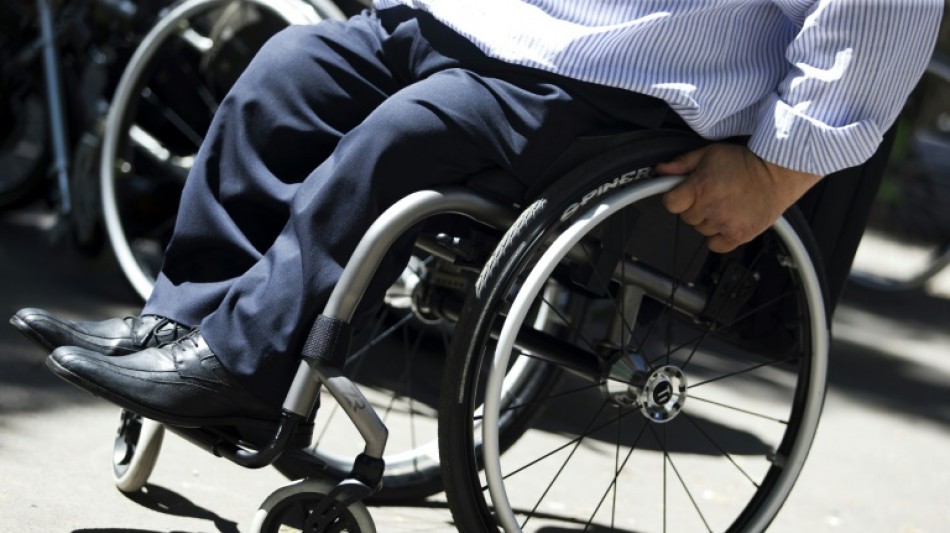
Suffered by millions worldwide, the degenerative disease erodes motor functions and in its later stages often confines patients to a bed or wheelchair.
This is due to a condition called orthostatic hypotension, which occurs when a person stands up and their blood pressure drops, causing dizziness and even fainting after a couple of steps.
For Parkinson's sufferers, it happens because a regulator in the brain -- which normally ensures sufficient blood flows to the brain when we stand up -- has been disrupted.
But new French research published in the New England Journal of Medicine last week found that a spinal cord implant could help advanced Parkinson's patients get back on their feet.
- Quality of life improved -
Earlier this year neurosurgeon Jocelyne Bloch and Gregoire Courtine revealed that such an implant had enabled three paralysed people to walk again.
Both were also involved in the latest research, which tested a similar implant on a 48-year-old woman.
While the woman did not have Parkinson's, she had such similar symptoms -- including orthostatic hypotension -- that she was initially diagnosed with the disease.
For paralysed people, the spinal cord implant mimics how the brain sends electrical pulses to muscles, reconnecting a severed link.
But for orthostatic hypotension, it stimulates the regulator in the brain that senses the need to send more blood when people stand upright.
Before receiving the implant, the woman would faint after a taking a few of steps.
Three months after the surgery, she was able to walk more than 250 metres (820 feet) with the help of a walking frame, the study said.
"She is not cured, she would not run a marathon, but this surgery has clearly improved her quality of life," Bloch told AFP.
However it is a single case and further research is needed, particularly involving Parkinson's patients.
It is not yet certain that the form of orthostatic hypotension seen in Parkinson's patients can be fixed solely by stimulating the regulator the implant targets.
- Anti-insomnia pump -
Insomnia is another common scourge of the 10 million Parkinson's sufferers globally, more than three quarters of whom have sleep-related symptoms, according to the Parkinson's Foundation.
Sleep can be affected by uncontrolled shaking which wakes patients up, while another factor is a lack of a dopamine, common in people with Parkinson's.
The medication apomorphine is normally used to replace dopamine, lessening symptoms such as shaking and stiffness.
But when taken orally, the drug can cause dopamine to spike and then drop, leading to muscle spasms.
A device similar to an insulin pump that delivers continuous apomorphine throughout the night could solve the problem, according to a study published in the journal Lancet Neurology on Thursday.
Co-author Emmanuel Flamand-Roze led previous research indicating that such a pump would help with Parkinson's, but the new study looked at how it helped with sleep.
The randomised study found that those using the pump had "significantly improved" sleep compared to those who received a placebo.
Flamand-Roze told AFP that "the constraints linked to wearing a small pump" are much lower during the night, compared to carrying such a device around all day.
However because the study had a small sample size -- fewer than 50 people -- and focused on people at an already advanced stage of Parkinson's, further research is needed.
V.F.Barreira--PC